1. Introduction: The Evolution of Free-Standing Outdoor Digital Signage
In high-traffic commercial pedestrian precincts, luxury outdoor shopping villages, transit hubs, smart city streets, and municipal plazas, static printed billboards and traditional lightboxes are rapidly being replaced by dynamic, high-brightness digital displays.
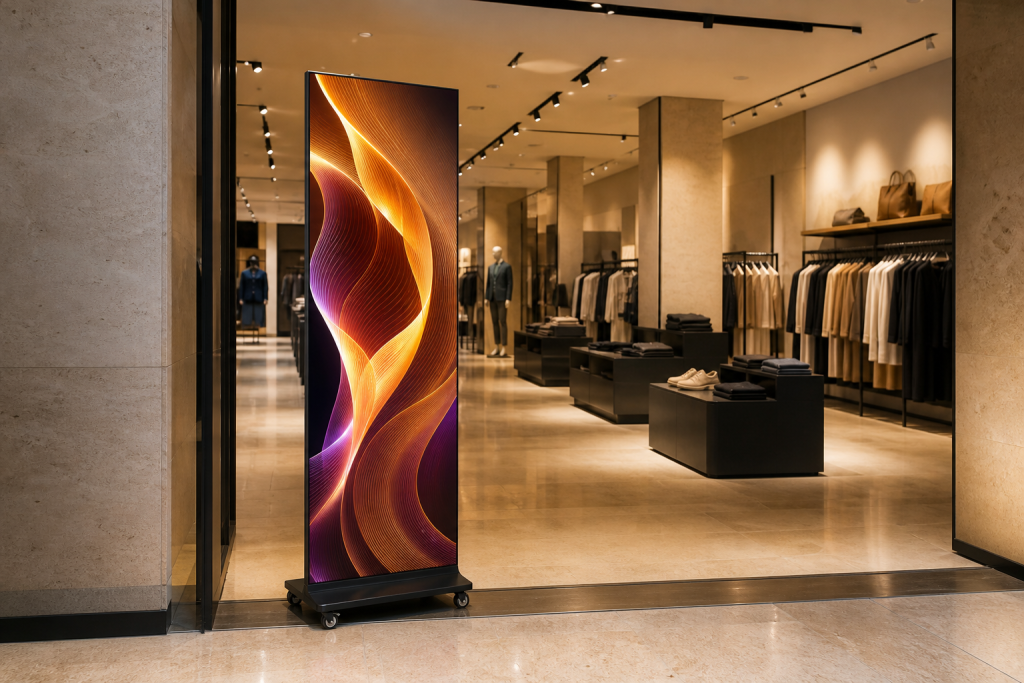
A floor-standing outdoor LED screen (also known as an outdoor LED advertising kiosk or outdoor digital signage totem) provides media operators and property owners with a turnkey, free-standing visual powerhouse. Unlike indoor displays or standard wall-mounted billboards, outdoor floor totems must endure scorching summer solar radiation, torrential rainfall, and sub-zero winter freezes while continuously delivering clear, high-contrast commercial messaging 24/7.
For out-of-home (DOOH) advertising networks and system integrators, selecting the right outdoor LED kiosk involves balancing optical performance, thermal engineering, vandal resistance, and maintenance accessibility. This guide provides B2B buyers with technical benchmarks to evaluate and procure heavy-duty commercial outdoor LED kiosks directly from manufacturers.
2. LED vs. LCD Outdoor Kiosks: Why Direct-View LED Dominates Commercial Spaces
When specifying outdoor floor-standing digital signage, buyers often debate between high-brightness LCD totems and direct-view LED kiosks. For commercial-grade installations, direct-view LED offers decisive architectural advantages:
| Engineering Dimension | Direct-View Outdoor LED Totem | High-Brightness Outdoor LCD Kiosk |
|---|---|---|
| Peak Brightness | 4,500 to 6,500 nits (clear visibility under direct tropical sunlight) | 2,000 to 3,000 nits (prone to washout in direct sunlight) |
| Solar Blackening Risk | Zero risk: inorganic LED diodes are immune to solar isotropic phase transitions | High risk of liquid crystal black spots when surface temperatures exceed 55°C |
| Operating Lifespan | 100,000 hours (typical MTBF to 50% brightness) | 50,000 hours (backlight degradation requires full panel replacement) |
| Maintenance Profile | Modular: individual LED modules or power units can be replaced on-site in minutes | Single-unit glass panel; impacts require replacing the entire display |
| Power Efficiency | Dynamic power consumption scales with content darkness | Constant high-power LED backlight draws continuous maximum wattage |
| Weather & Impact Protection | GOB full potting provides IP65/IP68 and high impact resistance | Vulnerable front cover glass; condensation issues between glass layers |
3. Critical Engineering Demands: Weatherproofing, GOB Protection, and Hydraulics
Reliable outdoor operation requires multi-layered mechanical and optical engineering tailored to outdoor exposure.
1. IP65 All-Weather Waterproof Enclosure
Commercial outdoor LED totems feature an all-aluminum or galvanized steel chassis treated with anti-corrosion fluorocarbon powder coating. Independent sealed internal chambers isolate driving electronics, power supplies, and media players from moisture, humidity, and corrosive coastal salt mist.
2. GOB (Glue-on-Board) Integrated Protective Encapsulation
Modern fine-pitch outdoor kiosks utilize GOB module potting technology. A transparent optical epoxy or polyurethane resin layer fully encapsulates the surface of the SMD/COB LED diodes. This creates an impenetrable barrier against:
- High-pressure water ingress and heavy driving rain;
- Airborne dust, urban pollution, and sandstorms;
- Physical impacts, accidental bumps, and public vandalism;
- Internal thermal condensation caused by rapid day-to-night temperature swings.
3. Hydraulic Front-Opening Maintenance Architecture
Outdoor maintenance labor is one of the highest lifetime operating costs for DOOH networks. Advanced outdoor kiosks incorporate gas-strut or hydraulic front-flip doors. A single service technician can unlock the front chassis and smoothly raise the hydraulic front face, gaining immediate access to internal power units, receiving cards, cooling fans, and wiring harnesses without cranes, scaffolding, or rear access clearance.
4. Key Technical Specifications: Pitch, Brightness, and Display Configurations
To ensure long-term ROI and crystal-clear image legibility, B2B buyers should specify the following optical and mechanical parameters.
Pixel Pitch Selection Guide for Ground-Level Viewing
Because pedestrians observe floor-standing kiosks from distances ranging from 1 to 5 meters, fine-pitch outdoor LED technology ensures crisp text and sharp 4K video:
- P1.24 / P1.48 / P1.86 (Ultra-Fine Pitch COB/GOB): high-end flagship retail boulevards, luxury automotive showrooms, and hotel entranceways requiring near-printed-paper visual fidelity.
- P2.0 / P2.5 (The Industry Gold Standard): optimal balance between ultra-high resolution and cost-effectiveness for commercial pedestrian shopping streets.
- P3.0 / P4.0 (Large-Format & Boulevard Wayfinding): cost-effective option for large-scale municipal wayfinding and transport interchange totems.
Single-Sided vs. Dual-Sided Configurations
- Single-Sided Totems: mounted against walls, shopfront pillars, or building boundaries where foot traffic flows in one primary direction.
- Dual-Sided (Double-Sided) Totems: positioned along center pedestrian aisles, walkways, and transit concourses to double advertising impressions within the same ground footprint. Units support synchronized mirror playback or independent asynchronous ad scheduling per face.
5. Intelligent Remote Cloud Control and DOOH Network Management
Modern outdoor LED advertising totems operate as smart IoT edge terminals. Integrated with 4G/5G, Wi-Fi, and Gigabit Ethernet connectivity, operators can manage thousands of screens from a centralized web dashboard:
- Remote Cloud Cluster Scheduling: schedule time-targeted ad campaigns, emergency municipal broadcasts, and real-time weather feeds across thousands of screens simultaneously.
- Automatic Ambient Brightness Sensors: light sensors adjust screen brightness in real time, dimming to 800 nits at night and boosting to 5,500 nits under bright midday sun.
- Synchronous & Asynchronous Video Processing: support real-time HDMI input for live sports/events or local onboard SSD playback for fail-safe 24/7 offline continuity.
- Intelligent Internal Climate Control: thermostatically controlled ventilation or closed-loop heat exchangers maintain operating temperatures between -20°C and +60°C.
6. How to Evaluate an Outdoor LED Kiosk Manufacturer: B2B Sourcing Checklist
When sourcing floor-standing outdoor LED kiosks from Shenzhen manufacturers, evaluate these core production and reliability factors:
- IP65/IP66 Waterproof and Salt-Spray Testing Reports: request certified third-party environmental test certificates verifying high-pressure water resistance and 96-hour neutral salt spray corrosion resistance.
- Thermal Dissipation and Solar Radiation Simulation: verify finite element thermal modeling ensures hot air exhausts efficiently without trapping heat around LED driver ICs.
- Chassis Metalwork and Base Anchoring Engineering: confirm the base plate includes expansion bolt templates rated for high wind-load tolerances, such as Class 12 typhoon resistance.
- Safety Protection and Circuit Breakers: ensure integrated lightning protection, surge suppression (SPD), overload protection, and individual power supply isolation breakers are pre-wired.
- OEM/ODM Customization Capabilities: check whether the factory can customize housing colors, add laser-cut backlit logos, integrate interactive touch foils, or embed AI demographic cameras and environmental sensors.
7. Frequently Asked Questions (FAQ)
Q1: How do outdoor LED screens handle direct sunlight without overheating?
Commercial outdoor LED kiosks combine efficient low-power LED chipsets with temperature-controlled cross-flow cooling fans and all-aluminum heat-conductive chassis. This ensures heat from solar radiation and internal electronics is rapidly dissipated.
Q2: Can the screen operate safely in sub-zero winter temperatures?
Yes. Quality outdoor LED kiosks use wide-temperature electronic components rated from -20°C to +60°C, with optional internal low-temperature heating elements for extreme climates down to -40°C.
Q3: What is the maintenance advantage of a hydraulic front-opening design?
Traditional outdoor totems require rear access doors, demanding at least 1 meter of free space and complex disassembly. Hydraulic front-opening allows one operator to lift the front panel smoothly, perform servicing or module replacement in minutes, and install the kiosk tight against walls.
8. Conclusion and Sourcing with USER SDT
A floor-standing outdoor LED screen is the premier choice for premium commercial advertising, pedestrian wayfinding, and municipal digital communication. With 5,000+ nits direct-sunlight readability, rugged GOB IP65 weatherproofing, and ergonomic hydraulic front access, modern LED totems deliver superior ROI and long-term reliability.
As a leading Shenzhen LED display manufacturer with over 15 years of OEM/ODM engineering excellence, USER SDT designs and manufactures high-performance floor-standing outdoor LED advertising machines, street light pole screens, and commercial DOOH kiosks for global clients.
- Explore Our 2026 Outdoor Kiosk Series: inquire about P1.24, P1.48, P1.86, P2.0, P2.5, and P3.0 single- and dual-sided outdoor totems featuring hydraulic front-flip enclosures, GOB protective potting, and 4G cloud cluster control.
- Custom OEM/ODM Engineering: benefit from tailor-made kiosk dimensions, corporate brand colors, intelligent sensor integrations, and factory-direct project support.
Contact our engineering team today for technical datasheets, CAD installation drawings, and factory-direct project quotations:
- Website: USER SDT Official Site
- Email: jacky@usersdt.com
- WhatsApp: +86 18923710941