1. Introduction: Breaking Free from Flat Rigid Video Walls
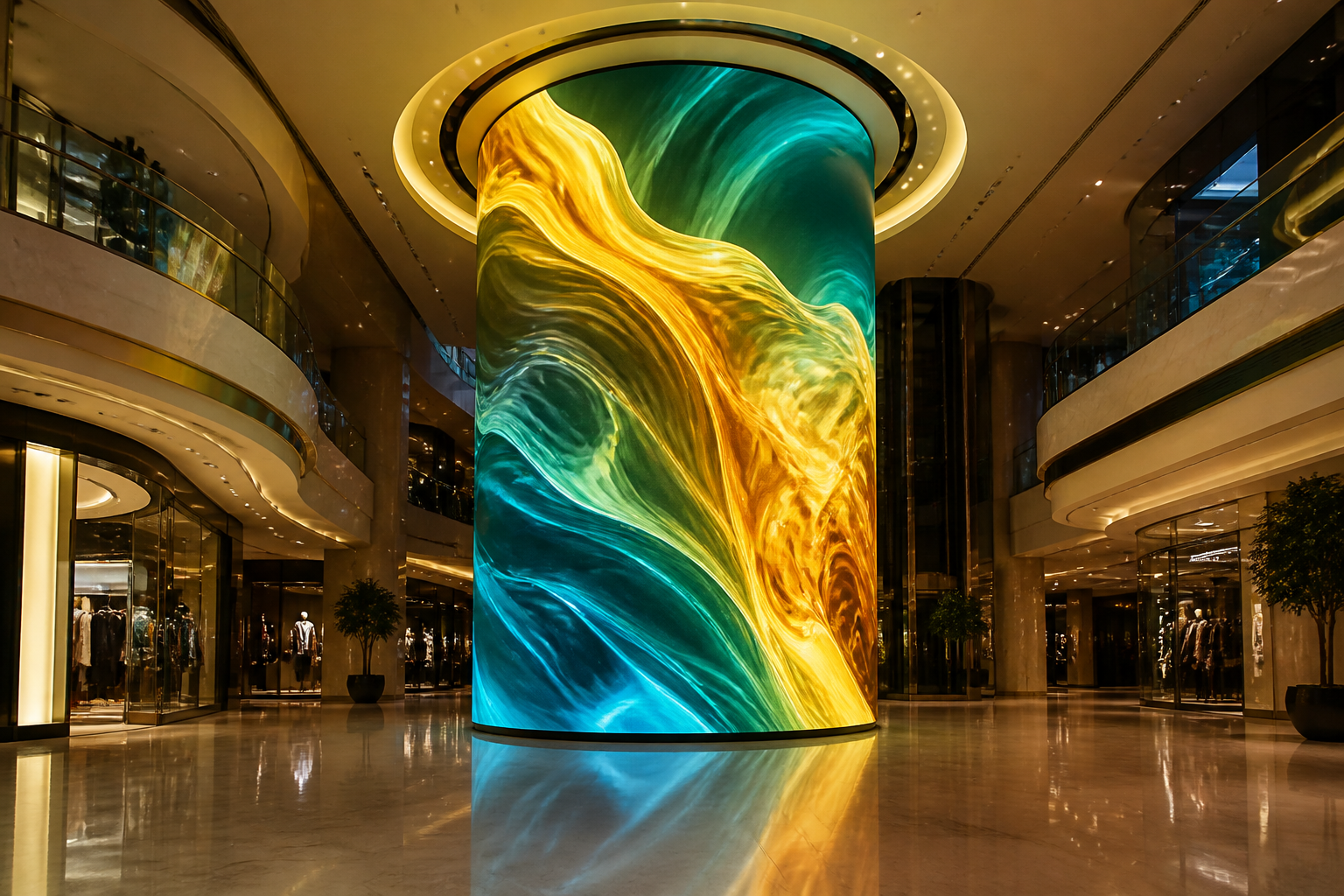
In contemporary commercial architecture, luxury retail design, modern corporate headquarters, and high-end hospitality venues, flat rectangular video walls are frequently inadequate to match dynamic architectural curves. Structural pillars, circular lobbies, sweeping wave ceilings, and concave experiential theaters demand display technology that seamlessly integrates with organic architectural geometry.
Attempting to approximate curved surfaces using traditional rigid die-cast aluminum or iron LED cabinets inevitably results in noticeable faceted edges, visible seam gaps, and awkward mechanical protrusions. A purpose-engineered flexible LED display (also widely referred to as a flexible LED screen, soft module LED display, or bendable LED video wall) solves this architectural challenge.
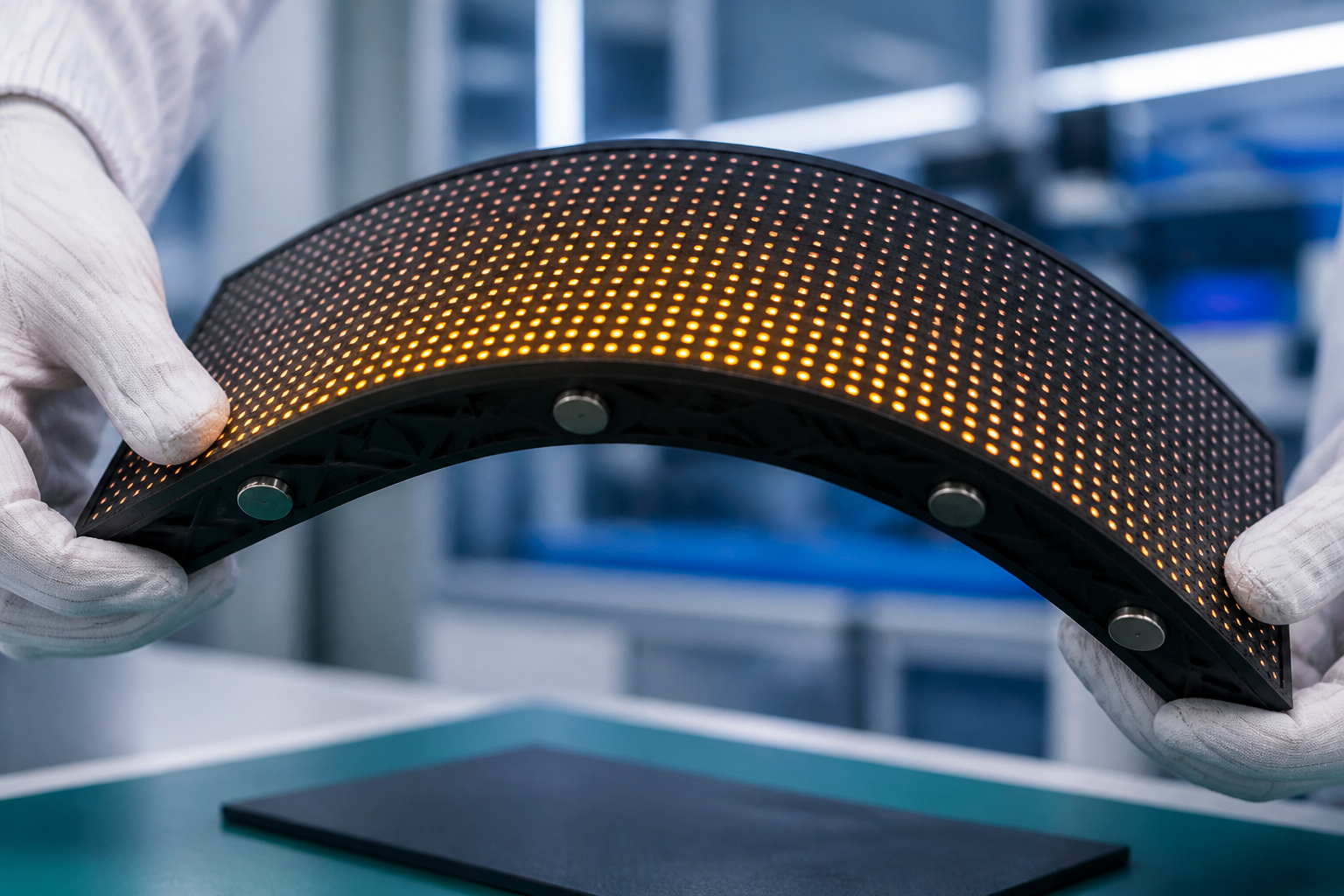
Constructed using pliable flexible printed circuits (FPC), specialized silicone or rubber bottom masks, and high-density magnetic mounting points, soft LED modules bend smoothly into convex arcs, concave curves, 360-degree cylindrical column wraps, S-shaped waves, and complex spherical shapes without compromising visual resolution or optical uniformity. This comprehensive guide provides international B2B buyers, architects, and AV engineering contractors with essential technical and procurement insights for specifying flexible LED display projects.
2. Key Engineering Advantages: Why Architects Specify Flexible LED Screens
Compared to faceted flat cabinets and standard projection mapping, flexible soft LED modules offer transformative architectural and visual benefits:
- True Seamless Curvature Without Faceted Stepping: Unlike rigid cabinets that create disjointed polygonal edges along curved walls, soft modules conform to continuous radial curves. This delivers unbroken panoramic imagery with zero visible seam gaps, ensuring perfect viewing angles (140° to 160°) across all approach directions.
- Pliable FPC Substrate and Resilient Silicone Housing: Soft LED modules utilize flexible multi-layer copper FPC boards paired with high-elongation, flame-retardant silicone or rubber masks. This resilient construction allows individual modules to bend smoothly across angles ranging from 135° to 170°, accommodating tight minimum bend radii down to R150 mm to R300 mm without fracturing internal electrical circuit traces.
- Ultra-Slim Profile and Extreme Lightweight Construction: Soft modules measure only 5 mm to 8 mm in module thickness and weigh under 200 to 350 grams per unit (standard module sizes: 240 × 120 mm or 320 × 160 mm). When installed onto low-profile custom sheet metal or extruded aluminum sub-frames, total system depth is frequently under 40 mm to 60 mm, preserving valuable interior floor space.
- Instant Front Magnetic Maintenance: Soft modules incorporate powerful neodymium magnets embedded directly into the flexible silicone backing. Technicians can detach, inspect, and replace any module from the front surface in under 20 seconds using standard magnetic extraction tools, eliminating the need for expensive rear service corridors.
- High Refresh Rates and Optical Camera Stability: Quality flexible LED displays integrate high-performance PWM driver ICs delivering ≥ 3840 Hz to 7680 Hz refresh rates and 14-bit to 16-bit grayscale. This guarantees flicker-free broadcast quality when filmed by smartphones, broadcast television cameras, and virtual production setups.
3. Core Architectural Geometries and Installation Configurations
Flexible LED screens adapt to a wide variety of custom architectural forms:
| Curvature Geometry | Mechanical Configuration | Typical Commercial Applications |
|---|---|---|
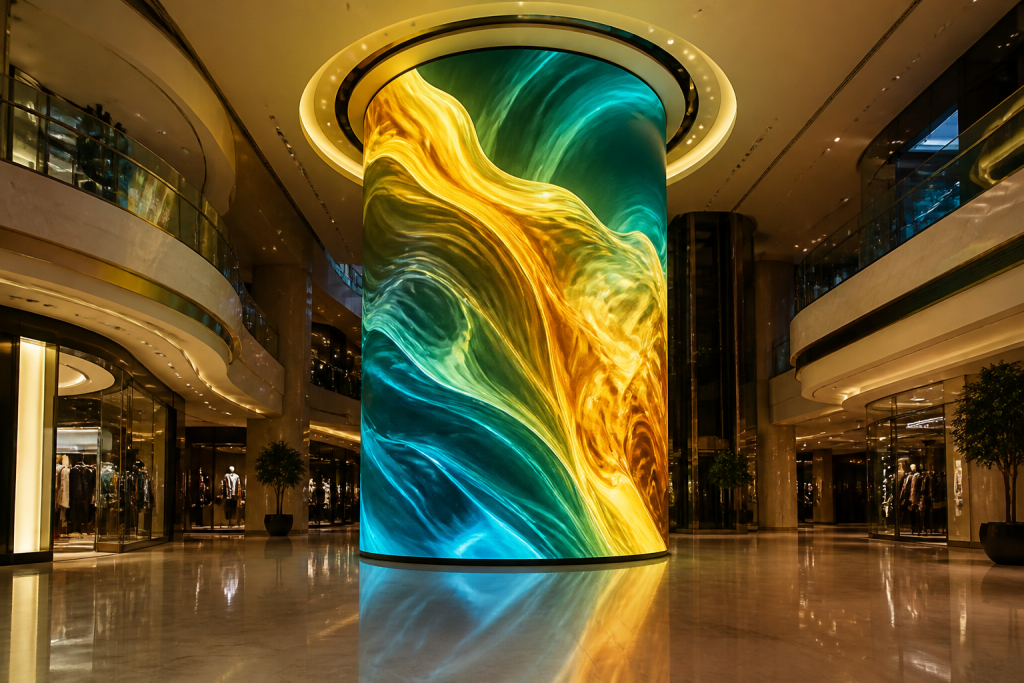
| 360° Cylindrical Column Wrap | Modules wrapped completely around circular structural pillars, closing with a precision seam | Airport terminals, luxury shopping mall atriums, hotel lobbies, train stations |
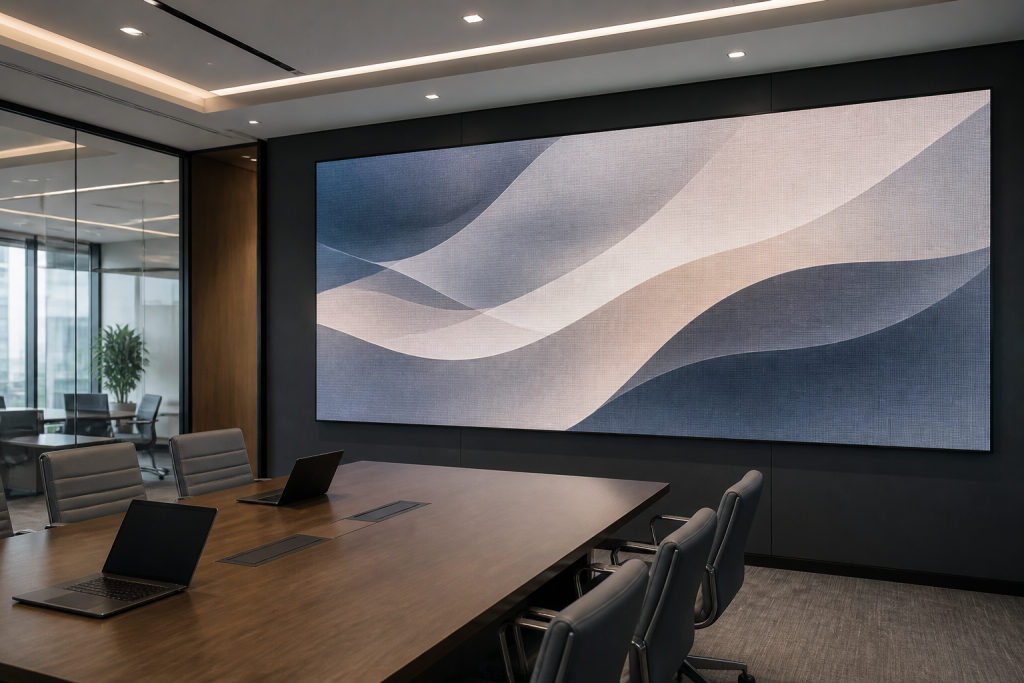
| Concave Curved Video Wall (Inner Arc) | Screen curves inward toward the audience, creating an immersive field-of-view wrap | Command and control centers, simulation theaters, VR CAVE rooms, luxury boardrooms |
| Convex Curved Display (Outer Arc) | Screen curves outward around building corners or central decorative bulkheads | Retail storefront display corners, museum interactive kiosks, exhibition booths |
| S-Shaped Wave Ceiling / Ribbon Display | Alternating concave and convex curves forming undulating organic ribbons | Nightclub overhead canopies, flagship experiential tunnels, corporate atrium ceilings |
| Spherical & Sculptural 3D Displays | Specially segmented flexible modules assembled into spheres, globes, or polygonal rings | Planetariums, science centers, high-tech corporate innovation hubs |
4. Key Technical Specifications: Evaluating Pitch, Bend Radius, and Structural Tolerances
When issuing an RFQ or evaluating manufacturer engineering proposals, B2B buyers should scrutinize the following critical parameters:
Pixel Pitch Selection and Minimum Viewing Distance
Selecting the appropriate pixel pitch for a curved surface depends on audience proximity and display size:
- P1.25 / P1.538 (Ultra-Fine Pitch): Ideal for close-up interactive installations in executive briefing centers, luxury retail displays, and high-end museums where visitors stand within 1.0 to 1.5 meters.
- P1.86 / P2.0 (Premium Commercial Balance): The industry-standard choice for shopping mall column wraps, luxury hotel reception desks, and corporate lobbies (viewing distance: 1.5 to 3.0 meters).
- P2.5 / P3.076 (Cost-Effective Public Space Standard): Excellent for large-diameter pillars, sweeping wave ceilings, and transit hub curved signage where viewers observe the screen from 3.0 to 6.0 meters away.
Minimum Bending Radius and Module Orientation
Manufacturers specify a Minimum Bend Radius (Rmin) for each module series. For a standard 320 mm × 160 mm soft module, the flexible FPC substrate is typically engineered to bend along its long axis (horizontal curvature) or short axis (vertical curvature):
- Horizontal Bending (Standard Column & Arc): Rmin typically ranges between 150 mm and 250 mm (enabling circular column diameters as compact as 300 mm to 500 mm).
- Vertical Bending (Arch & Wave Ceiling): Rmin typically ranges between 200 mm and 350 mm.
- Engineering Rule: Never force a module beyond its certified minimum bend radius during installation, as excessive mechanical stress can shear internal micro-wire bonds.
Sub-Frame Precision and Closing Seam Engineering
Because flexible modules conform precisely to the underlying metal surface, the quality of the display is governed by the accuracy of the structural skeleton:
- Precision CNC Laser-Cut Sub-Frames: Structural frames must be fabricated using CNC laser-cut sheet metal with radius tolerances within ± 0.2 mm to prevent visual distortion or uneven module seams.
- 360-Degree Column Closing Seam: When calculating column circumference (C = π × D), ensure the total arc length is an exact multiple of the module width (320 mm or 240 mm). A specialized closing compensation bracket should be planned to guarantee a gap-free final seam closure.
5. Primary Commercial Application Scenarios
Flexible LED displays provide high visual impact across multiple vertical markets:
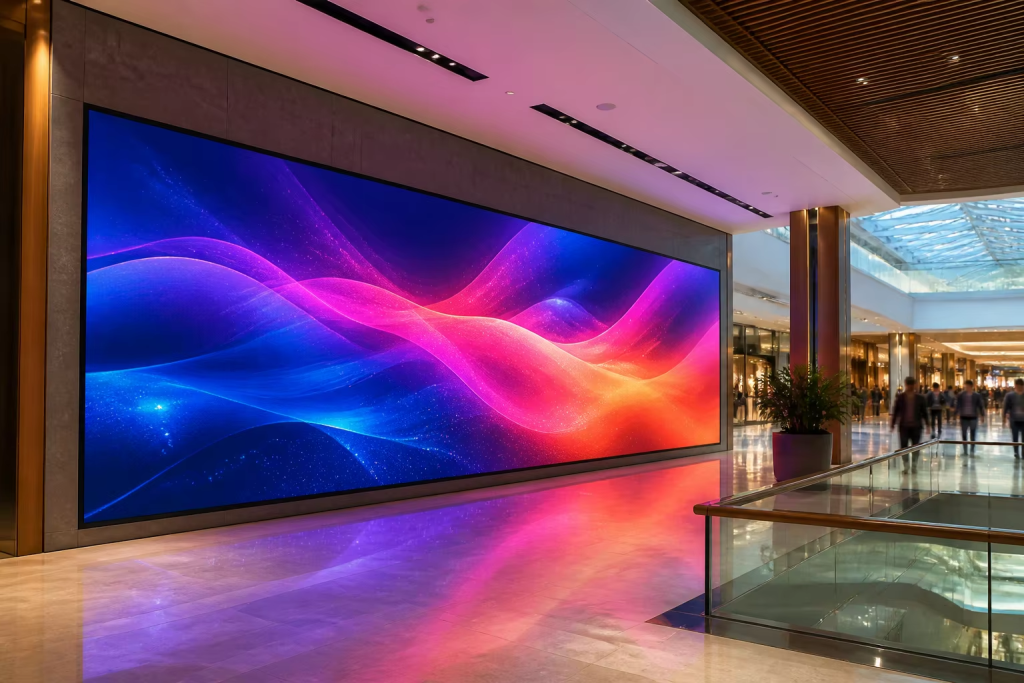
- Shopping Mall and Transit Column Advertising: Transforming dead load-bearing architectural pillars into high-value 360-degree dynamic DOOH advertising totems in busy mall atriums and airport concourses.
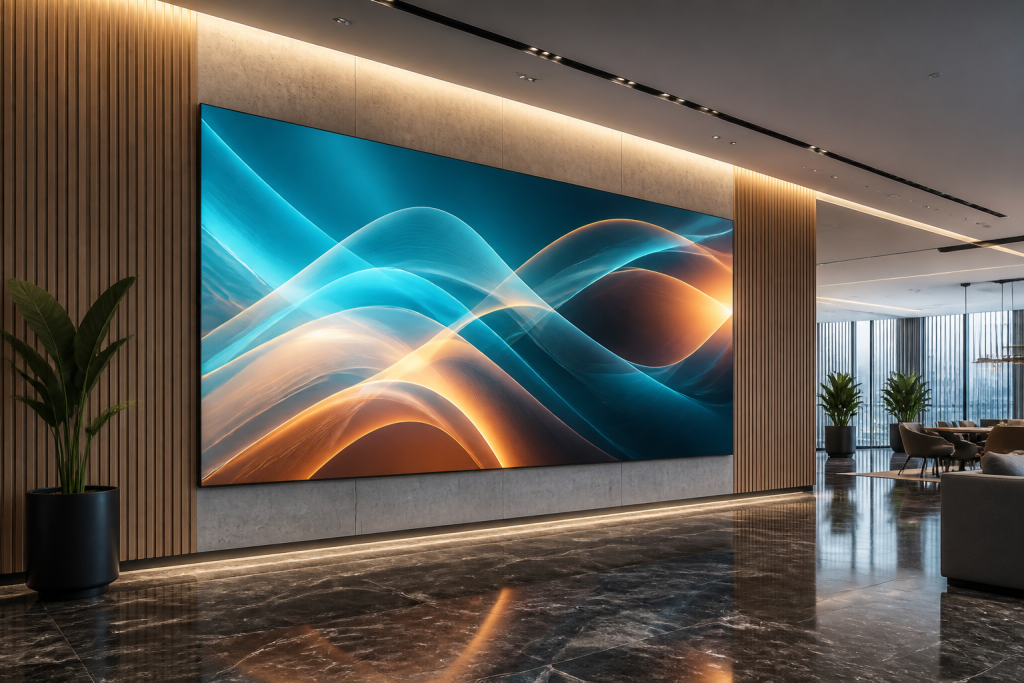
- Corporate Atrium Wave Ceilings and Dynamic Lobbies: Creating undulating organic ribbon displays that span ceiling trusses, playing ambient generative art, corporate branding, and live data visualizers.
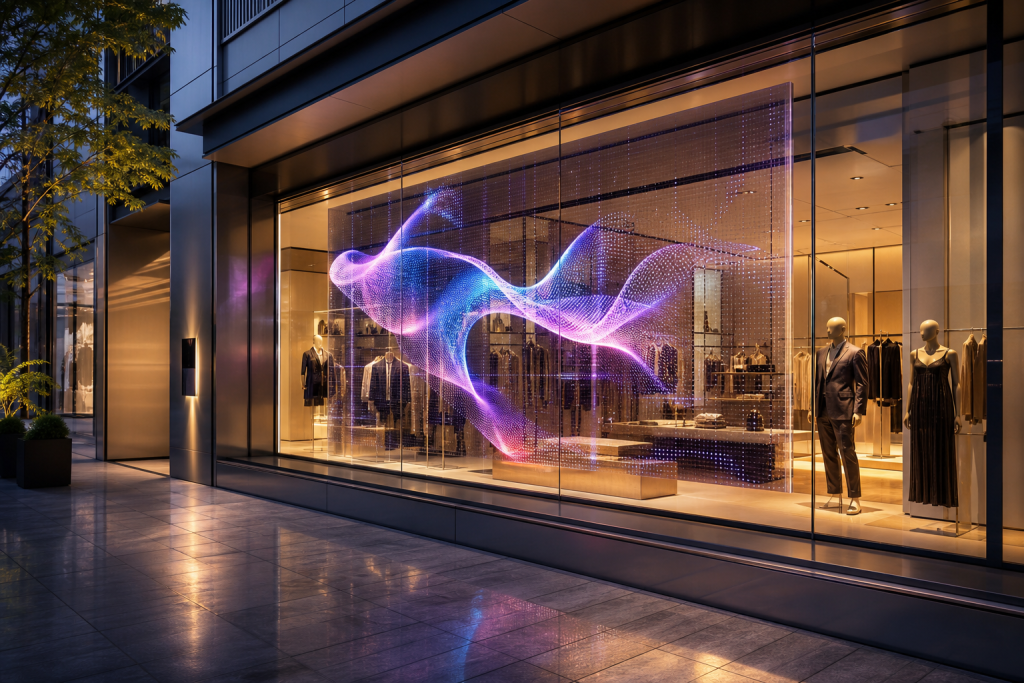
- Luxury Retail Boutique Experiential Features: Integrating curved convex video walls into perfume bars, cosmetics counters, and luxury fashion display pods to captivate shopper attention.
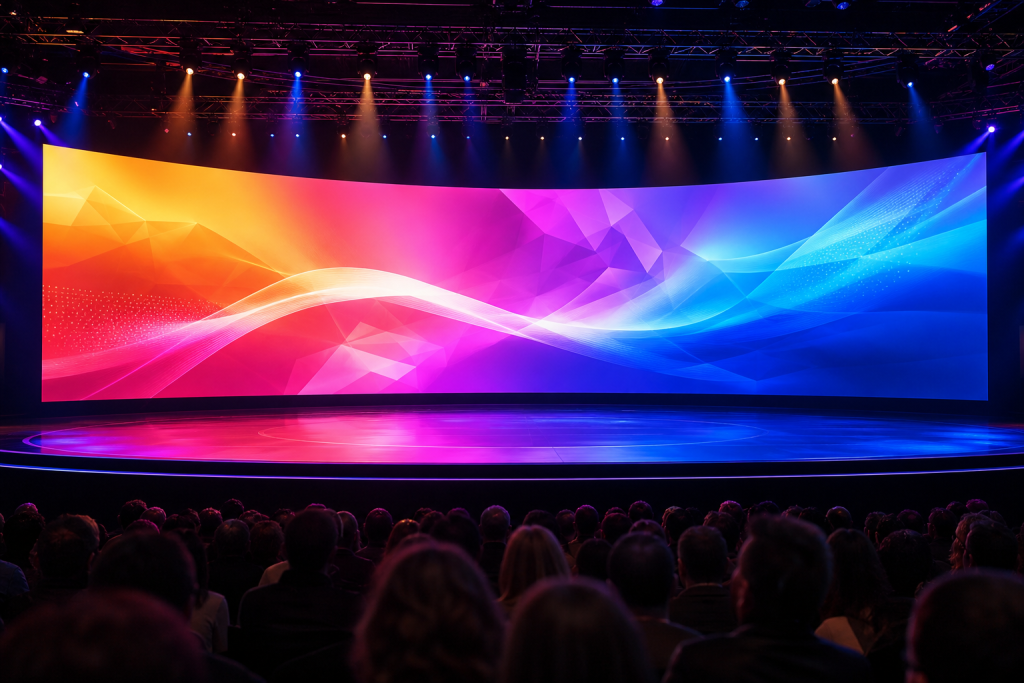
- Immersive Simulation Theaters and Virtual CAVE Environments: Utilizing ultra-high-resolution concave video walls to envelop viewers in a continuous 180° to 270° panoramic visual field.
- Television Broadcast Studios and Event Stage Backdrops: Replacing clunky segmented flats with sweeping seamless curved backdrops that look smooth and natural on camera from every studio pedestal angle.
6. How to Choose the Right Flexible LED Display Supplier: B2B Procurement Checklist
When sourcing flexible LED screens from Chinese manufacturers, overseas distributors and engineering contractors should verify the following supplier capabilities:
- Sub-Frame Engineering Support and 3D CAD Drawings: A qualified supplier must provide complete 3D structural CAD blueprints, sub-frame fabrication drawings, and precise magnetic layout calculations customized to your project’s exact architectural radius.
- Silicon Mask Quality and Anti-Aging Formulations: Ensure the silicone rubber mask is formulated with anti-UV, anti-oxidation, and flame-retardant additives to prevent hardening, cracking, or color degradation over years of thermal cycling.
- Dedicated Magnetic Vacuum Extraction Tools: Confirm that the manufacturer includes industrial electric or manual magnetic vacuum extraction toolkits with custom silicone suction cups designed for soft module surfaces.
- Video Processor Warping & Slicing Integration: For non-standard cylindrical and wave displays, verify that the supplier configures compatible video controllers (e.g., NovaStar, Colorlight, or Brompton) equipped with real-time geometric mapping and video warping software.
- Single-Bin LED Diode Consistency and Spare Parts Allocation: Insist on 3%–5% spare soft modules, receiving cards, and flat ribbon cables produced from the exact same manufacturing LED diode bin to ensure 100% color and brightness uniformity throughout future servicing.
7. Frequently Asked Questions (FAQ)
Q1: Can flexible LED modules be installed on both concave and convex surfaces?
Yes. Quality soft LED modules are engineered to bend in both directions—inward (concave) for immersive video walls and outward (convex) for column wraps and curved building corners.
Q2: How are flexible LED modules held securely onto curved walls?
Flexible modules feature strong neodymium magnets integrated into their rear silicone mask. These magnets latch directly onto curved steel structural skeletons or specialized iron backing sheets with high magnetic pull force, ensuring zero slippage while allowing fast front-side removal.
Q3: What is the minimum column diameter that can be wrapped with a flexible LED display?
With standard P1.538 to P2.5 soft modules (Rmin ≈ 150 mm), the minimum achievable column diameter is approximately 300 mm (approx. 12 inches). For larger columns (e.g., 600 mm to 1,500 mm diameter), installation is exceptionally smooth with virtually zero mechanical bending strain.
Q4: How is video content formatted for a 360-degree cylindrical LED screen?
Content for a 360-degree cylinder is rendered as a wide-aspect panoramic video corresponding to the total pixel resolution of the wrapped circumference. The media player loops this canvas seamlessly around the column, allowing dynamic motion graphics to rotate continuously around the pillar.
8. Conclusion and Sourcing with USER SDT
A flexible LED display transforms challenging architectural geometry into breathtaking digital canvases. From cylindrical structural column wraps in commercial shopping malls to sweeping concave immersion rooms and organic wave ceilings, soft LED modules provide the ultimate design freedom for modern commercial spaces.
As an established Shenzhen LED display manufacturer with over 15 years of OEM/ODM engineering excellence, USER SDT designs and fabricates high-precision flexible LED displays and curved staging solutions tailored for global distributors, AV system integrators, and architectural contractors.
- Explore Our Flexible LED Series: Inquire about our high-refresh P1.53, P2.0, P2.5, and P3.076 soft-link flexible modules, 360-degree column wrap structural kits, and 0°–20° adjustable-curvature arc-shaped rental staging panels.
- Custom OEM/ODM Engineering: Receive customized structural CAD blueprints, pre-rolled mounting frames, tailored power distribution systems, and turnkey video processing solutions.
Contact our sales and engineering team today to request custom CAD drawings, technical datasheets, and project quotations:
- Website: USER SDT Official Site
- Email: jacky@usersdt.com
- WhatsApp: +86 18923710941