
Choosing the right led display screen for advertising outdoor is one of the most important decisions you can make for your brand’s visibility and long‑term ROI. When you get the configuration wrong, your content may look dim, blurred, or unreliable, but the right solution delivers bright, clear messages 24/7 in all weather conditions, especially when you work with a professional manufacturer like USER LED official website.
This guide walks you step by step through scenarios, pixel pitch, brightness, IP rating, energy efficiency, and budget so you can make a confident decision for your next outdoor LED advertising project.
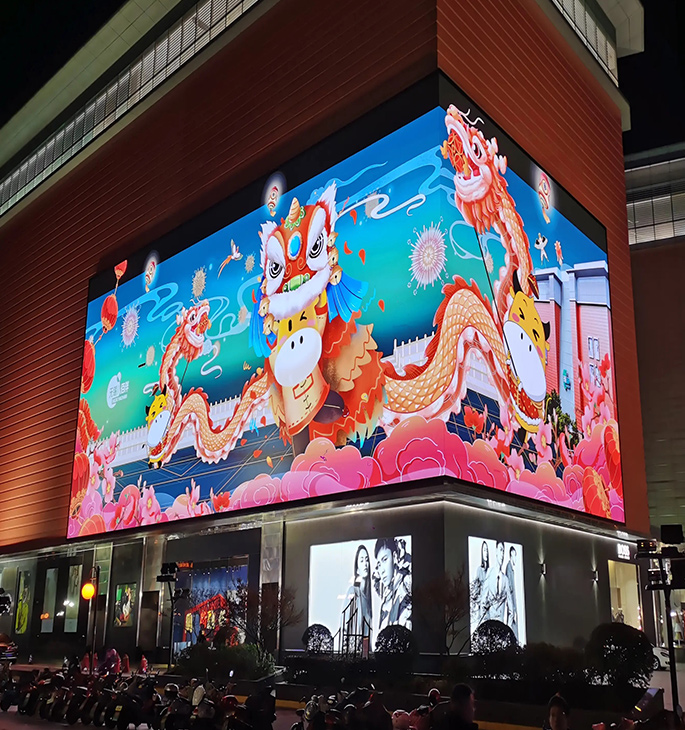
Start from your outdoor scenario
Before looking at technical specifications, you need to define where and how the screen will be used.
Typical scenarios for an outdoor advertising LED screen include:
- Shopping mall façades and retail complex entrances
- Roadside and highway billboards
- Building‑mounted branding screens in city centers
- Rooftop LED billboards
- Outdoor plazas, stations, and transport hubs
Each scenario has different viewing distances, angles, and ambient light, which directly affect pixel pitch, brightness, and size.
Scenario vs. viewing distance (example)
| Scenario | Typical viewing distance | Recommended pixel pitch range |
| Mall façade / city square | 20–60 m | P4–P6 |
| City‑center building wall | 40–120 m | P4–P8 |
| Roadside / highway billboard | 60–200 m | P6–P10 |
| Store canopy / entrance outdoor sign | 5–20 m | P3–P4 |
On USER’s dedicated outdoor LED display screens for advertising product category, these scenario needs are grouped into targeted outdoor models, making it easier to match your project to the right specification.
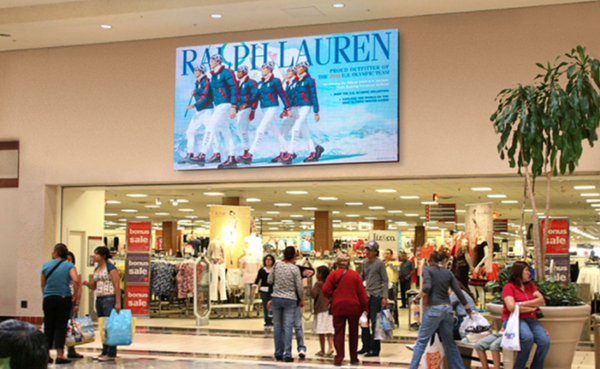
How to choose pixel pitch for outdoor advertising
Pixel pitch (P3, P4, P6, etc.) is the distance between adjacent pixels in millimeters and is one of the core parameters of any led display screen for advertising outdoor.
A practical rule of thumb used by many projects is:
- Comfortable viewing distance in meters ≈ pixel pitch in millimeters.
So a screen mainly seen from 40–60 m often uses about P4–P6, while a highway billboard viewed from 100 m+ can use P8 or P10.
Pixel pitch vs. clarity and cost
Smaller pixel pitch:
- Higher resolution and clearer images at close range
- Higher LED density and higher cost per ㎡
Larger pixel pitch:
- Lower cost per ㎡
- Still acceptable image quality from longer distances
For most advertising applications:
- Mall façades / city center: P4–P5 is a strong balance for clarity vs. budget
- Highway / expressway billboard: P6–P10 is usually the sweet spot
The fixed outdoor LED display series from USER, such as the P4 P6 P8 P10 Fixed Outdoor LED Display, is designed to map directly to these real‑world viewing distances, giving you practical options from medium to long‑range advertising.
Example: Typical outdoor fixed series mapping
| Item | Pixel pitch | Best viewing distance | Typical use |
| PN4 | 4 mm | > 4 m | Mall façades, plazas, building walls |
| PN5 | 5 mm | > 5 m | Medium‑size billboards, mall façades |
| PN6 | 6 mm | > 6 m | Larger billboards, city arterial roads |
| PN8 | 8 mm | > 8 m | Highway billboards, rooftops |
| PN10 | 10 mm | > 10 m | Extra‑large, long‑distance billboards |
Brightness, contrast, and visibility in daylight
Because outdoor LED screens compete with sunlight and reflections, brightness and contrast are critical.
For most led display screen for advertising outdoor projects:
- Minimum recommended brightness: about 5,000 nits
- For south‑facing, strong sunlight, or open plazas: 6,000–8,000 nits is preferred
- Very bright climates sometimes go above 8,000 nits but should combine this with automatic dimming at night.
USER outdoor displays typically reach around 5,000 nits and above, optimized for commercial advertising conditions and long‑term use.
Contrast and viewing angle also matter:
- High contrast keeps blacks deep and colors vivid rather than washed out.
- Wide viewing angles (around 160° H / 160° V in USER’s fixed outdoor series) ensure readability from different directions and approach angles.
Brightness & performance snapshot (USER fixed outdoor)
| Parameter | PN4–PN10 fixed outdoor series value |
| Brightness | 5,000 nits (typical) |
| Refresh rate | ≥ 1,920 Hz, up to 3,840 Hz |
| Viewing angle (H/V) | 160° / 160° |
| Gray level | 12–16 bit |
For stable, comfortable night‑time viewing and lower power usage, ask your supplier to include automatic brightness sensors and intelligent dimming.
Weather protection, IP rating, and durability
An outdoor advertising LED screen must work reliably in rain, dust, wind, and temperature changes.
Key concepts:
- IP rating: IP65 front is widely considered the baseline for professional outdoor advertising modules, meaning dust‑tight and resistant to water jets.
- Rear IP rating can be slightly lower (e.g., IP54–IP65), depending on cabinet and structure design.
USER’s outdoor solutions are engineered with sealed module structures and high IP ratings (IP65–IP66 front) to withstand long‑term outdoor exposure.
In coastal or very humid regions, you should also consider:
- Anti‑corrosion coatings on cabinets and steel structures
- Proper drainage and ventilation design
- Wind‑load‑rated support structures designed with local engineers.
These factors together protect both the LED surface and internal electronics, extending the working life of your advertising investment.
Energy efficiency and lifetime cost (TCO)
Outdoor screens often run 12–20 hours per day, so power consumption has a huge impact on long‑term cost.
USER uses a common‑cathode, energy‑saving architecture in its FC/FX series and also applies energy‑saving design to fixed outdoor models:
- Average panel temperature about 15 °C lower than traditional common‑anode designs
- Power consumption reduced by more than 20% via optimized current paths
- Four‑level energy‑saving mechanisms, including dynamic, black‑screen, full‑screen, and voltage‑reduction modes.
Energy‑saving features in USER fixed outdoor designs
| Energy‑saving level | Description |
| Dynamic energy saving | Shuts off driving circuit when no signal is displayed |
| Black‑screen energy save | Static current drops from ~6 mA to ~0.6 mA |
| Full‑screen energy save | After low level 300 ms, static current ~0.5 mA |
| Shunt & step‑down | Current passes LED first, reducing voltage drop & heat |
Over several years, these optimizations can significantly reduce your electricity bills, especially for networks of multiple outdoor advertising screens.
Typical configurations for key scenarios
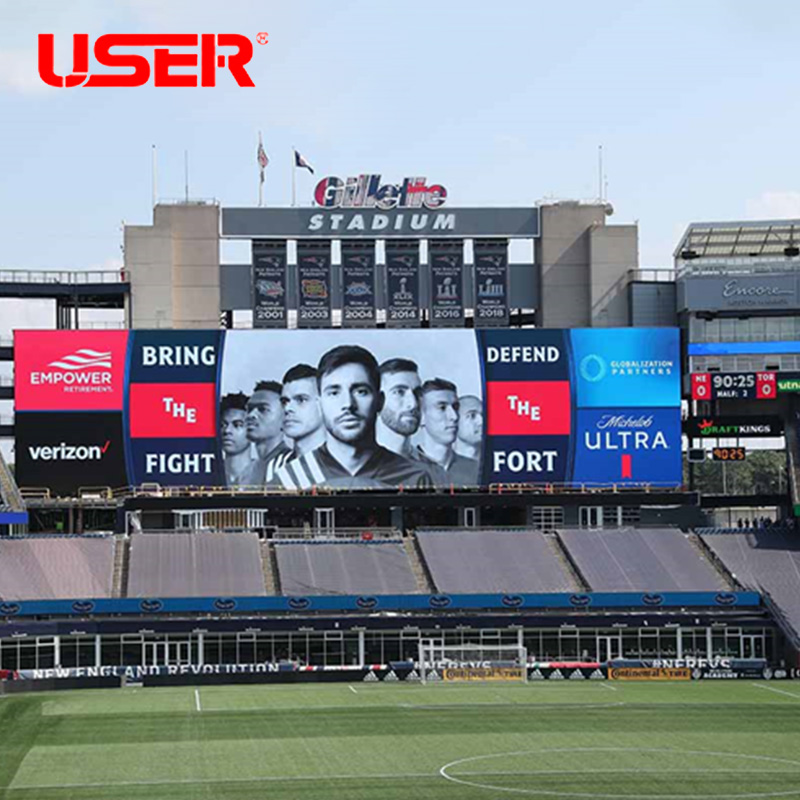
To make your decision more concrete, here are example configurations for two common uses of led display screen for advertising outdoor.
Example A: Shopping mall façade
- Scenario: City center mall façade, mixed pedestrian and car traffic
- Viewing distance: 30–80 m
- Suggested pitch: P4 or P5
- Suggested brightness: around 6,000–7,000 nits
- IP rating: IP65 front
- Size: 20–60 ㎡, depending on façade and budget
- Product fit: USER P4/P5 fixed outdoor series with energy‑saving design.
In this type of application, retailers often choose full‑color waterproof models such as P5, which can be found in USER’s dedicated waterproof outdoor full color LED product lines, to deliver strong visual impact while maintaining weather resistance.
Example B: Roadside / highway billboard
- Scenario: Highway or main road, mostly vehicle viewers
- Viewing distance: 80–200 m
- Suggested pitch: P6, P6.67, P8, or P10
- Suggested brightness: 6,000–8,000 nits
- IP rating: IP65 front or above
- Size: 30–200 ㎡, depending on structure
- Product fit: USER P6/P8/P10 fixed outdoor series or common‑cathode energy‑saving series for lower power.
By choosing a slightly larger pixel pitch here, you can keep costs under control while still achieving highly readable advertising content at typical driving speeds.
Control system, content, and maintenance
A high‑quality led display screen for advertising outdoor also needs reliable control and easy maintenance.
Typical control setup:
- Networked control system (LAN/4G/5G) to manage content playlists and schedules
- Central software to control multiple screens in different locations
- Optional remote monitoring (temperature, errors, brightness) to detect faults early.
Maintenance considerations:
- Front maintenance is ideal when the screen is directly on a wall and you have no rear access
- Rear maintenance works for freestanding billboards with a service platform
- Regular surface cleaning to maintain brightness and color accuracy
- Keeping spare modules and power supplies for quick replacement.
USER’s project solutions combine hardware with control systems and after‑sales services, supported by certifications such as ISO9001, ISO14001, and ISO45001 to ensure stable quality over the lifespan of your outdoor display.
Key cost drivers when budgeting
Understanding main cost drivers helps you read quotations more accurately and compare offers fairly.
Major factors:
- Pixel pitch: going from P8 to P4 roughly quadruples pixel count per ㎡ and raises cost accordingly
- Screen area: larger area increases LED cost, structure, control system, and installation effort
- Brightness level: higher brightness requires stronger LEDs and power, slightly increasing hardware cost
- Energy‑saving design: more advanced electronics may raise upfront price but reduce running cost
- Installation complexity: simple wall‑mount vs. tall freestanding structure with deep foundations.
Through USER’s focused outdoor LED display screens for advertising category, you can quickly narrow down suitable products by pitch and application, then discuss detailed pricing with the team based on your exact site conditions.
Quick specification overview: USER P4–P10 fixed outdoor LED
Below is a simplified spec table based on USER’s fixed outdoor LED display parameters.
| Item | PN4 | PN5 | PN6 | PN8 | PN10 |
| Pixel pitch | 4 mm | 5 mm | 6 mm | 8 mm | 10 mm |
| LED type | SMD1921 | SMD1921 | SMD3535 | SMD3535 | SMD3535 |
| Best distance | > 4 m | > 5 m | > 6 m | > 8 m | > 10 m |
| Module size | 320×160 mm | 320×160 mm | 320×160 mm | 320×160 mm | 320×160 mm |
| Brightness | 5,000 nits | 5,000 nits | 5,000 nits | 5,000 nits | 5,000 nits |
| Refresh rate | ≥ 1,920 Hz or ≥ 3,840 Hz | same | same | same | same |
| Avg. power | 250–700 W/㎡ | 250–700 W/㎡ | 250–700 W/㎡ | 250–700 W/㎡ | 250–700 W/㎡ |
| Color temp. | 6,500 K | 6,500 K | 6,500 K | 6,500 K | 6,500 K |
| Lifespan | 100,000 h | 100,000 h | 100,000 h | 100,000 h | 100,000 h |
These parameters make the series suitable for long‑term outdoor advertising duty in both city centers and roadside applications, from mid‑size mall screens to large highway billboards.
FAQs about led display screen for advertising outdoor
What is the best pixel pitch for a led display screen for advertising outdoor?
There is no single “best” pixel pitch; it depends on viewing distance and screen size. For mall façades and building walls in busy city areas, P4–P6 usually balances detail and cost well, while for roadside and highway billboards where viewers are much farther away, P6–P10 is more cost‑effective and still visually clear.
How bright should an outdoor advertising LED screen be?
For most installations, you should aim for at least 5,000 nits, with 6,000–8,000 nits for strong sunlight or south‑facing screens. Pairing high brightness with automatic light sensors allows the system to dim at night, saving energy and preventing glare for nearby residents or drivers.
What IP rating do I need for outdoor LED advertising?
For serious outdoor advertising, IP65 front protection is the standard recommendation to ensure dust‑tight and water‑jet‑resistant performance. In harsh or coastal environments, additional anti‑corrosion and potentially higher rear protection are advisable, and cabinet design becomes even more important to avoid moisture ingress.
How long can an outdoor LED advertising screen last?
With quality components, proper installation, and reasonable running conditions, outdoor LED screens commonly offer a rated lifespan of 50,000–100,000 hours. Actual usable life depends on factors such as brightness level, daily operating hours, ambient temperature, and maintenance quality throughout the project.
How much power does a led display screen for advertising outdoor consume?
Power consumption varies by pixel pitch, brightness, content, and energy‑saving design. Energy‑optimized designs like common‑cathode architectures and multi‑level power saving can typically reduce power by 20% or more versus traditional designs, helping to lower total cost over the project lifetime.
What information should I prepare before asking for a quotation?
To get an accurate proposal, you should share at least:
- Installation scenario and location (mall façade, roadside, rooftop, etc.)
- Approximate screen size (width × height)
- Viewing distance and main audience type (pedestrians, cars)
- Basic climate and environment (coastal, hot, dusty, etc.)
- Budget range and any special requirements (extra high brightness, energy saving, special shape).
By understanding your scenario, viewing distance, brightness needs, and budget, you can choose a led display screen for advertising outdoor that stays bright, stable, and cost‑efficient for many years. Using USER’s focused outdoor LED display screens for advertising and key models like the P4 P6 P8 P10 Fixed Outdoor LED Display, you can quickly move from concept to a customized solution that matches your site conditions and marketing goals.