
What Is a Flexible LED Transparent Film Screen?
A flexible LED transparent film screen is an ultra‑thin, highly transparent digital display that can be directly attached to glass surfaces such as shopfronts, curtain walls, and indoor glass partitions. Instead of using heavy metal cabinets, it embeds fine‑pitch LEDs into a clear PET or optical film substrate so the glass still looks almost unchanged when the screen is off. When powered on, the LEDs light up to show videos, images, logos, and text while maintaining a high level of transparency and daylight.
This new form factor is designed for modern retail and architectural environments that demand both aesthetics and performance. With typical transparency levels between 85% and 95%, customers can clearly see the products behind the glass while dynamic content runs on the surface. Because the film is bendable, it easily adapts to curved glass, columns, arches, and other creative shapes.
To see how USER positions flexible transparent solutions in their portfolio, you can explore their transparent LED display category. For a full overview of LED technologies and product families, visit the global LED display solutions page.
Core Structure and Working Principle
A flexible LED transparent film screen combines several layers to achieve both image quality and transparency. The base layer is a thin PET or similar high‑temperature‑resistant film that serves as the carrier for the circuit and LEDs. On this film, transparent conductive lines and LED chips are arranged in a grid, creating the pixels that will display content.
Because the spacing between LED strips and circuit paths is optimized, most of the glass area remains open, allowing natural light to pass through. When content is played, the LED pixels are driven by a control system similar to traditional LED displays, with refresh rates commonly around 1920–3840 Hz to ensure smooth motion and avoid flicker in cameras. Brightness can reach up to around 2000–5500 nits depending on the model, making these film screens visible even in bright indoor environments or near windows.
Key Technical Specifications to Consider
When selecting a flexible LED transparent film screen, several specifications directly influence visual performance and feasibility.
- Pixel pitch: Often between P5 and P15.6, balancing resolution and transparency for viewing distances from a few meters to tens of meters.
- Transparency: Typically 85–92% for crystal‑film style products, with some solutions reaching up to about 95%.
- Brightness: Around 2000 cd/m² for standard indoor applications, with high‑brightness variants up to about 5500 nits for window‑facing installations.
- Thickness and weight: The film can be just a few millimeters thick and as light as roughly 2–6 kg/m², significantly reducing structural load.
- Lifespan: Typical theoretical service life can approach 100,000 hours, similar to other quality LED displays when properly installed and maintained.
USER’s crystal film transparent LED screen uses high‑temperature‑resistant PET film, offers up to 85–92% transparency, and supports multiple pixel pitches such as P5, P6.25, P10, and P15.6. These models are designed for glass surface mounting and operate reliably between approximately −20 °C and 50 °C, making them suitable for a wide range of climates.
Advantages Over Traditional Transparent LED Cabinets
Compared with conventional transparent LED cabinets, flexible LED transparent film screens provide several clear advantages.
- Ultra‑light and ultra‑thin: Without heavy frames and modules, installation is much easier on existing glass structures.
- High transparency: Up to 90–95% light transmission minimizes impact on daylight and indoor ambience.
- Flexible installation: Film can follow curved glass and irregular shapes, enabling creative façades and immersive showcases.
- Minimal structural work: Many solutions use self‑adhesive backing, eliminating the need for complex steel structures.
- Easy maintenance: With modular design and surface‑mounted installation, replacing a damaged strip or module is simpler than cabinet‑based systems.
These benefits translate into shorter installation cycles, lower structural costs, and more flexible design freedom for architects and brand owners.
Typical Applications in Retail and Architecture
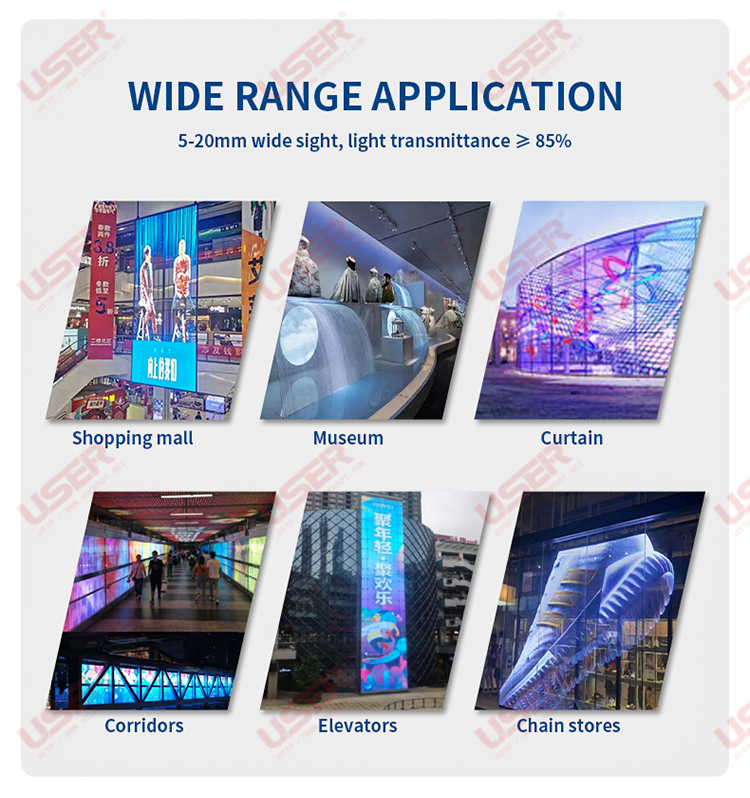
Flexible LED transparent film screens are particularly popular in sectors where glass is already a dominant design element.
- Retail shop windows: Fashion, electronics, and automotive brands use them to display campaigns while keeping merchandise visible.
- Shopping mall atriums and partitions: Film screens on glass balustrades and partitions create eye‑catching promotions without blocking sightlines.
- Corporate lobbies and showrooms: Large glass walls become interactive storytelling surfaces for corporate branding.
- Building façades: Used on glass curtain walls to deliver large‑scale media façades with reduced wind load and structural weight.
- Museums and cultural venues: Transparent content layers can explain exhibits while preserving the view of physical artifacts.
USER has implemented transparent LED installations in locations such as universities, shopping malls, and car retail stores around the world, showing real‑world performance in demanding environments.
Installation and Integration Considerations
Proper installation is crucial to achieving clean visuals and long‑term reliability with flexible LED transparent film screens.
- Glass preparation: The glass surface must be clean, dry, and smooth to ensure strong adhesion and avoid bubbles.
- Environmental conditions: Installation typically requires controlled temperature (often around 15–25 °C) and dust‑free conditions.
- Layout planning: Pixel pitch and content layout must match viewing distance and glass dimensions for optimal visual impact.
- Cable routing: Power and signal cables are usually concealed along window frames or within mullions to keep the installation visually unobtrusive.
- Control system: A professional LED controller and media player are used to manage brightness, schedules, and content distribution.
USER provides complete solutions that cover design, production, control systems, and after‑sales service, simplifying integration for system integrators and end users. If you are planning a project, you can start from the transparent LED display product overview and then contact USER for tailored technical advice.
Why Choose USER for Flexible Transparent Film Screens?
Shenzhen USER Special Display Technologies is a high‑tech enterprise with over 10,000 m² of factory space, full auto‑production lines, and exports to more than 80 countries. The company holds certifications such as ISO9001, ISO14001, ISO45001, CE, FCC, and RoHS, and serves global brands in retail, transportation, finance, and many other sectors.
By choosing USER’s crystal film and transparent LED series, you benefit from mature engineering, stable supply, and comprehensive project support, from design to on‑site commissioning. You can learn more about their integrated commercial display solutions on the official website home page at https://www.userledscreen.com/.