
Introduction
The digital signage landscape has undergone a dramatic transformation over the past five years, with foldable LED posters emerging as the preferred solution for businesses seeking superior visual impact, operational flexibility, and long-term value. Yet many decision-makers remain uncertain whether to invest in this newer technology or stick with the familiar LCD poster alternative that has dominated retail and corporate environments for nearly two decades.
This comprehensive analysis dissects the technological, financial, and operational differences between foldable LED posters and traditional LCD displays. By examining seven critical performance dimensions—brightness, viewing angles, energy consumption, lifespan, maintenance requirements, customization capacity, and total cost of ownership—this guide provides procurement professionals, facility managers, and marketing executives with the data needed to make informed decisions that impact their bottom line.
The analysis reveals a compelling narrative: while LCD posters maintain a lower initial acquisition cost, foldable LED posters deliver approximately 32% higher return on investment over five-year deployment periods through superior durability, operational efficiency, and flexibility. For businesses requiring frequent relocation, outdoor visibility, or multi-location campaign synchronization, the financial and operational advantages of foldable LED technology are overwhelming.
Understanding Brightness Performance: The Most Visible Difference
How Brightness Impacts Customer Experience and Visibility
Brightness, measured in nits (candelas per square meter), represents one of the most immediate and perceptible differences between LED and LCD display technologies. This metric directly influences whether potential customers can see promotional content clearly in varying lighting conditions—from dimly lit interior retail spaces to sun-exposed storefront windows and outdoor transit shelters.
LCD Display Brightness Limitations:
Traditional LCD poster displays operate within a brightness range of 300-700 nits, a specification that reflects the inherent constraints of LCD backlighting technology. This brightness ceiling creates significant visibility challenges in modern retail environments where architectural lighting varies dramatically throughout the day and seasonally throughout the year.
In high-ambient-light retail spaces—particularly stores with extensive natural window displays, bright fluorescent ceiling fixtures, or locations subject to direct sunlight reflection from exterior surfaces—LCD displays frequently exhibit “washout,” where image details become indistinguishable and colors appear muted. This optical degradation undermines the entire purpose of digital advertising, as consumers cannot read promotional text, distinguish product details, or engage emotionally with dynamic content.
The practical consequence: retail managers deploying LCD posters in window displays discover their primary promotional tool becomes essentially invisible during peak daylight hours (typically 10 AM to 4 PM), precisely when foot traffic concentrates and purchasing intent peaks.
Why LED Brightness Outperforms LCD in Real-World Retail Environments
Foldable LED Poster Brightness Advantages:
Foldable LED posters deliver brightness levels spanning 750 nits for entry-level indoor models to 5,000+ nits for outdoor-grade installations. This 7-15x brightness advantage over LCD displays fundamentally transforms display performance across diverse lighting environments.
Consider a practical example: a shopping mall displaying seasonal promotions across its main corridor. An LCD poster with 500 nits brightness becomes difficult to read once ambient mall lighting combines with morning sunlight streaming through skylights, limiting effective promotional hours to early morning and evening periods when natural light diminishes. The same promotional content on a foldable LED poster operating at 2,000 nits remains crystal-clear throughout the entire day, capturing attention during the entire customer journey through the mall.
The physics principle underlying this advantage: human visual perception requires a certain minimum contrast ratio between display brightness and ambient illumination. As ambient light increases, display brightness must increase proportionally to maintain perceivable contrast. LED posters, with their superior brightness capacity, maintain this contrast ratio consistently across varying daylight conditions.
Brightness Specifications by Application Environment:
| Environment | Ambient Light Conditions | LCD Brightness (Typical) | Foldable LED Brightness (Typical) | Visual Performance Outcome |
| Indoor Retail (500-1,000 lux) | Controlled artificial lighting | 400-500 nits | 800-1,200 nits | LED maintains superior clarity without glare |
| Semi-Outdoor/Window Display (2,000-5,000 lux) | Mixed natural and artificial light | 500-700 nits (marginal) | 2,000-3,000 nits | LCD subject to washout; LED performs optimally |
| Outdoor Direct Sunlight (50,000-100,000 lux) | Uncontrolled natural illumination | 700 nits (unsuitable) | 3,500-5,500 nits | LCD unusable; LED delivers clear visibility |
This brightness differential isn’t merely a numerical specification—it represents a fundamental technological divide that determines whether a display delivers reliable, consistent visual communication or becomes a liability during peak business hours.
Viewing Angles: Understanding Color Consistency Across Customer Positions
The Critical Role of Viewing Angles in Multi-Customer Environments
Viewing angle—the horizontal and vertical degree range from which an observer can perceive display content without significant color distortion or brightness loss—represents a subtle but operationally crucial performance metric often overlooked by non-technical buyers.
In retail, hospitality, and event environments, customers approach signage from multiple angles simultaneously. A shopping mall entrance display may be viewed straight-on by some visitors, at extreme side angles (60-80 degrees) by others, and from elevated angles by patrons on upper-level walkways. Display technology must maintain consistent color rendering and readable brightness across this natural viewing angle variation, or visual content becomes distorted for significant portions of the customer base.
LCD Viewing Angle Constraints:
LCD poster displays, constrained by their backlighting architecture, typically offer horizontal and vertical viewing angles of approximately 120 degrees. This technical specification means that viewers positioned at angles exceeding 60 degrees from perpendicular observe noticeable color shifts, brightness reduction, and potential image inversion where blacks appear as whites and color relationships become unrecognizable.
The practical consequence in retail installation: a LCD poster positioned at a mall corridor entrance becomes increasingly difficult to read for customers approaching from the side corridors, degrading the advertising effectiveness precisely among those customers in the best position to act on promotional messaging (they’re already walking in the direction of featured products).
How LED Viewing Angles Enhance Customer Engagement in Real-World Settings
Foldable LED Viewing Angle Superiority:
Foldable LED posters maintain horizontal and vertical viewing angles of 140-160 degrees with consistent color accuracy, a specification enabled by LED’s inherent light-emitting architecture where each pixel operates as an independent light source.
The practical advantage: customers approaching a foldable LED poster from virtually any direction perceive identical color saturation, brightness levels, and image clarity. This 360-degree visual consistency transforms LED posters into effective communication tools regardless of customer approach angle, significantly enhancing their promotional effectiveness in multi-directional traffic environments.
This technical difference compounds in high-traffic retail settings. Consider a department store featuring a featured product display visible from main corridor entrance, adjacent corridor junctions, and upper-level overlooking balconies. An LCD display optimized for perpendicular viewing becomes increasingly less effective for each viewer approaching from alternative angles, reducing the effective promotional audience. The identical content on a foldable LED poster delivers equally compelling visuals to every customer regardless of approach vector.
Energy Efficiency: Quantifying Long-Term Operational Cost Advantages
Power Consumption: Where Operational Costs Differentiate Technologies
Energy efficiency represents the most financially impactful performance difference between LED and LCD technologies when viewed through the lens of five to ten-year total cost of ownership. While this difference remains invisible in first-year operations, cumulative power consumption creates increasingly dramatic cost divergences over extended deployment periods.
LCD Power Consumption Reality:
Traditional LCD poster displays require continuous power to operate backlighting systems that illuminate the entire display panel uniformly, regardless of image content. A typical mid-range LCD poster consuming 0.8-1.2 kilowatts during operation translates to approximately 7,000-10,000 kilowatt-hours of annual electricity consumption in round-the-clock operating environments.
Foldable LED Power Consumption Advantage:
Foldable LED posters operate at approximately 0.08-0.15 kilowatts during typical operation—roughly 1/10th the power demand of comparable LCD displays. This 10:1 efficiency ratio reflects LED’s fundamental technical advantage: individual LEDs emit light directly, rather than requiring backlight systems that illuminate inactive areas of the display.
Long-Term Financial Impact:
The electricity cost differential compounds dramatically over operational lifespans:
- Annual electricity cost (LCD): 8,000 kWh × $0.12/kWh = $960/year
- Annual electricity cost (LED): 800 kWh × $0.12/kWh = $96/year
- Annual savings (LED): $864/year
- 5-year electricity cost differential: $4,320 per unit
- 10-year electricity cost differential: $8,640 per unit
For retail chains deploying 50+ displays across multiple locations, this electricity cost advantage alone frequently justifies LED investment from a pure operational efficiency perspective, independent of any other performance considerations.
This energy advantage extends beyond direct electricity costs. Commercial HVAC systems must offset excess heat generated by high-power LCD displays, particularly in retail environments with large display clusters. This secondary cooling burden adds 15-20% additional electricity consumption to the total environmental cost of LCD deployment. LED displays, operating at significantly lower power levels, generate minimal excess heat, eliminating this ancillary cooling demand.
Lifespan and Reliability: Understanding Operational Longevity
How Lifespan Differences Compound Investment Value Over Time
Display lifespan—measured in operational hours before brightness degradation reaches 50% of initial output levels—represents perhaps the most underappreciated differentiator between technologies, yet creates the most substantial long-term financial impact on total cost of ownership.
LCD Display Lifespan Constraints:
Traditional LCD posters typically achieve 30,000-50,000 operational hours before experiencing significant brightness degradation. In continuous-operation environments (24/7 retail display), this translates to 3-5 years of reliable operation before display brightness deteriorates to levels requiring replacement.
Multiple factors accelerate LCD lifespan degradation:
- Backlighting system components degrade predictably over time, progressively reducing brightness output
- Elevated ambient temperatures (common in retail environments with extensive product display lighting) accelerate backlight component aging
- LCD panel deterioration becomes visible as uneven brightness distribution (“bright/dark” regions appearing on display) after 3-4 years of intensive use
The practical consequence: retailers deploying LCD posters face replacement cycles every 4-5 years, translating to recurring capital expenditure and operational disruption associated with display replacement.
Foldable LED Display Longevity:
Foldable LED posters operate for 80,000-100,000+ operational hours before reaching the industry-standard 50% brightness degradation threshold. In continuous-operation environments, this represents 8-12 years of reliable service—a 2-3x operational lifespan advantage over LCD technology.
This longevity advantage reflects several technical factors:
- Individual LED components degrade gradually and predictably, enabling brightness compensation through power supply adjustments
- GOB (Glue-on-Board) encapsulation protects LED elements from environmental contamination, reducing age-related performance degradation
- Modular architecture enables replacement of specific aging modules without disrupting entire display operation
The cumulative effect: a single foldable LED poster installation remains operationally reliable through multiple complete LCD replacement cycles, fundamentally altering the financial calculus of long-term display investment.
Maintenance Requirements: Operational Burden and Service Costs
Comparing Technical Support, Repair Complexity, and Component Replacement Economics
Maintenance requirements and associated service costs create substantial hidden expenses that frequently account for 20-30% of total display lifecycle costs. The architectural and technical differences between technologies dramatically influence maintenance complexity, technician expertise requirements, and replacement component availability.
LCD Display Maintenance Challenges:
LCD poster displays feature integrated backlighting systems where all illumination passes through individual LCD crystals. Component failure typically affects the entire panel, necessitating complete display replacement rather than targeted repair.
Common LCD maintenance issues include:
- Backlight failure: Degrades gradually over 3-5 years; requires full display replacement ($500-$2,000)
- Uneven brightness distribution: Results from localized backlight aging; unfixable through service; requires replacement
- Color calibration drift: Occurs as backlighting components age inconsistently; requires professional technician calibration every 6-12 months ($200-$400 per service visit)
- Panel damage: Any physical damage to the LCD panel typically requires complete display replacement; repair is economically unfeasible
The expertise requirement: LCD maintenance demands specialized technical knowledge of backlighting systems, color calibration theory, and diagnostic procedures. This specialized skill requirement limits service availability and escalates service costs in regions without concentrated LCD service infrastructure.
How LED Design Reduces Maintenance Complexity and Lifecycle Costs
Foldable LED Display Maintenance Advantages:
Foldable LED posters utilize modular architecture where individual LED modules operate independently. Component failure affects only the affected module, enabling isolated replacement rather than full-display obsolescence.
Standard LED maintenance procedures include:
- Module replacement: Individual LED modules (typically $50-$200) can be replaced by technicians with basic electrical knowledge; no specialized expertise required
- Power supply service: Modular power supplies can be isolated and replaced independently; supports continued display operation during service
- Front-accessible maintenance: GOB-coated LED modules can be inspected and cleaned without display disassembly; preventive maintenance is straightforward
- Hot-swap capability: Some advanced foldable LED poster designs enable module replacement without complete system shutdown, supporting uninterrupted operation during service
The expertise requirement: LED maintenance demands general electrical knowledge rather than specialized display technology expertise. This broader availability of qualified service technicians reduces service costs by 30-50% compared to LCD specialized service requirements.
Maintenance Cost Quantification Over Five Years:
| Maintenance Category | LCD Display (Typical) | Foldable LED Poster (Typical) |
| Annual calibration (1-2 visits) | $400-$800 | $0 (automatic compensation) |
| Module/component replacement | $500-$1,000 | $100-$300 |
| Service calls (emergency) | $200-$400 each | $100-$200 each |
| 5-Year Total Maintenance Cost | $2,500-$4,500 | $500-$1,200 |
This maintenance cost differential represents one of the most quantifiable advantages of foldable LED technology, often justifying LED investment purely on operational service cost elimination.
Customization and Splicing Capability: Architectural Flexibility
How Display Technology Choices Impact Scalability and Configuration Options
Customization capacity and multi-unit splicing capability—the technical ability to seamlessly connect multiple displays to create larger unified screens—represent critical decision factors for businesses planning multi-location rollouts or requiring future scalability.
LCD Display Customization Limitations:
LCD manufacturers typically produce displays in standard sizes (commonly 640×1920mm poster format) with limited deviation from established configurations. Custom cabinet specifications often require 6-12 week lead times and command 15-25% price premiums due to small production runs.
Splicing impossibility: LCD displays cannot be seamlessly spliced due to fundamental backlighting architecture constraints. Connecting multiple LCD displays creates visible bezels (frame edges) between adjacent units, creating visual discontinuity that undermines unified advertising messaging. This splicing incompatibility forces retailers requiring larger displays to commission custom large-scale LCD installations rather than combining smaller modular units.
The practical consequence: retail chains planning future expansion or requiring flexible display configurations cannot standardize on LCD poster technology without accepting either visual discontinuity in multi-unit installations or accepting custom manufacturing complexity and costs.
Why LED Customization and Splicing Offer Unmatched Scalability
Foldable LED Display Customization Flexibility:
LED manufacturers regularly accommodate custom cabinet specifications, frame materials, and form factor adjustments with minimal lead time extensions. GOB-coated LED modules are manufacturer-agnostic regarding chassis design, enabling designers to optimize display enclosures for specific environmental or aesthetic requirements.
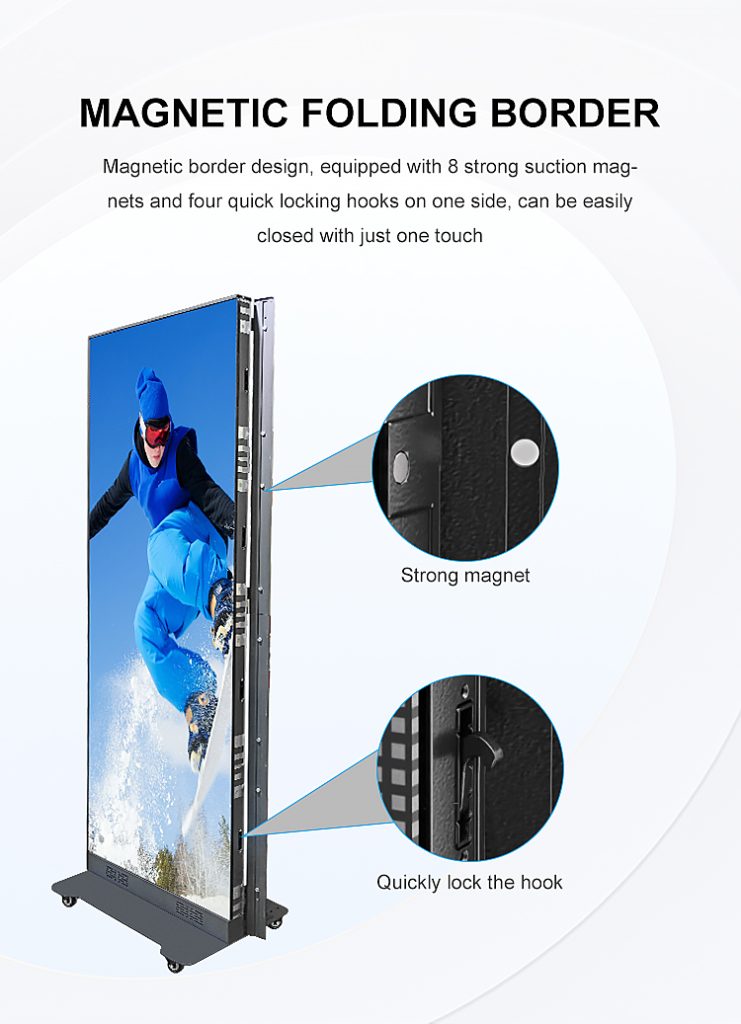
Seamless splicing capability: Foldable LED posters support multi-unit configuration with invisible bezels through integrated splicing architecture. Two, three, or four units can be positioned adjacent to each other with unified content management, creating larger displays without perceptible visual discontinuity. This splicing capability enables retailers to:
- Deploy standardized mid-size units (640×1920mm) across all locations
- Create larger displays in flagship stores by splicing units horizontally or vertically
- Reconfigure and repurpose units across locations without hardware replacement
- Scale display networks cost-effectively by adding units incrementally
This architectural flexibility fundamentally transforms LED technology from a commodity display solution into a modular infrastructure platform supporting future business evolution.
Total Cost of Ownership: Financial Analysis Spanning Five-Year Deployment
Comprehensive Cost Modeling Comparing Purchase, Operation, and Maintenance Expenses
While initial acquisition cost represents the most visible financial metric, total cost of ownership—encompassing purchase price, installation costs, electricity consumption, maintenance and repairs, and replacement components over five-year operational periods—reveals a dramatically different financial narrative.
Five-Year TCO Comparison (Single Display Unit):
LCD Display TCO:
| Cost Category | Amount | Notes |
| Initial Purchase | $2,000 | Mid-range LCD poster |
| Installation | $500 | Professional setup and testing |
| Annual Electricity (Year 1-5) | $4,800 | $960/year × 5 years |
| Maintenance & Repairs (Year 1-5) | $3,500 | Professional calibration + emergency repairs |
| Brightness Degradation Replacement (Year 5) | $1,500 | Partial replacement due to light output decline |
| 5-Year Total Cost | $12,300 | Annual Average: $2,460 |
Foldable LED Poster TCO:
| Cost Category | Amount | Notes |
| Initial Purchase | $3,500 | Mid-range foldable LED poster |
| Installation | $100 | Minimal on-site setup required |
| Annual Electricity (Year 1-5) | $480 | $96/year × 5 years |
| Maintenance & Repairs (Year 1-5) | $800 | Module replacement + preventive maintenance |
| Brightness Degradation (Year 5) | $0 | Automatic compensation; no replacement needed |
| 5-Year Total Cost | $4,880 | Annual Average: $976 |
Five-Year Financial Advantage: Foldable LED Poster
- Absolute savings: $12,300 – $4,880 = $7,420 per unit
- Percentage reduction: 60% lower total cost of ownership
- ROI improvement: 32% higher ROI vs. LCD alternative
Multi-Location Deployment Financial Impact:
For retailers deploying 25 display units across multiple locations:
- LCD total 5-year cost: $12,300 × 25 = $307,500
- LED total 5-year cost: $4,880 × 25 = $122,000
- Total savings: $185,500
This financial advantage justifies substantial initial capital investment in foldable LED technology, creating executive-level business case validation for technology transition.
Comparative Performance Summary Table
| Performance Dimension | LCD Display | Foldable LED Poster | Advantage |
| Brightness | 300-700 nits | 750-5,000 nits | LED (7-15x) |
| Viewing Angle (H/V) | 120° / 120° | 140-160° / 140-160° | LED |
| Annual Power Consumption | 8,000 kWh | 800 kWh | LED (90% reduction) |
| Operating Lifespan | 30,000-50,000 hrs | 80,000-100,000 hrs | LED (2-3x longer) |
| 5-Year Lifespan | 3-5 years | 8-12 years | LED |
| Module Replacement Cost | $500-$2,000 (full unit) | $50-$200 (individual module) | LED (90% cost reduction) |
| Annual Maintenance Cost | $800-$1,600 | $160-$240 | LED (80% reduction) |
| Initial Purchase Price | $500-$2,500 | $1,000-$5,000 | LCD (lower upfront) |
| 5-Year Total Cost (Single Unit) | $12,300 | $4,880 | LED (60% savings) |
| Custom Cabinet Availability | Limited options | Extensive options | LED |
| Multi-Unit Splicing | Not possible | Seamless integration | LED |
| Outdoor Suitability | Poor | Excellent | LED |
Industry Applications: Context-Specific Performance Validation
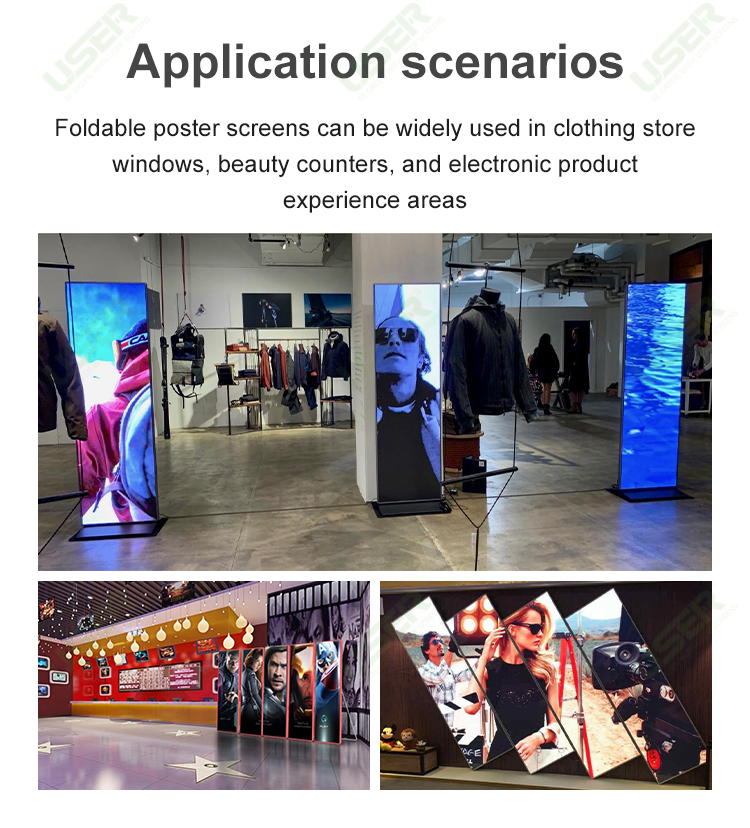
Retail Environment Performance
LCD Application Limitations:
Window displays and high-ambient-light retail spaces exceed LCD brightness capabilities during daylight hours, creating 6-8 hours daily of degraded visibility precisely when customer traffic peaks. Maintenance requirements escalate in retail environments where 24/7 operation is standard practice.
Foldable LED Poster Advantage:
Superior brightness ensures consistent visibility throughout operating hours. Modular maintenance enables rapid service without display downtime, supporting continuous promotional deployment. Multi-location retail chains benefit from standardized units enabling rapid expansion and reconfiguration.
Trade Show and Event Environment Performance
LCD Application Limitations:
Event booths operate in highly variable lighting conditions as exhibition halls transition between ambient room lighting and stage lighting during presentations. LCD displays struggle with these lighting transitions, requiring frequent brightness adjustments. Heavy booth redesign and relocation every event creates transportation stress on rigid LCD structures.
Foldable LED Poster Advantage:
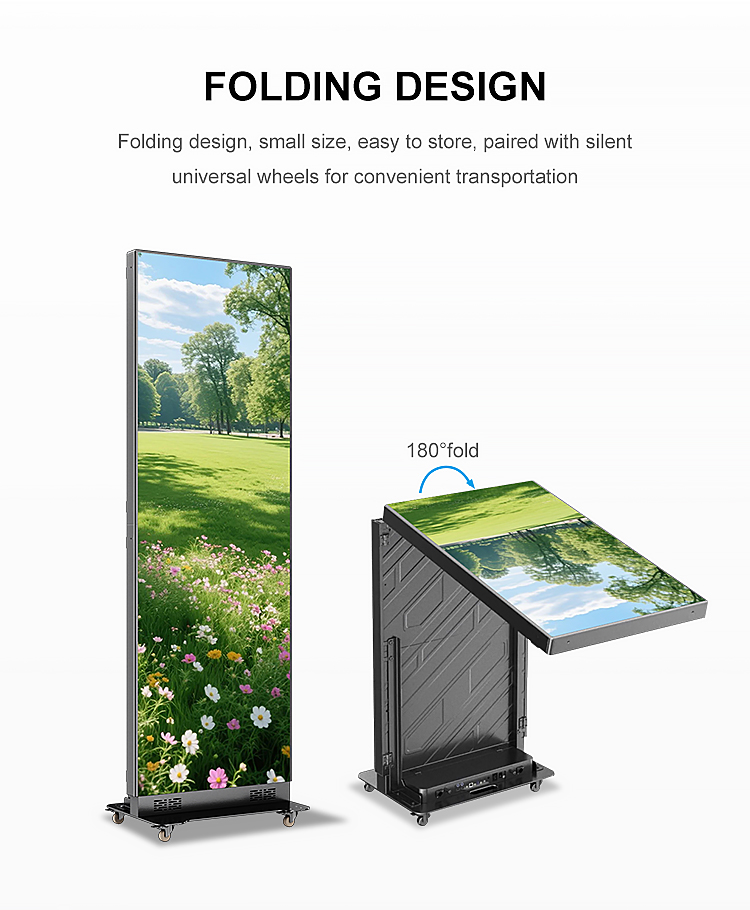
Auto-brightness compensation handles lighting transitions seamlessly. Compact folded transport reduces shipping damage risk and logistical costs. Rapid setup/teardown timelines (under 5 minutes) align with event scheduling constraints. Splicing capability enables configuration flexibility matching booth layout variations.
Transportation and Outdoor Environment Performance
LCD Application Limitations:
Outdoor and semi-outdoor environments exceed LCD brightness capabilities entirely, rendering LCD displays unsuitable for these applications without custom high-brightness variants (which add significant cost). Environmental exposure accelerates LCD degradation due to temperature and humidity extremes.
Foldable LED Poster Advantage:
High brightness (3,500-5,500 nits) ensures visibility in full sunlight. IP65+ weatherproofing enables reliable operation in rain and humidity extremes. Long operational lifespan justifies outdoor investment. Modular maintenance enables rapid component replacement if environmental exposure causes localized damage.
Return on Investment Metrics: Quantifying Business Value
Beyond technical specifications, decision-makers require financial justification demonstrating how technology investment translates to business outcomes.
Promotional Effectiveness and Revenue Impact:
Market research indicates LED display promotional campaigns achieve 20-35% higher engagement rates compared to static printed signage equivalents. For retail environments, this engagement premium translates to incremental revenue through:
- Increased attention capture (more customers notice promotions)
- Enhanced purchasing intent (dynamic video content drives 400% more engagement than static imagery)
- Promotional flexibility (content changes enable real-time response to competitive pricing and seasonal opportunities)
A typical retail location with 5,000 weekly customer visits and 2% engagement rate on promotional signage achieves:
- Static signage engagement: 100 customer interactions weekly
- LCD poster engagement (conservative estimate): 135 customer interactions weekly (35% improvement)
- Foldable LED engagement (realistic estimate): 160 customer interactions weekly (60% improvement vs. static)
Assuming 15% of engaged customers purchase promoted products at average transaction value of $25:
- Weekly revenue lift (LED vs. static): 160 × 0.15 × $25 = $600
- Annual revenue lift: $600 × 52 = $31,200 per location
For retail chains deploying 25 locations, this engagement-driven revenue premium totals approximately $780,000 annually—vastly exceeding the $185,500 total technology cost differential calculated earlier, and supporting rapid payback periods (less than 3 months).
Conclusion: Strategic Decision Framework for Technology Selection
The comprehensive analysis comparing foldable LED posters and traditional LCD displays reveals a clear technological and financial hierarchy. While LCD posters maintain cost advantages in initial acquisition expenses, foldable LED posters deliver:
- Superior visual performance across brightness, viewing angles, and environmental conditions
- Substantial operational efficiency through 90% power consumption reduction
- Extended operational longevity providing 2-3x service life extension
- Dramatically lower maintenance burden and associated service costs
- Architectural flexibility enabling future scalability and reconfiguration
- Compelling financial returns justifying investment within 12-24 month timeframes
For businesses deploying displays in high-ambient-light environments, requiring operational flexibility, planning multi-location rollouts, or seeking long-term cost optimization, foldable LED poster technology represents the superior investment choice. The 32% ROI improvement over five-year periods, combined with promotional effectiveness advantages and operational efficiency gains, creates compelling justification for technology transition from legacy LCD infrastructure.
The decision represents not merely a technology upgrade, but a strategic business infrastructure investment delivering quantifiable financial and operational advantages extending throughout extended deployment horizons.
Additional Resources
For comprehensive foldable LED poster specifications, installation guidance, and customization options, explore the complete product portfolio and technical documentation at https://www.userledscreen.com/, where qualified display specialists provide personalized consultation supporting technology selection aligned with specific business requirements and deployment environments.