

In the hyper-competitive landscape of modern retail and public messaging, the battle for consumer attention is won and lost in milliseconds. Static signage is rapidly fading into obsolescence, replaced by dynamic digital surfaces that can adapt, engage, and convert. At the heart of this digital transformation lies a critical hardware decision that business owners, facility managers, and marketing directors must face: the choice between Liquid Crystal Display (LCD) technology and the commercial advertising poster led display.
While both technologies promise to deliver digital content to your audience, they are fundamentally different tools with distinct performance envelopes, lifecycles, and return-on-investment (ROI) profiles. This comprehensive guide analyzes the technical and commercial disparities between these two giants of digital signage, explaining why the shift toward LED technology is reshaping the advertising industry.
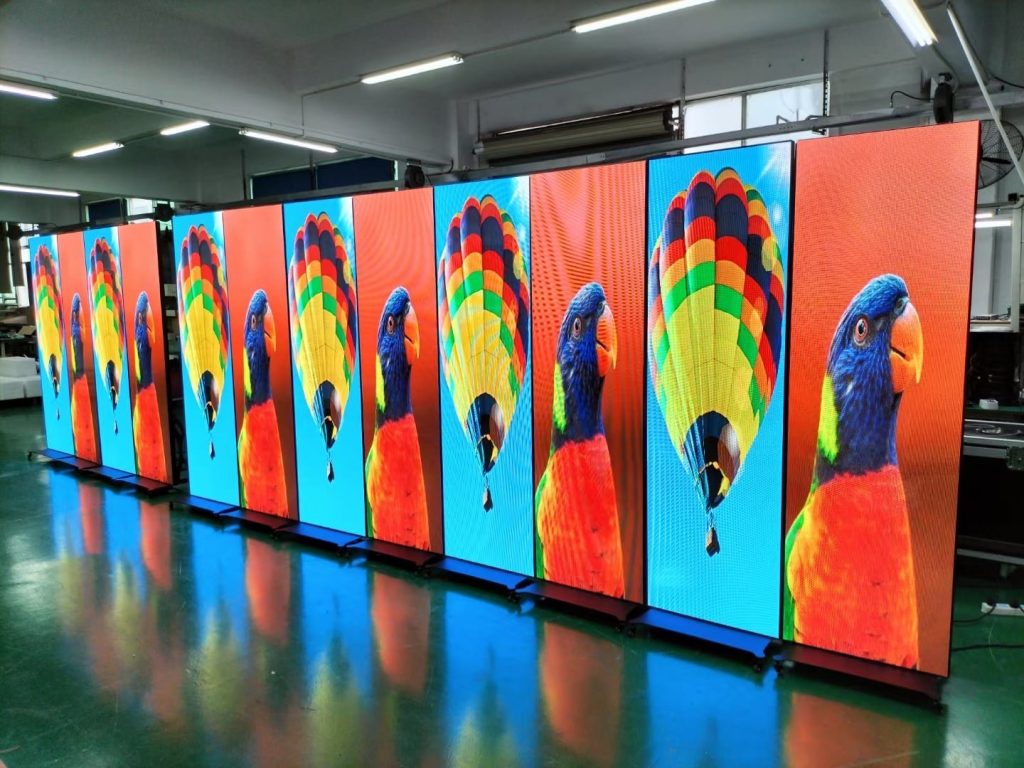
The Fundamental Difference: Backlight vs. Self-Emitting
To understand why a commercial advertising poster led display often outperforms its LCD counterpart, one must first understand the architecture of the image.
LCD technology is subtractive. It relies on a constant, always-on white backlight located behind a layer of liquid crystals. These crystals act as shutters, opening and closing to let light through colored filters to create an image. Even when displaying black, the backlight is blazing away, and the crystals are simply trying to block it. This results in light leakage, lower contrast, and higher energy baselines.
In contrast, Direct-View LED (Light Emitting Diode) technology is additive and self-emitting. In a commercial advertising poster led display, each pixel is a tiny light bulb (or a cluster of red, green, and blue diodes). When the image calls for black, the pixel simply turns off. There is no backlight. This fundamental difference drives every major advantage LED holds: superior brightness, infinite contrast, and energy efficiency.
Round 1: Brightness and Visibility—The “Sunlight Test”
The most immediate differentiator between the two technologies is raw luminance, measured in nits (candelas per square meter). This is the single most important metric for any digital signage facing a window or placed in a bright atrium.
LCD screens, even “high-brightness” professional models, typically top out between 300 and 700 nits. While this is sufficient for a dimly lit living room or a controlled corporate boardroom, it is often disastrous for commercial advertising. In a shopping mall with skylights or a storefront facing the street, 700 nits appears washed out and dim. Glare from the glass surface of an LCD panel further degrades visibility, rendering the advertisement unreadable.
A commercial advertising poster led display, however, operates in an entirely different weight class. Standard indoor LED posters effortlessly deliver brightness levels ranging from 1,000 to over 3,000 nits. For window-facing or outdoor applications, specifications jump to 5,000 or even 10,000 nits.
This capability allows LED content to cut through direct sunlight, ensuring that brand messaging remains vibrant and legible regardless of the weather or time of day. For businesses relying on foot traffic, this visibility is non-negotiable. If a customer cannot see your promotion from the sidewalk because of the sun’s reflection, the advertising investment is wasted. The commercial advertising poster led display ensures that your content is the brightest object in the viewer’s field of vision, naturally commanding attention.
Round 2: Contrast and Visual Impact
Brightness gets attention, but contrast keeps it. Contrast ratio is the difference between the brightest white and the darkest black a screen can produce.
Because LCDs rely on a backlight that can never be fully blocked, “black” on an LCD screen is actually a glowing dark gray. This limits the depth of the image and reduces color “pop.”
The commercial advertising poster led display boasts contrast ratios ranging from 4,000:1 to 8,000:1 and beyond. Because black pixels are effectively “off,” the contrast is theoretically infinite. This creates a visual experience where colors seem to leap off the screen. For luxury brands, automotive showrooms, and high-end retail, this visual fidelity is crucial. It conveys a subconscious message of quality and premium positioning that washed-out LCD screens cannot match.
Furthermore, LED technology offers superior viewing angles (typically 140-160 degrees). LCD panels often suffer from color shifting or brightness drop-off when viewed from the side—a common occurrence in retail corridors where pedestrians approach signage from acute angles. LED maintains color accuracy and brightness from virtually any vantage point, maximizing the impressions generated by your commercial advertising poster led display.
Round 3: The Bezel-Free Advantage
Aesthetics play a massive role in interior design and architectural integration. Here, LCD suffers from a hardware limitation: the bezel. Every LCD panel, no matter how “slim,” requires a border to house the electronics and glass. When you attempt to create a large video wall by tiling LCD screens together, you are left with a grid of black lines breaking up the image.
The commercial advertising poster led display is a seamless technology. LED modules can be tiled together to create displays of any size or aspect ratio without visible seams. A standalone LED poster can be linked with five others to create one massive, uninterrupted panoramic screen. This “frameless” canvas allows for more creative freedom. Designers are not constrained by the 16:9 aspect ratio of a TV panel; they can create columns, ribbons, or massive immersive walls that integrate perfectly into the environment.
For unparalleled seamless display solutions, explore the offerings at https://www.userledscreen.com/, where modular design meets aesthetic perfection.
Round 4: Lifespan, Durability, and Maintenance
Commercial advertising equipment is an asset, and depreciation matters. The operational lifespan of display technology defines its true value.
LCD panels generally utilize organic components in their liquid crystal layers and backlights that degrade over time. The typical lifespan for a commercial LCD is 50,000 to 70,000 hours. Furthermore, if the backlight fails or a row of pixels dies, the entire unit usually needs to be replaced. There is no easy way to repair a “dead spot” on an LCD screen.
A commercial advertising poster led display is engineered for endurance, typically rated for 80,000 to 100,000 hours of continuous operation. This equates to over 11 years of 24/7 usage.
More importantly, LED displays are modular. They are constructed of smaller modules (e.g., 250mm x 250mm tiles). If a pixel is damaged by a vandal or an electronic component fails, a technician can simply swap out the specific magnetic module in minutes, often without even turning off the rest of the screen. The cost of repair is a fraction of the cost of replacement. This serviceability ensures that a commercial advertising poster led display retains its pristine appearance for a decade, whereas an LCD wall with one broken screen looks neglected and unprofessional immediately.
Regarding environmental durability, LED is the clear winner for semi-outdoor or outdoor environments. Many commercial LED posters feature IP65 ratings, meaning they are dust-tight and protected against water jets. LCDs generally require expensive, bulky protective enclosures to survive similar conditions, which adds cost and bulk while trapping heat.
Round 5: The Energy Efficiency Equation
Sustainability and operational costs are top-of-mind for 2025 business strategies. There is a common misconception that LED screens are power-hungry because they are so bright. However, the data tells a different story.
As noted in the comparison, LCDs consume power constantly. A 100-inch LCD video wall consumes electricity across the entire surface area 100% of the time the unit is on, regardless of whether the image is white or black.
The commercial advertising poster led display utilizes selective pixel illumination. If your content has a black background with white text, only the white pixels are drawing significant power. The black areas draw almost zero.
Moreover, modern LED displays are equipped with intelligent environmental sensors. An LCD typically runs at a set brightness. A high-quality commercial advertising poster led display will automatically dim itself on cloudy days or during evening hours, optimizing power usage in real-time.
Market data suggests that for equivalent size and brightness impact, the power consumption efficiency can favor LED by a significant margin. When you factor in the heat generation—LCD walls can turn into massive radiators requiring additional HVAC cooling costs—the energy efficiency argument swings heavily toward Direct-View LED.
Round 6: Cost Structure and ROI
The “sticker shock” is the primary hurdle for LED adoption. It is an undeniable fact: the upfront purchase price of a high-resolution commercial advertising poster led display is higher than that of a commodity LCD screen. Entry-level commercial LCDs are inexpensive, driven down by the economies of scale of the television market.
However, smart capital expenditure is about Total Cost of Ownership (TCO), not just the initial invoice.
The False Economy of LCD:
- Replacement Rate: You may buy two or three LCD screens in the time span of one LED display’s life.
- Installation Costs: Installing a video wall of LCDs requires precise, complex mounting brackets to minimize bezel gaps.
- Content Limitations: Because of low brightness, LCDs limit where you can advertise (away from windows), potentially losing high-value impressions.
The ROI of LED:
- Revenue Generation: A brighter, more attractive screen grabs more attention. Research indicates that LED displays can drive sales lifts of up to 30-40% compared to static or dim signage.
- Versatility: A portable commercial advertising poster led display on wheels can be moved from the window (daytime) to the event space (evening), serving double duty.
- Residual Value: Because they are modular and repairable, high-quality LED screens retain resale value, whereas used LCDs are electronic waste.
When amortized over a 5-7 year period, the cost-per-impression of a commercial advertising poster led display is often lower than LCD, despite the higher entry fee.
Application Scenarios: When to Choose What?
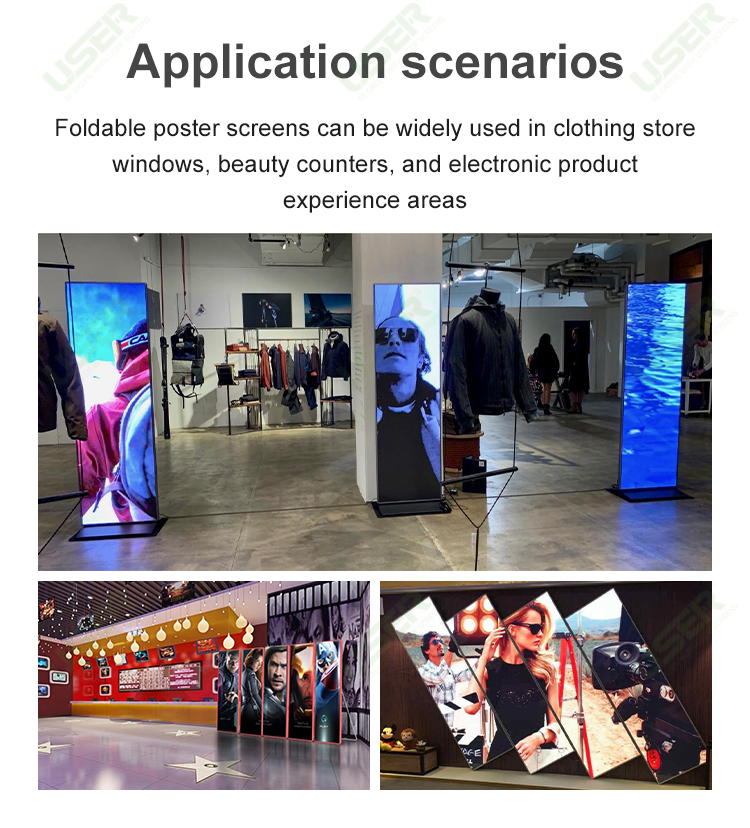
While the trend is moving toward LED, is there still a place for LCD? Yes. The choice depends on the specific “Search Intent” of the deployment—what is the goal of the screen?
Choose LCD When:
- Viewing distance is extremely close (under 1 meter): If the viewer is touching the screen (interactive kiosk) or reading fine print document text from 2 feet away, the high pixel density of 4K LCD is still superior to all but the most expensive MicroLEDs.
- Budget is the only constraint: If the project has strictly zero capital flexibility, LCD is the budget option.
- Static, text-heavy information: For flight information display systems (FIDS) where static text sits for hours, the sharpness of LCD is beneficial.
Choose a Commercial Advertising Poster LED Display When:
- Distance is 2 meters or more: For standard retail viewing distances, P1.8 or P2.5 LED is indistinguishable from HD.
- Ambient light is present: Any windows, atrium lights, or outdoor usage demands LED.
- Impact is the goal: If the goal is to stop someone in their tracks, LED’s vibrancy is required.
- Aesthetics matter: If you want a sleek, bezel-free look that implies modernity.
- Versatility is needed: If you need to link screens together for a large wall one day and separate them for different aisles the next.
The Future: MicroLED and COB Technology
The gap between LCD and LED is widening further with the introduction of Chip-on-Board (COB) and MicroLED technologies. These advancements are allowing commercial advertising poster led display units to achieve even finer pixel pitches (P0.9, P1.2), rivaling the resolution of LCDs while keeping all the benefits of high brightness and contrast.
COB technology encapsulates the LED chips directly on the board, making the screens incredibly rugged. Unlike traditional fragile LEDs, COB displays can be wiped down with a wet cloth and are resistant to impact—solving one of the few historical weaknesses of LED in high-traffic areas.
Conclusion: The Strategic Advantage
In the analysis of commercial advertising hardware, the conclusion is clear. While LCD served as the bridge from analog to digital, the commercial advertising poster led display represents the mature, high-performance future of the medium.
For businesses, the decision comes down to the objective. If the objective is simply to display information cheaply, LCD suffices. But if the objective is to advertise—to compel, to attract, and to rise above the visual noise of the modern environment—LED is the only technology capable of delivering the necessary intensity and engagement.
By investing in a commercial advertising poster led display, businesses are not just buying a screen; they are acquiring a durable, energy-efficient, and high-impact communication asset that will drive foot traffic and revenue for a decade. As the technology continues to evolve and prices normalize, the “LED vs. LCD” debate is effectively ending, with LED standing as the undisputed champion of commercial visibility.
For those ready to upgrade their visual strategy with cutting-edge technology, visit https://www.userledscreen.com/ to explore professional-grade LED solutions tailored for high-impact commercial advertising.