
COMPLETE DELIVERABLE: Cinema Poster LED Display SEO-Optimized Article
Introduction
The entertainment industry stands at an inflection point. Traditional cinema projection systems, long considered the gold standard for theatrical experiences, now face serious competition from direct-view LED technology. Cinema poster LED displays represent a paradigm shift in how theaters engage audiences, generate revenue, and operate facilities. For facility managers, theater owners, and cinema chains making significant capital investments, understanding the strategic advantages of LED displays has become essential to competitive positioning.
The global cinema LED display market reflects this transformation. Theater operators increasingly recognize that LED technology delivers not just superior image quality, but quantifiable business improvements: higher concession sales, reduced operational costs, new advertising revenue streams, and decreased energy consumption. This comprehensive guide explores the commercial and technical case for cinema poster LED displays, providing facility managers and decision-makers with the evidence-based framework needed to evaluate this transformative technology.
The Core Business Case: Why Theater Operators Are Switching to LED
Revenue Multiplication Through Digital Menu Boards
The primary driver of cinema LED display adoption centers on concession revenue optimization. Digital menu boards installed in theater lobbies and concession areas dramatically alter customer purchasing behavior. Industry research demonstrates that digital menu boards increase impulse purchases at concession stands by 20-30%—a significant uplift compared to static signage.
The mechanism driving this improvement operates on multiple levels. First, dynamic visual presentation captures attention more effectively than static posters. Motion graphics and animated promotions trigger the eye’s natural response to movement, keeping customer focus on promotional messaging longer. Second, digital boards enable real-time pricing and promotion changes, allowing theater operators to respond instantly to inventory levels, demand patterns, and time-of-day variations. A concession manager can push a premium item promotion at peak evening hours, then switch messaging during afternoon matinees—something impossible with static posters requiring manual change-outs.
Third, and most powerfully, digital menus employ sophisticated merchandising techniques. Motion highlighting can direct attention specifically to high-margin items (the 3-5% increase in average transaction value documented by industry studies). Strategic placement of upsell items—a premium beverage paired with popcorn, specialty candy bundled with larger concession packages—influences purchasing psychology in ways static menus cannot replicate.
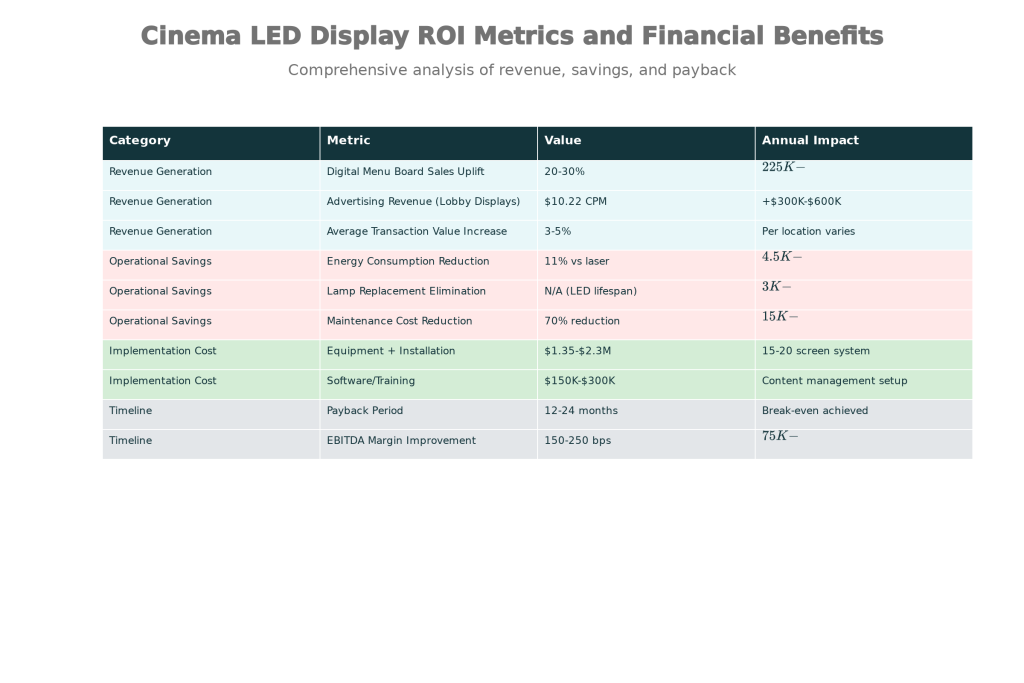
The financial impact compounds across seasons. A multi-location theater chain implementing digital menu boards across 20-50 locations experiences measurable top-line revenue increases. A single location serving 300-500 daily customers can capture an additional $15,000-$30,000 annually from 3-5% transaction value increases alone. For a 15-location regional chain, this translates to $225,000-$450,000 in incremental concession revenue—with no additional traffic required.
Cinema LED Display ROI Metrics: Financial Impact Summary
Secondary Revenue Streams: Cinema Advertising Ecosystem
Beyond concession optimization, cinema poster LED displays unlock entirely new revenue categories. Theater lobbies represent high-value advertising real estate: audiences gather for 20-30 minutes before screenings, removing distractions (phones are discouraged), with inherent purchase intent (they have already bought tickets, demonstrating entertainment spend capacity). This captive audience environment commands premium advertising rates.
Brands seeking cinema advertising opportunities view theater lobbies as sophisticated venues for reaching affluent, entertainment-engaged demographics. Local and national advertisers pay venue fees for lobby screen placement, supporting categories like automotive (luxury vehicles, dealership promotions), consumer packaged goods (beverage and snack brands), financial services, and entertainment properties (upcoming film promotions, streaming service advertising).
The Los Angeles market demonstrates these dynamics concretely. Average cinema advertising achieves CPM (cost per thousand impressions) of $10.22, with per-theater monthly impressions exceeding 1.7 million. A 20-screen multiplex with multiple lobby displays generates 30-50 million monthly ad impressions, creating consistent inventory for national and regional advertising campaigns.
This revenue model operates independently from concession margins. While digital menu boards drive internal transaction improvements, cinema lobby advertising generates pure incremental revenue from external brand partnerships. Theater chains negotiate annual advertising agreements, creating predictable revenue streams. Premium placement—screens positioned at concession stand entry points or main lobby thoroughfares—command higher rates. Exclusive category deals (one automobile manufacturer per market, one beverage brand per property) maximize advertiser value and venue pricing power.
Technical Foundation: Why DCI Certification Matters for Commercial Viability
Understanding DCI Compliance Requirements
Any cinema poster LED display installation in a professional theater environment must achieve DCI certification—a non-negotiable requirement established by Digital Cinema Initiatives, LLC, a consortium controlled by major motion picture studios. Without DCI certification, displays cannot legally show theatrical content, eliminating the core use case for cinema operators.
DCI certification establishes rigorous standards across multiple technical dimensions. Color accuracy must match DCI-P3 color gamut specifications, ensuring that studio-mastered content displays exactly as creators intended. Resolution must support both 2K (2048×1080) and 4K (4096×2160) standards, with 4K becoming increasingly mandatory for premium applications. Contrast ratios typically must exceed 4000:1, enabling true blacks and bright highlights within a single scene.
The evolution toward HDR (High Dynamic Range) capability represents the current frontier of DCI certification. Traditional cinema displays operate in SDR (Standard Dynamic Range), with fixed gamma curves and limited brightness/darkness extremes. HDR cinema requires much higher brightness levels (display peaks at 300+ nits for major studios’ HDR mastering), expanded color gamuts, and sophisticated tone-mapping capabilities.
LED displays possess inherent advantages for DCI compliance compared to traditional projection. Direct-view LED technology generates light directly from individual diodes, enabling true blacks by turning off pixels completely—something impossible with projection systems that must project minimum light levels. This fundamental property allows LED displays to achieve significantly higher contrast ratios while simultaneously supporting HDR with superior dynamic range.
The certification process itself demands substantial investment. Manufacturers must submit equipment for comprehensive testing by DCI-accredited laboratories, verifying compliance across dozens of technical parameters. The testing process typically requires 6-12 months and significant engineering resources. Only the most committed manufacturers (Samsung with Onyx Cinema LED, LG with Miraclass, GDC with Cinity LED, and specialized vendors) maintain active DCI certifications.
Why DCI Matters to Theater Operators
For facility managers and theater owners, DCI certification provides critical assurance. First, it guarantees content compatibility. Major studios and distributors exclusively release theatrical content in DCI-compliant formats. Without certification, theater operators face compliance friction, requiring separate content preparation or losing access to premium releases.
Second, DCI certification signifies quality standards that protect audience experience. Audiences expect theater movie presentation to match streaming and home options—or exceed them. DCI-certified displays ensure brightness, contrast, color accuracy, and HDR performance meet international theatrical standards.
Third, certification mitigates long-term risk. DCI standards continuously evolve, adding requirements (HDR certification represents a recent addition). Equipment from uncertified manufacturers may become obsolete as studios transition to new distribution standards. DCI-certified equipment from established vendors includes roadmap clarity and upgrade pathways.
Energy Efficiency: The Hidden Operational Advantage
Quantifiable Power Consumption Advantages
Energy consumption represents a significant but often overlooked operational expense for theater operators. Traditional cinema projection systems (RGB laser projectors specifically) consume substantial power. Samsung’s Onyx Cinema LED display, for comparison, demonstrates typical power consumption of 3.74KW compared to 4.2KW for equivalent RGB laser projection systems—approximately 11% energy reduction for equivalent output.
This differential compounds dramatically across operational hours. A typical multiplex operating 14 hours daily (matinee through late evening screenings) across 15-20 screens generates monthly electricity consumption measured in thousands of kilowatt-hours. An 11% reduction across a full facility translates to 300-500 kWh monthly savings, depending on screen count and usage patterns. At regional electricity rates ($0.12-$0.18 per kWh), annual savings reach $4,500-$10,800 per facility—meaningful budget relief for operating margins.
Beyond direct electrical savings, LED displays eliminate consumables required by projection systems. Traditional projectors depend on replacement lamps/light sources, typically costing $3,000-$8,000 per replacement, with replacement cycles of 3,000-8,000 hours depending on technology type. LED displays eliminate this category of expense entirely, with manufacturer-specified lifespans of 50,000+ hours.
Energy Flexibility and Environmental Compliance
LED technology provides additional operational flexibility unavailable with projection systems. Direct-view LED brightness can be dynamically adjusted based on ambient lighting conditions, enabling facilities to optimize energy consumption for different times of day. Afternoon matinees can operate at lower brightness levels (reducing power consumption), while evening premium screenings operate at maximum brightness.
This flexibility aligns with increasingly stringent environmental regulations and corporate sustainability commitments. Theater chains pursuing carbon neutrality targets and ESG (Environmental, Social, Governance) objectives find LED technology instrumental to emissions reduction goals. The elimination of mercury-containing lamps in projection systems also addresses hazardous materials handling and disposal costs.
Comparative Analysis: LED Displays vs. Traditional Projection Systems
Image Quality Dimensions
LED displays surpass traditional projection in three critical image quality metrics. Contrast stands as the defining differentiator. Direct-view LED technology achieves true black reproduction (zero nits) by deactivating individual pixel elements, while projection systems must project minimum light levels, resulting in grayscale blacks rather than true black. This fundamental difference translates to dramatically superior perceived image quality, particularly in dark scenes comprising 40-50% of theatrical content.
Brightness uniformity represents a second advantage. Projection systems must account for screen curvature, viewing angle degradation, and hotspot artifacts (brighter centers, dimmer edges). LED displays deliver consistent brightness across all viewing angles and screen positions, ensuring equivalent visual experience from any seat.
Color accuracy and gamut constitute the third dimension. DCI-certified LED displays maintain consistent color space throughout the brightness range, eliminating color shift artifacts common in projection as brightness varies. This capability becomes especially critical for HDR content, where color accuracy matters across 10-100x greater brightness variations than SDR.
Operational Reliability and Maintenance
Traditional projection systems require ongoing maintenance: lamp replacement every 3,000-6,000 hours, air filter changes, alignment verification, and periodic recalibration. These maintenance intervals generate cumulative operational costs and scheduling complexity. A facility running 15 screens requires systematic tracking of 15 lamp lifecycles, coordinating replacement during low-traffic periods to minimize disruption.
LED displays require dramatically less maintenance. Pixel-level redundancy in premium installations allows display systems to continue operating at full performance even if individual diodes fail (degradation only becomes visible after multiple diode failures). Professional service intervals extend to annual or semi-annual verification, compared to quarterly maintenance typical for projection systems.
This operational simplification carries secondary benefits: reduced downtime risk, lower technical expertise requirements for maintenance staff, and more predictable maintenance scheduling. Theater operators can plan maintenance during planned closures rather than emergency repairs disrupting operations.
Installation and Infrastructure Implications
LED displays eliminate projection booth infrastructure entirely. Traditional projection requires climate-controlled rooms, elaborate cooling systems (laser projectors generate significant heat), cable management for multiple image processing servers, and electrical infrastructure supporting 4-5KW sustained power.
Direct-view LED installations require far simpler infrastructure. Wall-mounting systems are straightforward, electrical requirements are consolidated to single connection points, and content delivery networks handle software/media distribution. For theater operators planning renovations or new construction, LED installations simplify building design and reduce infrastructure costs substantially.
Addressing Common Implementation Concerns
Installation and Integration Questions
Theater facility managers frequently ask whether LED displays integrate seamlessly into existing cinema workflows. The answer is definitively yes—but with important nuances. DCI-certified LED displays accept identical content formats as projection systems (JPEG2000 encoded DCP—Digital Cinema Package files). Content management systems, scheduling software, and distribution networks operate identically whether displays are LED or projection.
However, LED installation does require different expertise than projection booth management. LED displays integrate more closely with venue-wide AV systems, networking infrastructure, and content management platforms (from vendors like Kitcast, ScreenCloud, and Look Digital Signage). Theater operators benefit from vendor selection prioritizing implementation support and staff training—critical success factors often overlooked in cost-focused procurement.
For multi-location theater chains, LED displays enable superior centralized management. Cloud-based content management systems simplify scheduling, promotions, and emergency messaging across dozens of locations simultaneously. A regional chain can push a new promotional campaign to 30 locations simultaneously with confidence that display updates occur identically across all venues—something requiring substantially more coordination with projection systems.
Pixel Pitch Selection: Balancing Resolution and Cost
One technical decision requiring careful evaluation: pixel pitch selection (the distance between individual LED diodes, measured in millimeters). Smaller pixel pitches (P1.25-P2.5mm) deliver higher resolution images, enabling clarity and detail at close viewing distances (particularly important for cinema lobby poster displays where viewers stand 3-5 feet away). Larger pixel pitches (P4-P6mm) reduce resolution slightly but lower equipment costs substantially.
For cinema poster displays specifically, industry best practice gravitates toward P2.5mm pitch—delivering sufficient resolution for poster-quality image reproduction while maintaining cost-effectiveness for multi-location rollouts. This specification provides visibility of detail comparable to high-quality printed posters while remaining budget-friendly for multi-location deployments.
The Financial Case: ROI Timeline and Break-Even Analysis
Year-One Financial Model
Conservative financial modeling for a 15-20 screen cinema installation demonstrates compelling ROI. Assume 25% increase in concession transaction value from digital menu board optimization (a conservative estimate given 20-30% industry benchmarks). A theater serving 500 daily customers at $18 average transaction value ($9,000 daily concession revenue) experiences $2,250 daily uplift, translating to $821,250 annual incremental concession revenue.
Simultaneous advertising revenue generation from lobbies contributes $25,000-$50,000 monthly ($300,000-$600,000 annually) from annual advertising agreements with premium brands. Combined incremental revenue reaches $1.1-1.4 million annually from concession optimization and advertising alone.
Equipment and installation costs for a quality 15-20 screen LED system average $1.2-$2.0 million, with software, content management, and staff training adding $150,000-$300,000. Total system cost reaches $1.35-$2.3 million. Simple payback—the point at which incremental revenue equals total system cost—occurs in Year 1 to mid-Year 2, depending on execution quality and revenue realization rates.
Long-Term Financial Benefits Beyond Year Two
Beyond break-even, facility economics accelerate. Ongoing operational cost reductions (11% energy savings, elimination of lamp replacement, reduced maintenance overhead) generate additional $20,000-$40,000 annually in direct cost reductions. More importantly, these revenue streams prove highly durable. Concession revenue improvements sustain year-over-year (assuming continued digital merchandising discipline). Advertising agreements typically renew or expand as initial success encourages advertiser retention and new category participation.
Net margin improvement—the financial impact most relevant to theater owners—typically reaches 150-250 basis points (1.5-2.5 percentage point improvement) in overall facility EBITDA. For a theater generating $5-10 million in annual revenue, this translates to $75,000-$250,000 in incremental EBITDA annually, representing sustainable value creation well beyond initial implementation.
Implementation Best Practices: Maximizing Realization of Benefits
Vendor Selection Criteria
Selecting the right equipment vendor proves critical to success. DCI certification is table-stakes—non-negotiable requirement eliminating non-certified vendors immediately. Beyond certification, evaluate vendors on three dimensions: (1) global support infrastructure ensuring accessible technical service and parts availability, (2) proven implementation track record in theater environments (references from comparable installations), and (3) cloud-based content management software quality (an area where vendors diverge significantly in ease-of-use and feature capability).
Premium vendors (Samsung Onyx, LG Miraclass, GDC Cinity) command price premiums but deliver superior long-term value through implementation support, software capability, and brand recognition. Regional specialists (Cinstar, ViboLED, Leyard) offer competitive pricing while maintaining adequate support infrastructure. Evaluate total cost of ownership over a 5-7 year horizon rather than capital purchase price alone.
Content Strategy and Organizational Alignment
Technical installation represents only 50% of implementation success. Content strategy—the processes, governance, and creative execution around menu merchandising, advertising partnerships, and film promotion—determines whether financial benefits materialize. Facilities achieving superior ROI invest in content management discipline: assigning clear ownership for digital menu optimization, establishing promotional testing protocols, and building content calendars coordinating with seasonal demand patterns.
Organizational alignment proves equally critical. Digital menu boards deliver optimal results when concession management (typically vendors like Levy, Aramark, or Legends) maintains day-to-day control within governance frameworks established by venue IT. Advertising partnerships function best when a dedicated marketing resource manages brand relationships and content scheduling. Theater operators treating digital displays as true profit centers—rather than ancillary infrastructure—realize substantially superior financial outcomes.
Conclusion: The Strategic Imperative
Cinema poster LED displays represent far more than technological incrementation. For facility managers and theater operators evaluating capital investments, LED technology offers a compelling strategic case: superior image quality that differentiates theatrical experiences from streaming alternatives, quantifiable revenue improvements through concession optimization and advertising generation, measurable operational cost reductions through energy efficiency and maintenance elimination, and DCI-certified reliability ensuring long-term viability and content compatibility.
The financial case, grounded in documented industry benchmarks, demonstrates payback within 12-24 months, with sustainable margin improvements extending decades beyond break-even. Theater chains delaying LED adoption increasingly face competitive pressure from operators who have captured concession and advertising revenue opportunities LED technology enables.
The investment decision ultimately reflects strategic positioning: theaters can maintain legacy projection infrastructure indefinitely, but doing so leaves revenue opportunities uncaptured and cedes operational efficiency advantages to competitors. Conversely, theater operators implementing LED displays join a growing ecosystem of operators competing on customer experience and profitability through technology-enabled merchandising excellence.
For detailed information on cinema LED display solutions, implementation approaches, and technical specifications, facility managers can explore resources provided by leading vendors offering comprehensive guidance on technology selection and deployment strategies at https://www.userledscreen.com/ and comparable professional providers in the cinema display technology sector.
Key Takeaways for Theater Operators
- Revenue Impact: Digital menu boards increase concession impulse purchases 20-30%, with 3-5% average transaction value uplift translating to $225,000-$450,000 annually across 15-location chains.
- Advertising Opportunity: Cinema lobby displays unlock $300,000-$600,000 annual advertising revenue through premium brand partnerships at $10.22 CPM rates.
- Energy Efficiency: LED displays consume 11% less power than laser projection systems, generating $4,500-$10,800 annual facility-level savings, plus elimination of $3,000-$8,000 annual lamp replacement costs.
- DCI Compliance: Certification is mandatory for theatrical content compatibility, with direct-view LED delivering superior contrast ratios (4000:1+) and true black reproduction unavailable from projection systems.
- ROI Timeline: Total system payback (equipment + installation + software) occurs within 12-24 months, with sustained margin improvement of 150-250 basis points in facility EBITDA.
- Operational Simplification: LED displays require minimal maintenance compared to projection systems, reducing technical staffing demands and enabling more predictable operating schedules.