
Introduction
Finding the best poster LED display can be overwhelming with countless brands, specifications, and price points cluttering the market. Whether you’re a retail manager seeking digital menu boards, an advertiser planning outdoor billboards, or a corporate decision-maker investing in premium conference room displays, understanding the differences between top performers is critical for maximizing return on investment.
The LED display industry has experienced explosive growth, with LED signage adoption accelerating 31% year-over-year driven by indoor retail and corporate sectors adopting fine-pitch micro-LEDs for premium visual storytelling. The global LED poster display market is projected to reach $3,434 million with a growth rate of 6.3% CAGR through 2026, signaling strong market validation.
This comprehensive guide compares the leading brands, breaks down technical specifications, and provides decision frameworks to help you select the best poster LED display for your specific application and budget.
Understanding Poster LED Display Specifications
Before comparing brands and models, you need to understand the key technical parameters that define poster LED display performance.
Pixel Pitch (P-Rating)
Pixel pitch measures the distance between adjacent LED pixels in millimeters. This single specification dramatically impacts image quality, viewing distance, and cost.
Fine-Pitch Indoor Displays (P1.25–P1.86):
- Best for close-range viewing (2–4 meters)
- Ideal for boardrooms, retail displays, exhibition halls
- Superior image clarity and detail
- Higher cost (pixel density increases costs proportionally)
- Popular specifications: P1.25, P1.53, P1.86
Standard Indoor Displays (P2.0–P2.5):
- Optimal for medium viewing distances (2.5–4 meters)
- Best value for retail stores, malls, conference rooms
- Balanced cost-to-performance ratio
- Pixel density: 160,000–250,000 pixels/m²
- Brightness: 800–1,000 nits
Large-Pitch Outdoor Displays (P3.91–P10):
- Designed for long-distance visibility (5+ meters)
- Lower resolution but superior brightness
- Weatherproof construction
- Brightness: 5,000–10,000 nits
Brightness (Nits)
Brightness directly impacts content visibility in various lighting conditions.
Indoor Requirements:
- Standard office/retail: 600–800 nits
- Brightly lit retail: 1,000–1,500 nits
- Broadcast/live streaming: 1,500–2,500 nits
Outdoor Requirements:
- Shaded locations: 3,000–5,000 nits
- Direct sunlight exposure: 7,000–10,000 nits
Higher brightness improves visibility but increases power consumption. Selecting appropriate brightness for your environment prevents glare, reduces energy waste, and extends display lifespan.
Refresh Rate
Refresh rate measures how many times per second the display redraws its image.
- Standard: 1,920–3,840 Hz (sufficient for most content)
- Camera-critical applications: 3,840+ Hz (broadcast, live streaming, XR production)
- Higher refresh rates eliminate flicker visible to cameras and sensitive viewers
Viewing Angle
Viewing angle defines the horizontal and vertical angles at which content remains visible without color degradation.
- Standard: 160°–170° (suitable for most installations)
- Wide angle: 170°–180° (premium models, corporate applications)
- Wide viewing angles ensure content remains clear for distributed audiences
Contrast Ratio
Contrast ratio measures the difference between the brightest whites and darkest blacks.
- Standard: 4,000:1–5,000:1
- Premium: 8,000:1 and higher
- Higher contrast ratios deliver richer, more detailed visuals
Top Poster LED Display Brands & Models: Detailed Comparison
Samsung IF Series
Overview: Samsung’s IF Series ranks among the best LED digital signage displays in 2025 for premium indoor installations, combining exceptional color accuracy, HDR10+ support, and seamless modular scalability.
Key Specifications:
- Pixel pitch: 1.5–3.9 mm (fine-pitch to standard)
- Brightness: up to 1,800 nits
- Resolution: 4K and 8K capable
- Refresh rate: 3,840 Hz
- Viewing angle: 160° horizontal/vertical
- Power consumption: ≤9 W/ft²
- Operating temperature: –10°C to +40°C
Strengths:
- AI color calibration automatically adjusts to ambient lighting
- 22% energy savings vs. previous generation
- Seamless edge-to-edge design eliminates visible bezels
- Full CMS integration with Samsung MagicINFO
- Trusted for high-profile brand installations
Ideal Applications: High-end malls, corporate lobbies, luxury retail, broadcast studios
Price Range: $3,000–$5,000+ per cabinet
LG MAGNIT (Micro-LED)
Overview: LG’s MAGNIT is one of the most advanced micro-LED signage displays delivering 8K resolution, ultra-fine pixel pitch, and architectural-grade visual presentation for luxury environments.
Key Specifications:
- Pixel pitch: 1.56 mm (ultra-fine)
- Brightness: Up to 500 nits (peak 1,500 nits)
- Resolution: 8K capable
- Refresh rate: 3,840 Hz
- Viewing angle: 170° wide-angle
- Power consumption: 10 W/ft²
- Black coating technology reduces dust/fingerprints
Strengths:
- Micro-LED precision delivers sharpest visuals
- HDR10 Pro produces rich contrast and lifelike detail
- Superior durability with proprietary black coating
- AI Picture Pro enables real-time color mapping
- Modular tile system supports seamless installations
Ideal Applications: Corporate lobbies, luxury brand spaces, art galleries, premium retail
Price Range: $4,500–$6,000+ per cabinet
Absen KL Series
Overview: The Absen KL Series delivers the best value-for-money LED signage option in 2025, offering fine pixel pitch (1.8–2.9 mm) and 4K clarity with robust durability.
Key Specifications:
- Pixel pitch: 1.8–2.9 mm
- Brightness: 1,500 nits
- Resolution: 4K
- Refresh rate: 3,840 Hz
- Viewing angle: 160°
- Power consumption: 8.5 W/ft²
- Operating temperature: –10°C to +40°C
Strengths:
- Proven durability in event and venue environments
- Excellent price-to-performance ratio
- Fine pixel pitch suitable for close viewing
- Strong modular design simplifies maintenance
- Multiple connectivity options (HDMI, LAN, daisy-chain)
Ideal Applications: Events, conferences, retail networks, exhibitions, trade shows
Price Range: $1,500–$3,000 per cabinet
Unilumin UpanelS II
Overview: Unilumin’s UpanelS II supports custom 4K and 8K assemblies via ultra-fine 0.9–1.5 mm pixel pitch configurations, making it ideal for control centers and high-resolution applications.
Key Specifications:
- Pixel pitch: 0.9–1.5 mm (ultra-fine options)
- Brightness: up to 2,200 nits
- Resolution: 4K and 8K capable
- Wide color gamut for accurate color reproduction
- High refresh rate with low latency
Strengths:
- Among the brightest indoor LEDs available
- Customizable configurations for specialized applications
- Superior color accuracy suitable for control room applications
- Flexible modular design
Ideal Applications: Control centers, monitoring facilities, broadcast facilities, control rooms
Price Range: $5,000+ per installation
Planar CarbonLight CLI VX Series
Overview: Renowned for lightweight carbon-fiber framing and broadcast-grade color performance, Planar CarbonLight ranks among the most portable yet premium LED solutions.
Key Specifications:
- Lightweight carbon-fiber frame construction
- Brightness: 1,500 nits
- Resolution: 4K
- Viewing angle: 160°–170°
- Professional color calibration
- Portable design suitable for touring
Strengths:
- Exceptional portability without compromising performance
- Broadcast-grade color accuracy
- Fast setup and deployment
- Durable construction for frequent transport
- Professional technical support
Ideal Applications: Broadcasting, live events, touring shows, rental installations
Price Range: $3,200–$4,500 per cabinet
ViewSonic All-in-One LED Series
Overview: The ViewSonic All-in-One LED Series offers all-inclusive solutions optimized for fast installation in conference halls and corporate environments.
Key Specifications:
- Display size: 108″–216″ scalable
- Brightness: 1,200 nits
- Resolution: 4K
- Refresh rate: 3,840 Hz
- Viewing angle: 178°
- Power consumption: 8 W/ft²
- Operating temperature: 0°C to 40°C
Strengths:
- Quick installation with minimal assembly
- Professional appearance without complex setup
- Integrated control and content management
- Multiple size options for flexible installations
Ideal Applications: Conference rooms, corporate meetings, education venues, retail foyers
Price Range: $2,200–$3,500 per installation
Hisense 4K LED VisionPro
Overview: Hisense’s VisionPro combines native 4K UHD with energy-efficient operation, featuring android-based digital signage apps pre-installed for rapid deployment.
Key Specifications:
- Pixel pitch: Supports 4K assembly
- Brightness: 1,400 nits
- Resolution: Native 4K UHD
- Panel sizes: 55″–165″
- Refresh rate: 3,840 Hz
- Power consumption: 8.2 W/ft²
- Pre-installed digital signage apps
Strengths:
- Crisp text and menu visibility in high-ambient light
- Energy-saving architecture reduces operational costs
- Wide viewing angle (178°)
- Pre-configured for rapid deployment
- Excellent value proposition for retail and QSR
Ideal Applications: Restaurants, quick-service restaurants, retail chains, grocery stores
Price Range: $1,000–$2,500 per installation
LED vs. LCD: Complete Comparison Matrix
Understanding how poster LED displays compare to LCD alternatives clarifies technology trade-offs:
| Feature | LED Displays | LCD Displays |
| Brightness | 1,200–2,500 nits | 300–700 nits |
| Outdoor Visibility | Excellent (5,000–10,000 nits available) | Poor (washes out in sunlight) |
| Energy Efficiency | Moderate-to-high (8–12 W/ft² typical) | Lower power (3–6 W/ft²) |
| Lifespan | 100,000+ hours | 60,000–80,000 hours |
| Color Accuracy | Strong (HDR10 capable) | Excellent (highest pixel density) |
| Cost per Unit | $1,500–$6,000+ | $500–$1,500 |
| Scalability | Modular (unlimited sizes) | Limited (max 86″) |
| Viewing Angle | 160°–180° | 170°–178° |
| Close-Range Detail | Lower detail at <1.5m (pixelation visible) | Superior detail at all distances |
| Operating Lifespan | 10–15 years | 3–5 years under 24/7 use |
Bottom Line: LED displays excel in brightness, outdoor visibility, and durability. LCD displays outperform in color accuracy and initial cost for small indoor installations. For most poster display applications, LED’s brightness advantages justify the higher upfront investment.
Detailed Technical Specifications: Best Indoor Poster LED Displays
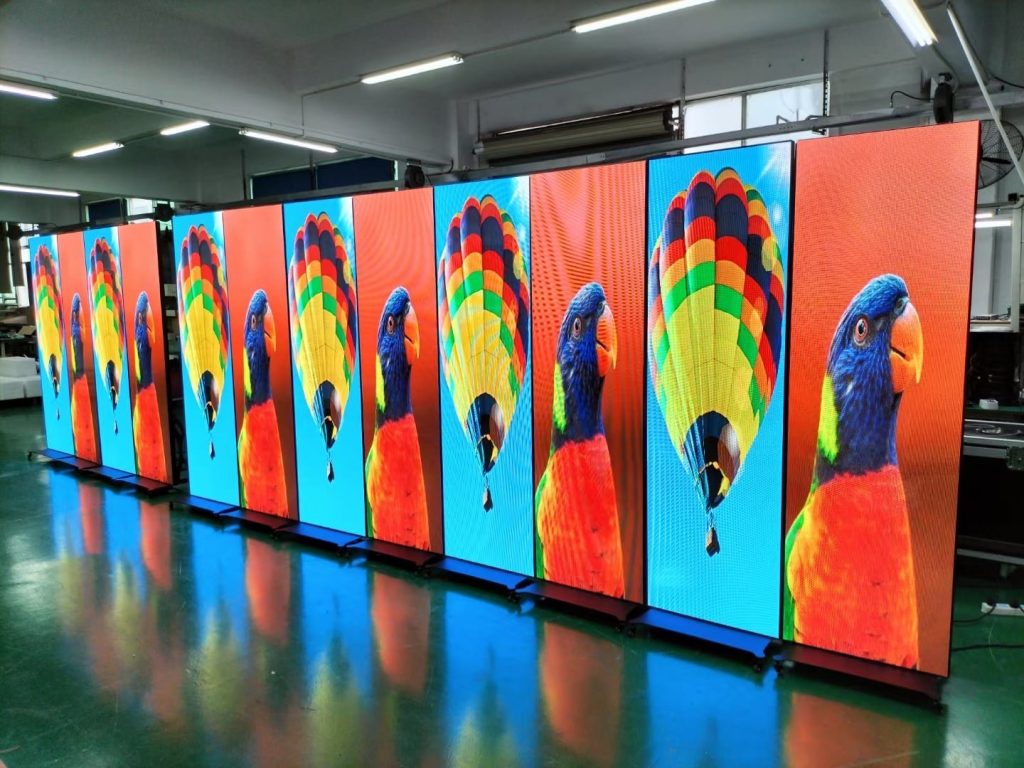
For retail, restaurant, and indoor advertising applications, these specifications represent the market standard:
P1.86 Indoor Poster LED Display
- Pixel density: 289,444 pixels/m²
- Brightness: 750 cd/m² (sufficient for retail)
- Best viewing distance: 3–10 meters
- Power consumption: 220–280 W/m² (average)
- Typical cabinet size: 640×1920 mm
- Ideal viewing angle: 140° horizontal/vertical
- Applications: High-end retail, corporate displays, exhibitions
P2.0 Indoor Poster LED Display
- Pixel density: 250,000 pixels/m²
- Brightness: 800–1,000 nits
- Best viewing distance: 2.5–8 meters
- Power consumption: 200–250 W/m² (average)
- Refresh rate: 3,840 Hz standard
- Gray scale: 14–16 bit
- Applications: Conference rooms, corporate meetings, multimedia displays
P2.5 Indoor Poster LED Display
- Pixel density: 160,000 pixels/m²
- Brightness: 800–1,000 nits
- Best viewing distance: 3–10 meters
- Power consumption: 165–260 W/m² (average)
- Optimal for: School lobbies, airports, government offices, retail locations
- Modular sizes: 160×160mm, 320×160mm, 240×240mm
- Cost-effectiveness: Excellent (lowest cost among fine-pitch options)
Pricing & Total Cost of Ownership Analysis
Return on Investment Analysis
LED poster display investments demonstrate compelling returns:
- 32% higher ROI compared to static signage
- $2,000–$10,000 monthly revenue potential (outdoor billboards)
- 50% energy savings vs. traditional outdoor lighting
- 100,000+ hour lifespan (10–15 years typical)
- 17% annual energy cost reduction for optimized installations
For a $5,000 investment generating $4,000 monthly advertising revenue, break-even occurs within 1.5 months for outdoor applications. Indoor retail installations typically achieve break-even within 18–24 months through improved customer engagement and sales lift.
How to Select the Best Poster LED Display for Your Application
1. Determine Viewing Distance
Measure the minimum distance your audience will view the display:
- <2.5 meters: P1.25–P1.53 (fine-pitch essential)
- 2.5–4 meters: P1.86–P2.5 (best value)
- 4–8 meters: P2.5–P3.91 (good clarity)
- >8 meters: P4.81–P5+ (outdoor-grade)
2. Assess Ambient Lighting
- Indoor (controlled): 600–1,000 nits sufficient
- Indoor (bright): 1,000–1,500 nits recommended
- Outdoor (partial shade): 3,000–5,000 nits
- Outdoor (direct sun): 7,000–10,000 nits
3. Evaluate Installation Constraints
- Permanent installation: Fixed wall mounting, heavy chassis acceptable
- Portable/rental: Lightweight design, quick setup essential (P2.604, P2.976, P3.91)
- Creative shapes: Curved, transparent, or custom configurations available (premium pricing)
4. Calculate Budget Including TCO
Balance hardware cost against energy efficiency and longevity:
- Entry-level LED: Lower initial cost, higher operational expenses
- Mid-market LED: Optimal balance for most applications
- Premium LED: Higher initial cost, superior performance, lower energy consumption
5. Verify Brand Support
Confirm the manufacturer provides:
- Local technical support and service
- Spare parts availability
- Software/firmware updates
- Warranty coverage (typically 2–5 years)
- Training for installation and operation
Official USER LED Display Solutions
As a comprehensive poster LED display provider, USER offers industry-leading solutions with 15+ years of manufacturing expertise. USER specializes in indoor poster displays across multiple pixel pitches (P1.86, P2, P2.5) optimized for retail, exhibitions, and commercial applications.
USER Indoor Poster LED Specifications:
- Pixel pitch options: P1.86–P2.5 mm
- Brightness: 600–800 nits
- Cabinet dimensions: 320×960 mm, 640×1920 mm
- Modular design supports seamless installation
- Front/rear maintenance options
- Full CMS integration
USER’s Manufacturing Advantage:
- ISO 9001 certified quality management
- CE, RoHS, UL certifications
- 10,000+ m² modern facility
- Automated production lines (SMT, assembly, testing)
- Custom OEM/ODM capabilities
- Global export to 80+ countries
For detailed specifications and custom configuration assistance, visit https://www.userledscreen.com/
Key Takeaways: Finding Your Best Poster LED Display
- Pixel pitch determines image quality: Select P1.86–P2.5 for retail and corporate applications; P3.91–P5 for distant viewing.
- Brightness varies by environment: Indoor displays require 600–1,500 nits; outdoor installations demand 5,000–10,000 nits for visibility in direct sunlight.
- Top brands deliver proven performance: Samsung IF Series, LG MAGNIT, Absen KL, Unilumin, and Planar lead the market with distinct strengths.
- LED outperforms LCD for poster applications: Superior brightness, durability, and scalability justify higher upfront investment.
- Total cost of ownership favors LED: 10–15 year lifespan and energy efficiency reduce 5-year operational costs substantially.
- ROI potential is significant: 32% higher returns vs. static signage, with outdoor billboards generating $2,000–$10,000 monthly.
- Proper specifications match application: Fine-pitch (P1.86–P2.5) suits retail; standard pitch (P2.5–P3.91) serves events; large-pitch (P5–P10) dominates outdoor advertising.
Conclusion
Selecting the best poster LED display requires balancing pixel pitch, brightness, durability, cost, and application-specific requirements. The Samsung IF Series delivers premium color accuracy for luxury retail; LG MAGNIT excels for ultra-high-resolution corporate applications; Absen KL provides unmatched value for events and venues; Unilumin dominates control room installations; and Planar leads portable broadcast applications.
Your decision ultimately depends on viewing distance, ambient lighting, budget constraints, and intended application. By evaluating these factors systematically and comparing specifications across leading brands, you’ll identify the display that maximizes visual impact while delivering measurable return on investment.
Whether you choose a premium micro-LED solution or a cost-effective standard-pitch display, the LED poster display revolution has democratized access to premium visual communication tools that were previously available only to enterprise-scale deployments. The technology continues advancing with AI calibration, energy efficiency innovations, and increasingly affordable fine-pitch options throughout 2026.