
In the competitive world of retail, first impressions matter. Your storefront window is often the first—and sometimes the only—opportunity to capture a passerby’s attention. That’s why more businesses are turning to commercial poster LED display solutions to transform static windows into dynamic, high-impact visual experiences.
But choosing the right display for a storefront window isn’t as simple as picking the brightest screen. Retailers face a unique set of challenges: balancing brightness against direct sunlight, managing heat dissipation in tight spaces, and ensuring the display’s slim profile doesn’t compromise aesthetics or safety.
This guide walks you through the critical factors in selecting a commercial poster LED display for retail window applications, with real-world insights, technical specifications, and frequently asked questions.
Why Retail Storefronts Need a Specialized LED Poster Display
Retail environments demand displays that perform under challenging conditions. Unlike indoor lobby screens or outdoor billboards, storefront window displays must:
- Combat direct sunlight without losing visibility
- Fit into narrow window cavities without protruding into the retail space
- Operate reliably for extended hours, often 12–16 hours daily
- Maintain visual appeal from both inside and outside the store
A standard consumer-grade TV or even a basic indoor LED screen will quickly fail in these conditions. That’s why a purpose-built commercial poster LED display is essential.
The Critical Decision: Brightness vs. Heat Dissipation
The most common dilemma retailers face is selecting a display that offers sufficient brightness for daytime visibility without generating excessive heat in a confined window space.
Brightness Requirements for Storefront Windows
For a storefront window facing direct sunlight, brightness is measured in nits (candelas per square meter). Here’s a quick reference:
| Environment | Recommended Brightness (nits) |
| Indoor (no direct sunlight) | 500–1,000 nits |
| Storefront with indirect sunlight | 1,500–2,500 nits |
| Storefront facing direct sunlight | 3,500–6,000 nits |
| Full outdoor (building facade) | 6,000+ nits |
For most retail window applications, a high-brightness commercial poster LED display rated at 3,500 nits or higher is necessary to maintain image clarity during peak daylight hours.
The Heat Challenge
High brightness generates heat. In a storefront window, where space is often limited, trapped heat can:
- Reduce the lifespan of LED components
- Trigger thermal shutdowns during peak hours
- Create uncomfortable temperatures near the display area
- Increase air conditioning costs for the store
This is why heat dissipation design is just as important as brightness specifications. A well-engineered commercial poster LED display incorporates:
- Aluminum alloy back panels for passive heat conduction
- Ventilation channels within the slim housing
- Temperature sensors that adjust brightness dynamically
- Optional active cooling for high-temperature regions
Ultra-Slim Design: A Non-Negotiable Feature for Storefronts
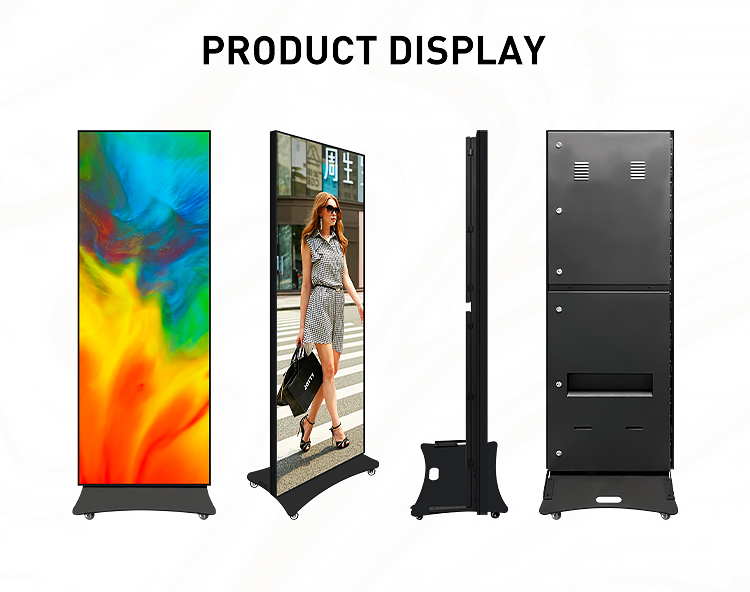
Retail space is valuable. A bulky display that extends deep into the window area reduces usable floor space and can obstruct product visibility. Modern commercial poster LED display units now feature ultra-slim profiles, with thicknesses under 30mm to 50mm.
Benefits of Slim Design
| Benefit | Impact |
| Minimal visual intrusion | Maintains clean storefront aesthetics |
| More retail floor space | Preserves area for product displays and customer movement |
| Easier installation | Fits into existing window frames without structural modifications |
| Improved safety | Reduces risk of accidental impact in high-traffic areas |
Key Specifications to Evaluate
When comparing commercial poster LED display models for storefront use, focus on these core specifications:
| Specification | Recommended Value | Why It Matters |
| Pixel Pitch | P1.2–P2.5 | Provides clear viewing from both close proximity (inside store) and across the street |
| Brightness | 3,500–6,000 nits | Ensures visibility even in direct sunlight |
| Contrast Ratio | 3,000:1 or higher | Delivers deep blacks and vibrant colors |
| Refresh Rate | ≥ 1,920 Hz | Eliminates flicker in video content |
| Thickness | ≤ 50 mm | Fits seamlessly into window frames |
| Ingress Protection | IP54 or higher | Protects against dust and moisture in semi-outdoor environments |
| Operating Temperature | -20°C to 60°C | Ensures reliable performance across seasons |
Real-World Application: Retail Window Installations
Leading retailers worldwide have already adopted specialized commercial poster LED display solutions to enhance their storefront presence. For example, USER LED Screen has deployed high-brightness, ultra-slim displays in retail environments across multiple countries, including:
- Luxury brand storefronts in Europe and North America
- High-end shopping malls in Southeast Asia
- Standalone retail outlets in the Middle East
These installations consistently demonstrate that the right combination of brightness, thermal management, and slim design directly correlates with increased foot traffic and higher in-store conversion rates.
Why Choose USER LED Screen for Your Storefront Display

With over 17 years of experience in LED display manufacturing, USER LED Screen combines technical expertise with a deep understanding of retail environments. Their commercial poster LED display series is engineered specifically for storefront applications, featuring:
- Ultra-slim profiles starting from 30mm thickness
- High-brightness options up to 6,000 nits
- Advanced thermal management for stable 24/7 operation
- Customizable sizes to fit any window dimension
- Global certifications including CE, RoHS, UL, and ISO9001
Every display undergoes rigorous testing in USER’s 10,000-square-meter Shenzhen facility, ensuring reliability from installation through years of daily operation.
Comparison: Commercial Poster LED Display vs. Other Solutions
| Feature | Commercial Poster LED Display | Standard TV / LCD | Outdoor LED Billboard |
| Brightness (nits) | 3,500–6,000 | 300–800 | 6,500+ |
| Thickness | < 50 mm | 50–100 mm | 150–300 mm |
| Heat Management | Optimized for enclosed spaces | Poor | Designed for open air |
| Lifespan | 80,000–100,000 hrs | 30,000–50,000 hrs | 100,000+ hrs |
| Ideal Use | Storefront windows, indoor retail, semi-outdoor | Home, office lobbies | Large outdoor billboards |
| Cost Efficiency | Medium-High | Low | High |
Final Decision Checklist
Before purchasing a commercial poster LED display for your storefront window, evaluate the following:
- Brightness meets or exceeds 3,500 nits
- Thickness fits within your window frame depth
- Thermal management features are clearly specified
- Pixel pitch matches your viewing distance needs
- Manufacturer offers global certifications and warranty
- Installation and after-sales support are available locally
Conclusion
A commercial poster LED display is more than just a digital screen—it’s a powerful retail tool that captures attention, communicates your brand message, and drives foot traffic. However, success depends on selecting the right solution for your specific storefront conditions. Brightness, heat dissipation, and slim design are the three pillars that determine whether your investment delivers lasting value.
For retailers seeking a reliable partner, USER LED Screen offers proven expertise, customizable solutions, and a commitment to quality that aligns with the needs of modern commercial environments. Explore their range of commercial poster LED display products at www.userledscreen.com.
Frequently Asked Questions (FAQs)
Can I use a standard indoor LED screen in a storefront window?
No. Standard indoor LED screens typically have brightness levels below 1,000 nits, which are invisible in direct sunlight. They also lack the thermal management required for enclosed window spaces, leading to overheating and premature failure.
What is the ideal pixel pitch for a storefront window display?
For storefront windows, where viewers may be as close as 1–2 meters inside the store or as far as 10–20 meters across the street, a pixel pitch between P1.2 and P2.5 offers the best balance of resolution and viewing distance flexibility.
How do I manage heat in a window installation?
Choose a commercial poster LED display with:
- Integrated passive cooling (aluminum backplate with heat sink design)
- Smart brightness control that reduces output during non-peak hours
- Adequate clearance around the display for airflow
In some cases, consulting with an installer to add micro-ventilation in the window cavity may be necessary.
Is a high-brightness display more expensive to operate?
While high-brightness displays consume more power at maximum output, many models include energy-saving features such as:
- Automatic brightness adjustment based on ambient light
- High-efficiency LED chips (e.g., common cathode technology)
- Lower average power consumption due to reduced runtime at full brightness
Can the display be seen clearly from inside the store?
Yes. A high-quality commercial poster LED display with wide viewing angles (160° horizontal and vertical) ensures that both passersby outside and customers inside see crisp, clear content without color shift or contrast loss.
How long do these displays last?
A properly maintained commercial LED poster display typically has a lifespan of 80,000 to 100,000 hours, which translates to over 10 years of operation at 24 hours per day.