

In an era where visual communication dictates brand perception and customer engagement, the choice of digital signage technology is a critical business decision. For marketers, facility managers, and business owners, the debate often centers on two prevalent technologies: the modern Commercial Advertising Poster LED Display and the traditional Liquid Crystal Display (LCD) screen. While LCDs have been a staple for years, advancements in LED technology have redefined expectations for performance, durability, and impact. This guide explains why Commercial Advertising Poster LED Displays are the superior long-term investment for serious applications.
Understanding the Technological Divide: More Than Just a Screen
To appreciate the performance gap, one must first understand the foundational engineering principles behind each technology. This isn’t just about different ways to show a picture; it’s about fundamentally different philosophies of light generation and control. 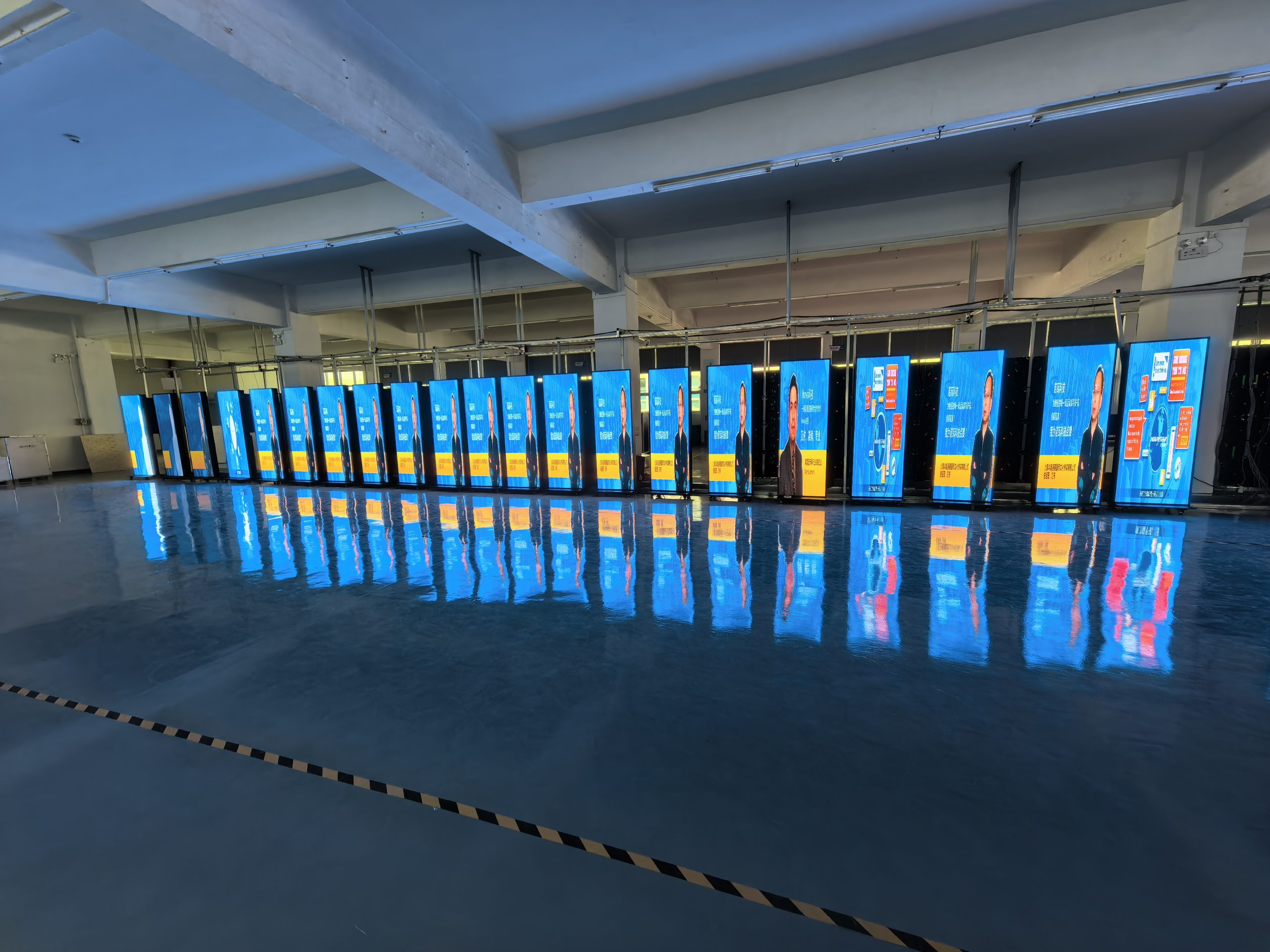
The LCD Approach: Light as a Liquid to be Filtered
An LCD screen is essentially a sophisticated filtering system. Its core component is a layer of liquid crystals—a state of matter between liquid and solid—that can be manipulated by an electric current. Behind this layer lies a constant, uniform white backlight (now typically composed of LEDs, creating some confusion in the market). The liquid crystals act like microscopic shutters, twisting to allow varying amounts of this white backlight to pass through a series of red, green, and blue color filters. The resulting combination creates the image you see. The critical limitation here is that the light source (the backlight) is always on and separate from the pixel layer. Achieving true black is impossible because the backlight cannot be completely blocked at a pixel level, leading to “backlight bleed” that washes out dark scenes and reduces contrast.
The LED Display Approach: Light as a Direct Emission
A true Commercial Advertising Poster LED Display operates on a direct-emission principle. Each pixel on the screen is comprised of tiny, self-contained light-emitting diodes (LEDs). These are solid-state semiconductor devices that emit light directly when an electrical current passes through them. By grouping miniature red, green, and blue LEDs closely together, the display can produce the full color spectrum directly from the source. Each LED pixel emits its own light, enabling perfect blacks, high brightness, and key advantages over LCD.
In-Depth Analysis of Visual Performance: Where First Impressions Are Formed
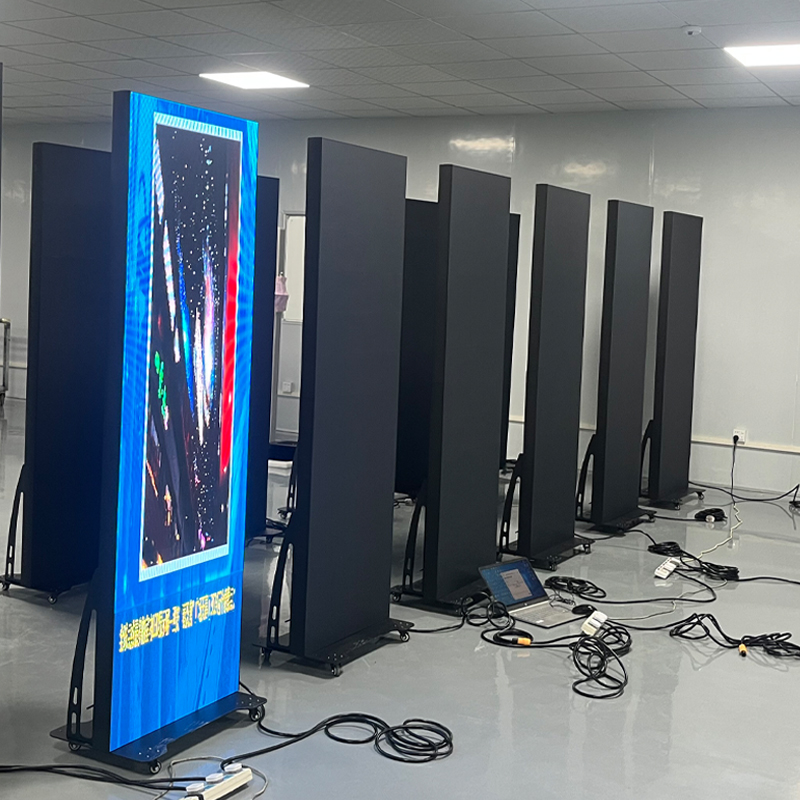
The success of an advertising display hinges on its ability to command attention and convey a crystal-clear message under any condition. Here, the differences between LED and LCD are not subtle; they are transformational.
Brightness and Combatting Ambient Light
Commercial environments are challenging. Sunlight pours through windows, atrium lighting is intense, and storefronts battle the glare of the outdoors. A display’s brightness, measured in nits (candelas per square meter), is its weapon in this fight. A standard commercial LCD panel typically ranges from 300 to 700 nits. In a brightly lit mall or a sun-drenched window, this can appear dim and washed out, forcing viewers to squint and ultimately ignore the content.
A professional-grade Commercial Advertising Poster LED Display, such as those developed for high-impact advertising, starts where LCDs max out. Brightness levels commonly range from 1,500 to over 5,000 nits. This isn’t just incrementally better; it’s a different league of performance. It ensures that colors remain vibrant, text stays razor-sharp, and the advertisement maintains its visual dominance regardless of ambient conditions. For businesses in retail, hospitality, or automotive showrooms, this capability is non-negotiable for ensuring their messaging is always seen at its best.
Contrast Ratio and Image “Pop”
If brightness ensures visibility, contrast ratio defines depth and emotional impact. Contrast ratio is the difference between the darkest black a display can produce and the brightest white. Due to the always-on backlight, even the best LCDs struggle to produce deep blacks, resulting in contrast ratios in the range of 3,000:1 to 5,000:1 under ideal conditions.
A Commercial Advertising Poster LED Display achieves what is effectively an infinite contrast ratio. When a section of the image needs to be black, those specific LEDs are simply turned off, emitting zero light. This allows for truly profound blacks right alongside searing highlights. The visual effect is striking: images gain a three-dimensional quality, colors appear more saturated and natural, and the overall content has a dynamic “pop” that LCD technology cannot physically replicate. This is paramount for advertising luxury goods, showcasing high-resolution product photography, or creating a captivating brand experience that feels premium and immersive.
Viewing Angle Integrity
Commercial spaces are dynamic. Customers move, queues form at angles, and lobbies are viewed from various vantage points. An LCD screen’s performance degrades significantly when viewed off-center. Colors shift (often toward a blue or yellow tint), contrast plummets, and brightness drops. This means a significant portion of your audience sees a compromised version of your advertisement.
Direct-view LED technology excels in viewing angle consistency. High-quality LED displays maintain nearly identical color fidelity, brightness, and contrast at horizontal and vertical viewing angles exceeding 160 degrees. Whether a customer is standing directly in front of a retail LED poster display or viewing it from the side of a corridor, the message is presented with unwavering integrity. This guarantees that your investment in content creation delivers a consistent brand experience to every single viewer.
Seamlessness and Creative Freedom
One of the most tangible differentiators is the physical structure of the screen. LCD panels come in fixed sizes (55”, 65”, 86”, etc.) with thick, black bezels surrounding the active display area. To create a larger video wall, these panels are tiled together, resulting in unsightly grid lines that fragment the image and destroy immersion. These bezels are a constant visual distraction, reminding the viewer they are looking at multiple screens rather than one cohesive canvas.
A Commercial Advertising Poster LED Display is inherently modular and bezel-free. It is constructed from individual panels or modules that lock together seamlessly. This allows for the creation of a perfectly smooth, continuous visual surface of virtually any size or custom aspect ratio—a true canvas limited only by wall space and imagination. For flagship spaces, seamless LED displays create immersive, high-impact visuals unmatched by LCD video walls.
Long-Term Durability and Operational Practicalities
A commercial display is a capital investment, and its total cost of ownership (TCO) over 5-10 years is as important as its purchase price. Here, the operational advantages of LED technology compound over time.
Lifespan and Image Retention (Burn-In)
Robustness and Modular Maintenance
An LCD panel is a single, fragile sheet of glass. Physical impact, pressure, or excessive vibration can lead to a catastrophic and costly failure requiring a full unit replacement. The entire display must be unmounted and shipped out for service, resulting in significant downtime.
LED displays are engineered for resilience. Without a single large glass substrate, they are more resistant to impact. Their greatest maintenance advantage, however, is modularity. A Commercial Advertising Poster LED Display is made of individual modules, power supplies, and receiving cards. If a small section is damaged or fails, a technician can typically perform a front-serviceable repair by replacing just the affected module in a matter of minutes. This drastically reduces repair costs, minimizes operational downtime to almost zero, and extends the functional life of the entire display indefinitely. Manufacturers like USER LED design their products with this serviceability in mind, ensuring businesses can maintain a flawless presentation with minimal effort and cost.
Energy Efficiency and Thermal Management
Operating a display 24/7 incurs ongoing energy costs. Traditional LCDs and older LED designs can be power-hungry, generating significant heat that requires cooling and shortens component life.
Modern LED technology, particularly innovations like Common Cathode drive circuitry, has dramatically improved efficiency. In a Common Cathode design, the power pathway to the red, green, and blue LEDs is optimized separately, reducing wasted energy that is converted to heat. For example, USER LED’s K-series of energy-saving commercial displays are reported to consume 30-40% less power than standard screens. This translates into direct, substantial savings on electricity bills year after year. Lower heat improves component reliability, extends lifespan, reduces ownership costs, and lowers environmental impact.
Making the Strategic Choice: Application-Based Recommendations
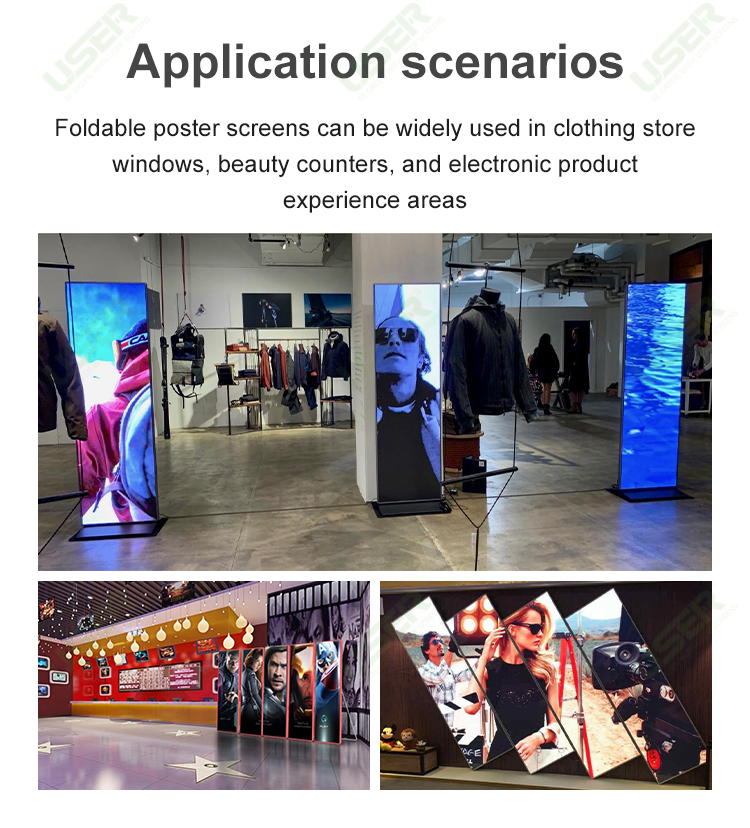
The decision between LED and LCD should be driven by specific use-case scenarios and long-term strategic goals. Unquestionably Choose a Commercial Advertising Poster LED Display for:
- High-Traffic Retail & Hospitality: Storefront windows, in-aisle promotions, and digital menus in bright restaurants where visibility and reliability are paramount.
- Corporate & Architectural Spaces: Seamless video walls in lobbies, boardrooms, and reception areas that demand a flawless, immersive brand image.
- Control Rooms & Mission-Critical Environments: Where 24/7 reliability, modular serviceability, and zero risk of burn-in from static data layouts are essential.
- Creative & Custom Installations: Curved walls, columns, irregular shapes, or any project where bezel-free scalability and unique form factors are required.
- Applications with Static Content: Digital signage displaying logos, fixed information, or schedules where LCD burn-in would be a guaranteed failure mode.
An LCD Screen Might Suffice for:
- Static, Secondary Information Displays: In back-office areas, employee break rooms, or low-light corridors where cost is the absolute primary constraint and impact is not a concern.
- Temporary or Short-Term Campaigns: Where the display will be used for a limited time (less than 2-3 years) and can be positioned in a perfectly controlled lighting environment.
- Very Small-Scale, Standard-Size Needs: When a single, sub-85-inch screen in a standard aspect ratio is perfectly adequate and the viewing environment is dark and controlled.
The Future-Proof Verdict
The trajectory of display technology is clear. LCD suits basic indoor displays, but brightness, contrast, and reliability limit its professional advertising use. Investing in a high-quality Commercial Advertising Poster LED Display is an investment in visual sovereignty. It provides the tools to dominate the visual landscape of any commercial space: Unmatched brightness, infinite contrast, seamless scalability, and durable design ensure long-lasting, impactful displays. In competitive markets, choosing LED is a strategic commitment to impactful communication. Ready to explore commercial-grade LED solutions engineered for performance and longevity? Investigate the advanced technology and robust design that defines modern Commercial Advertising Poster LED Displays and discover how they can transform your space and amplify your message.