
The landscape of commercial visual communication has transformed dramatically. Today’s architects, designers, and brand experience creators demand screens that conform to their vision—not the other way around. This evolution has brought two distinct technologies into focus: the time-tested traditional rigid LED display and the innovative HOB flexible LED display.
For project planners and creative directors, the choice between these form factors impacts aesthetics, budget, installation complexity, and long-term satisfaction. This guide provides an objective comparison to help you determine which technology aligns with your specific project requirements.
Understanding the Core Technologies
What Is a Traditional Rigid LED Display?
Traditional rigid LED displays have been the industry standard for decades. They are constructed using individual cabinets—typically die-cast aluminum or steel—that house LED modules, power supplies, and receiving cards. These cabinets lock together to create a perfectly flat, seamless surface.
Key characteristics:
- Modular cabinet construction (typically 500mm x 500mm to 1000mm x 1000mm)
- Precision alignment mechanisms for pixel-perfect accuracy
- Robust structural integrity protecting internal components
- Proven reliability across decades of deployment
What Is a HOB Flexible LED Display?
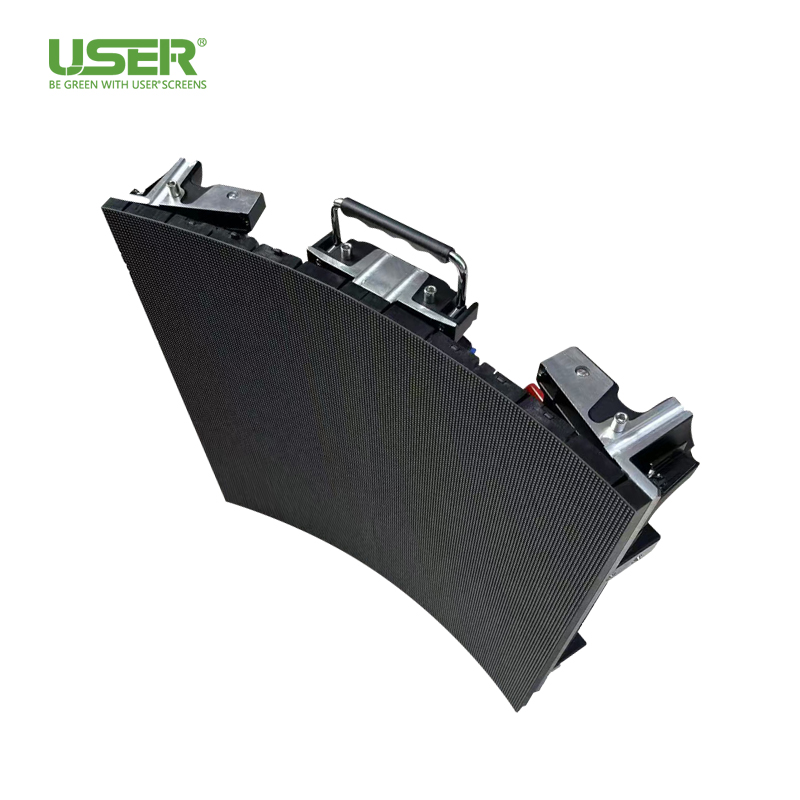
A HOB flexible LED display represents a significant engineering evolution. HOB—High-Quality Output Board technology—enables LED modules that can bend and curve without damaging circuits or solder joints. These displays use specially designed flexible printed circuit boards (PCBs) that allow controlled deformation.
Key characteristics:
- Flexible PCB substrate allowing controlled bending
- Magnetic attachment to curved substructures
- Lightweight construction (3-8 kg per square meter)
- Curvature capability up to 90° or full cylinders
USER LED’s flexible display series exemplifies this technology, offering modules that conform to waves, columns, and organic shapes while maintaining consistent image quality.
Head-to-Head Comparison: 8 Key Decision Factors
Factor 1: Form Factor & Design Flexibility
Rigid displays are designed for flat surfaces. Creating curves requires custom-fabricated cabinets for specific radii, with limitations:
- Each curve radius requires custom tooling
- Lead times extend significantly
- Costs escalate dramatically
- Organic shapes are practically impossible
HOB flexible displays overcome these limitations:
- Form smooth curves along X or Y axis
- Create concave and convex shapes
- Wrap around columns and pillars
- Form waves and organic contours
- Achieve cylindrical or spherical configurations
Winner: Flexible – Creative possibilities fundamentally expand with flexible technology.
Factor 2: Installation Requirements & Complexity
Rigid installation:
- Requires robust structural steel support
- Precision leveling essential
- May require hoists and multiple installers
- Longer installation timelines
Flexible installation:
- Minimal structural demands (3-8 kg/m²)
- Magnetic attachment to curved framework
- Tool-free module installation
- On-site curvature adjustment
- Simplified logistics
Winner: Flexible – Lighter weight and magnetic attachment make installation significantly faster and easier.
Factor 3: Durability & Longevity
Rigid displays:
- Proven 10+ year track record
- Robust cabinet protects against damage
- Superior for extreme environments
- Maintain structural integrity indefinitely
HOB flexible displays:
- Modern engineering ensures bend resistance
- Extensive cycle testing validates reliability
- Indoor durability now approaches rigid
- Repeated flexing requires careful consideration
Winner: Rigid (slight edge) – For extreme environments, rigid maintains advantage. For indoor permanent installations, quality flexible offers comparable durability.
Factor 4: Image Quality & Viewing Experience
Rigid displays:
- Perfect uniformity on flat surfaces
- No geometric distortion
- Consistent viewing angles
- Well-established calibration
HOB flexible displays:
- Consistent pixel pitch even when curved
- No color shift at curved sections
- Brightness consistency maintained
- Curved viewing can enhance experience
Winner: Tie – Both deliver excellent image quality. Flexible no longer represents a visual compromise.
Factor 5: Application Versatility
Rigid optimal for:
- Outdoor billboards
- Control room video walls
- Stadium scoreboards
- Standard digital signage
- Extreme environments
HOB flexible optimal for:
- Retail brand environments
- Museum exhibits
- Corporate lobbies with columns
- Trade show custom shapes
- Architectural integration
- Any space with curves
Winner: Flexible – Serves both standard and creative applications, offering greater versatility.
Factor 6: Cost Considerations
Rigid displays:
- Lower cost for flat applications
- Economies of scale benefit pricing
- Mature supply chain
HOB flexible displays:
- Higher material cost for flat applications
- Often lower total cost for curved projects (vs. custom rigid)
- Installation savings offset premium
- More economical for significant curves
Winner:
- Rigid for flat applications
- Flexible for curved projects (all-in cost basis)
Factor 7: Maintenance & Serviceability
Rigid maintenance:
- Standard front/rear access
- Tools required for module replacement
- Heavier modules to handle
- Longer replacement time
Flexible maintenance:
- Magnetic tool-less removal
- Lightweight modules (under 1 kg)
- Front-serviceable design
- Minimal downtime
Winner: Flexible – Magnetic attachment and lightweight construction simplify maintenance dramatically.
Factor 8: Transportation & Logistics
Rigid logistics:
- Heavy cabinets require palletized shipping
- Higher freight costs
- Specialized handling equipment needed
Flexible logistics:
- Lighter weight reduces freight costs
- More compact shipping options
- Reduced handling requirements
- Lower carbon footprint
Winner: Flexible – Weight advantage translates directly to logistics savings.
Comparison Summary Table
| Factor | Rigid LED Display | HOB Flexible LED Display |
| Form Factor | Flat only (or expensive custom curved) | Curves, cylinders, waves, organic shapes |
| Installation | Heavy, structural steel required | Lightweight, magnetic, tool-less |
| Durability | Excellent (10+ years) | Very good for indoor permanent |
| Image Quality | Excellent on flat | Excellent even when curved |
| Best Applications | Billboards, control rooms, stadiums | Retail, museums, architecture, creative spaces |
| Initial Cost | Lower for flat | Higher for flat; lower for curved vs. custom |
| Maintenance | Tools required, heavier modules | Tool-less magnetic swap |
| Shipping | Heavy, higher freight | Lighter, lower freight |
When to Choose Each Technology
Choose Rigid LED Display When:
- Your installation surface is perfectly flat
- The project is a standard video wall or outdoor billboard
- Budget is the primary constraint and no curves are required
- The environment is extreme (outdoor, high vibration, industrial)
- Long-term proven durability is the absolute priority
Choose HOB Flexible LED Display When:
- Your design requires curves, columns, or organic shapes
- The installation is in a retail, museum, or architectural environment
- You need to wrap columns or integrate with existing curved structures
- Weight is a concern (suspended installations, historic buildings)
- You want future-proof flexibility to reconfigure
- Installation access is challenging
Real-World Application Examples
Retail & Brand Environments
Luxury retailers use flexible displays for curved brand walls and product highlight columns. At Chanel, Dior, and other luxury brands, flexible technology enhances rather than competes with retail design.
Museums & Exhibitions
Museum designers create narrative environments with curved timelines and immersive spaces. The Smithsonian and major science museums worldwide use flexible displays for educational exhibits.
Corporate Lobbies
Curved brand statements in reception areas signal innovation. Building columns wrapped in seamless displays become dynamic information points.
Events & Exhibitions
Trade show exhibits with curved brand backdrops stand out. Product launch stages with flowing display surfaces create memorable moments.
Technical Considerations
Minimum Bending Radius
Most flexible displays achieve curves with radii from 500mm to 2000mm. Choose a display with smaller radius capability than your tightest curve requirement.
Pixel Pitch & Viewing Distance
Tighter curves may require finer pixel pitches for close viewing. Quality flexible displays maintain consistent pitch even at maximum curvature.
Magnetic Mounting Systems
A curved framework must support magnetic modules. Magnet strength must ensure secure attachment while allowing easy removal.
Why Quality Matters: HOB Technology Explained
What HOB Brings to Flexible Displays
Advanced HOB engineering addresses the fundamental challenge: maintaining electrical integrity while bending.
- Stress-relieved trace routing prevents cracking
- Reinforced solder joints withstand mechanical forces
- Multi-layer flexibility maintains signal continuity
- Thermal management remains effective when curved
How USER LED Implements HOB Technology
With 17 years of experience and a 10,000+ sqm automated facility, USER LED delivers reliable flexible solutions:
- Rigorous testing: bend-cycle, temperature cycling, humidity, mechanical shock
- Quality control: automated optical inspection, aging tests
- Defect control: final defect rates below 1.7%
- Premium materials: only grade-A LEDs and components
USER’s flexible LED series features:
- Magnetic modules for tool-free installation
- Lightweight construction (under 8 kg/m²)
- Seamless curved installation
- Indoor and outdoor options
- Multiple pixel pitch choices
- Consistent color across curved surfaces
Cost Analysis: Total Project Economics
Initial Investment
- Flat applications: Rigid costs 15-30% less per square meter
- Curved applications: Custom rigid costs 2-5x more than standard; flexible eliminates this premium
Installation Savings with Flexible
- Reduced structural engineering
- Lower labor costs (faster installation)
- Minimal equipment needs
- Shorter installation timeline
Long-Term Value
- Indoor durability now comparable to rigid (10+ years)
- Energy efficiency equivalent to rigid
- Maintenance advantages reduce long-term costs
- Future reconfiguration possible
Decision Framework: 5 Questions to Ask
- What shape does my installation require?
- Flat only → Consider rigid
- Curved/organic → Flexible is the solution
- What are my structural and weight constraints?
- Weight-sensitive → Flexible advantages
- What is my budget for curved elements?
- Compare custom rigid vs. flexible all-in cost
- How important is future flexibility?
- Potential reconfiguration → Flexible provides optionality
- Who is installing and maintaining?
- Value simplicity → Tool-free flexible reduces risk
Conclusion
The evolution of HOB flexible LED display technology has fundamentally changed commercial display possibilities. No longer must designers compromise vision to fit rigid limitations.
For purely flat applications with lowest initial cost priority, traditional rigid displays remain a valid choice. However, for any project involving curves, creative forms, architectural integration, or future reconfiguration potential, HOB flexible LED displays represent the superior solution. They combine visual performance and reliability with the form-factor freedom creative visions require.
The key lies in partnering with a manufacturer who understands both technologies and delivers proven quality. With proper engineering and installation, a flexible display will deliver years of reliable, stunning performance—transforming spaces in ways flat screens never could.
- Lead times extend by weeks or months for custom fabrication.
- Flexible displays eliminate these premiums entirely.
Installation Cost Savings with Flexible
The lighter weight and simpler installation of flexible displays generate multiple savings:
- Reduced structural engineering: Less robust support structures are required.
- Lower labor costs: Faster installation means fewer labor hours.
- Minimal equipment needs: No hoists, lifts, or heavy handling equipment required.
- Shorter installation timeline: Reduced site disruption and faster project completion.
Long-Term Value Considerations
Durability parity: For indoor permanent installations, quality flexible displays now offer lifespans comparable to rigid displays—10+ years with proper maintenance.
Energy efficiency: Modern flexible displays incorporate efficient LED drivers and power supplies, with energy consumption comparable to equivalent rigid displays.
Maintenance advantages: The tool-less, front-serviceable design of flexible displays reduces long-term maintenance costs. When modules eventually require replacement, the process takes minutes rather than hours.
Future-proofing: If your space reconfigures in the future, flexible displays can potentially be relocated or reshaped—an option rigid displays do not offer.
Decision Framework: 5 Questions to Ask Before Choosing
Before finalizing your display technology decision, work through these five questions with your project team:
What shape does my installation require?
- If flat only: Consider rigid displays for cost efficiency.
- If curved or organic: Flexible displays are the practical solution.
- If primarily flat with minor curves: Evaluate whether the curved elements justify the premium for flexible technology.
What is my budget for curved elements?
- If budget is tight and all surfaces are flat: Rigid displays minimize cost.
- If curves are required and custom rigid fabrication is quoted: Compare the all-in cost of custom rigid versus flexible. You may find flexible is actually more economical.
How important is future flexibility?
- If the installation is permanent and will never change: Either technology works.
- If there is any possibility of reconfiguration, relocation, or reuse: The lighter weight and adaptability of flexible displays provide valuable optionality.
Who is installing and maintaining the display?
- If your installation team has extensive rigid display experience: Either technology can be learned.
- If you value simplicity and speed: The tool-free, magnetic installation of flexible displays reduces training requirements and installation risk.
Conclusion: Making the Right Choice for Your Project
The evolution of HOB flexible LED display technology has fundamentally changed the conversation around commercial displays. No longer must designers compromise their vision to fit the limitations of rigid screens. No longer must project planners accept the cost and complexity of custom-fabricated curved cabinets to achieve organic forms.
For purely flat applications where lowest initial cost is the priority, traditional rigid displays remain a valid, proven choice. They have served the industry well for decades and will continue to do so.
However, for any project that involves curves, creative forms, architectural integration, or the potential for future reconfiguration, HOB flexible LED displays represent not just an alternative but the superior solution. They combine the visual performance and reliability that professionals demand with the form-factor freedom that creative visions require.
The key to success lies in partnering with a manufacturer who understands both technologies and can guide you to the right solution for your specific application. Look for proven experience, transparent specifications, robust quality control, and a track record of successful installations similar to your project.
With quality engineering and proper installation, a HOB flexible LED display will deliver years of reliable, visually stunning performance—transforming your space and captivating your audience in ways that flat screens never could.