
Introduction
In the rapidly evolving world of digital advertising and visual communication, flip-chip COB (Chip-On-Board) poster LED displays have emerged as a transformative technology that is redefining how businesses communicate with their audiences. Whether you’re operating a high-end retail store, a hospitality establishment, an event venue, or managing advertising campaigns across multiple locations, understanding the power and potential of flip-chip COB poster LED displays is essential for staying competitive in today’s dynamic market.
The shift from traditional paper-based advertising to digital solutions has accelerated dramatically over the past decade. However, not all LED displays are created equal. Flip-chip COB technology represents a significant advancement in LED packaging and performance, offering unparalleled advantages in brightness, thermal efficiency, energy consumption, and long-term reliability compared to conventional SMD (Surface Mounted Device) alternatives.
This comprehensive guide explores everything you need to know about flip-chip COB poster LED displays, including their technology, advantages, applications, specifications, and why they represent the optimal investment for modern businesses seeking high-impact visual solutions.
What is Flip-Chip COB Technology?
Understanding COB LED Technology
COB stands for “Chip-On-Board,” a packaging technique that directly mounts multiple LED chips onto a single circuit board, rather than individually packaging each chip before assembly. This integration creates a dense array of light-emitting elements that work in concert to produce uniform, high-quality illumination.
In traditional LED display manufacturing, individual LED chips are mounted on separate circuit boards or packages, then connected through wire bonding. This approach, while functional, introduces multiple points of potential failure and creates thermal bottlenecks that limit overall performance.
The Flip-Chip Innovation
Flip-chip COB technology elevates the basic COB concept by inverting the chip orientation. Instead of connecting the chip’s top surface to the circuit board through wire bonds, flip-chip technology uses solder bumps to create direct contact between the chip’s backside and the PCB (Printed Circuit Board). This seemingly simple change delivers revolutionary performance improvements.
The key difference is that in flip-chip COB, the active light-emitting layer of the LED chip is positioned directly against the heat-dissipating substrate. This eliminates the wire bonding process entirely, removing a significant source of thermal resistance and electrical inefficiency.
Technical Superiority of Flip-Chip Design
The flip-chip architecture offers several fundamental technical advantages:
Direct Thermal Pathways: The active layer is positioned closer to the substrate, creating a shorter heat flow path from the LED chip to the thermal management system. This dramatically reduces thermal resistance, allowing heat to dissipate more efficiently and maintaining cooler operating temperatures.
Elimination of Wire Bonds: Traditional COB designs rely on fine wire bonds to connect chip terminals to the substrate. These wires, while microscopic, create electrical resistance, reduce packing density, and represent points of mechanical failure. Flip-chip technology eliminates these entirely through solder bump connections.
Higher Packing Density: Without wire bonds consuming valuable circuit board space, LED chips can be positioned closer together, enabling significantly higher pixel density and brightness. This allows for superior resolution and luminous intensity within the same physical footprint.
Improved Electrical Performance: Solder bump connections provide lower electrical resistance and reduced inductance compared to wire bonding. This improves circuit response time, transmission efficiency, and overall power delivery reliability.
Key Advantages of Flip-Chip COB Poster LED Displays
Superior Energy Efficiency and Lower Operating Costs
One of the most compelling advantages of flip-chip COB technology is its exceptional energy efficiency. Studies demonstrate that flip-chip COB LED displays consume up to 45% less power than conventional face-up COB designs when producing equivalent brightness levels.
This efficiency gain translates directly to lower operational costs. For businesses operating LED poster displays continuously or for extended hours daily, the cumulative energy savings over a display’s 100,000+ hour lifespan can be substantial. Reduced power consumption also means lower cooling requirements, further minimizing operational expenses.
The thermal efficiency advantage ensures that screens run cooler—up to 10°C lower than conventional COB displays under equivalent brightness conditions—extending component lifespan and reducing the likelihood of thermal-related failures.
Exceptional Brightness and Visual Impact
Flip-chip COB poster LED displays deliver unmatched brightness performance, making them ideal for applications requiring visibility in challenging lighting conditions. These displays can achieve brightness levels of 800 to 6000 nits (depending on specific model and configuration), ensuring content visibility even in direct sunlight or well-lit retail environments.
The high packing density enabled by flip-chip architecture means more LED chips can fit in the same space, concentrating light output and creating images with superior luminance and visual impact. This brightness advantage is particularly valuable in retail environments where capturing customer attention is critical.
Exceptional Resolution and Image Clarity
Modern flip-chip COB poster LED displays offer multiple pixel pitch options, from ultra-fine P0.78mm to standard P2.5mm and beyond, enabling sharp, detailed visuals at close viewing distances. This makes them ideal for applications where viewers stand within a few meters of the display, such as retail store windows, exhibition booths, and hospitality venues.
The high pixel density—measured in dots per square meter (dots/m²)—ensures that text remains legible, images appear crisp, and video playback is smooth without visible pixelation. A P0.78mm pixel pitch display, for example, delivers 1,638,400 dots/m², compared to 160,000 dots/m² for traditional P2.5mm displays—a tenfold difference in visual information density.
Enhanced Reliability and Extended Lifespan
The elimination of wire bonds in flip-chip architecture significantly improves mechanical reliability. Wire bonds are potential failure points, particularly in vibration-prone environments or applications with frequent thermal cycling. By removing these components, flip-chip COB displays achieve superior durability.
With proper maintenance, flip-chip COB poster LED displays deliver lifespan exceeding 100,000 hours of operation—equivalent to 11+ years of continuous 24-hour operation, or 27+ years of 8-hour daily use. This extended lifespan dramatically improves total cost of ownership compared to traditional signage solutions requiring frequent replacement.
Superior Thermal Management and Heat Dissipation
Effective thermal management is critical for LED display performance and longevity. Flip-chip COB technology’s superior thermal pathways enable significantly better heat dissipation compared to traditional designs.
The active LED layer sits closer to the heat-dissipating substrate, reducing the distance heat must travel to reach the cooling system. This efficient heat transfer prevents hot spots, maintains consistent color output across the display surface, and prevents the thermal degradation that accelerates LED aging.
Lower operating temperatures also improve color stability and consistency. LED brightness and color shift with temperature, so maintaining cooler operation ensures more stable, predictable color reproduction over extended periods.
Seamless Integration and Modular Flexibility
Flip-chip COB poster LED displays are designed for seamless modularity. Multiple units can be combined to create larger video walls or synchronized multi-screen installations without visible gaps or seams. Standard panel dimensions (typically 600×337.5mm or 600x675mm) enable flexible configurations for any space requirement.
This modular approach provides significant advantages for businesses with evolving needs. A single poster display can serve temporary promotional purposes, while multiple units can be configured for permanent installations or large-scale campaigns.
Front-Access Maintenance Design
Flip-chip COB poster LED displays typically feature front-access maintenance design, eliminating the need for complex rear-access installation or removal of surrounding infrastructure for service. This reduces downtime, lowers maintenance costs, and simplifies operations for non-technical staff.
When issues do arise, technicians can service displays quickly without disrupting surrounding spaces or requiring specialized installation expertise.
Flip-Chip COB vs. Traditional SMD LED Displays
Understanding the differences between flip-chip COB and traditional SMD (Surface Mounted Device) LED technology is essential for making informed display investment decisions.
Brightness and Light Output
Flip-chip COB technology delivers superior brightness compared to SMD alternatives. COB displays can produce up to three times more light than traditional SMD LEDs, making them ideal for high-visibility applications.
This brightness advantage stems from the higher density of LED chips that flip-chip architecture enables. While SMD displays typically feature individual LEDs spaced across a PCB, COB technology allows chips to be packed much more densely, concentrating light output in a smaller area.
Thermal Performance
SMD displays, with multiple small heat sources distributed across the board, generate lower localized thermal concentrations but experience less efficient overall heat dissipation. This distributed heat approach can actually result in higher overall operating temperatures.
Flip-chip COB displays, conversely, concentrate the light source and heat generation, but their superior thermal pathways enable more efficient dissipation. The result is cooler overall operating temperatures and better thermal stability.
Energy Efficiency
Flip-chip COB technology achieves superior energy efficiency—producing more light while consuming less power. For businesses operating displays 12+ hours daily, this efficiency translates to significant long-term cost savings.
SMD displays typically achieve lower power efficiency, requiring more power to produce equivalent brightness. Over the lifespan of an LED display, this power differential compounds into substantial additional operational costs.
Visual Quality and Uniformity
Flip-chip COB displays produce more uniform illumination without the “spotty” appearance sometimes visible in SMD displays where individual LED packages create discrete light sources. This uniformity is particularly important for video playback and image reproduction.
Cost Comparison
While flip-chip COB displays typically command a higher initial purchase price than SMD alternatives, the superior energy efficiency, longer lifespan, and lower maintenance costs result in significantly lower total cost of ownership over 5-7 years of operation.
Specifications and Technical Details
Resolution and Pixel Pitch Options
Flip-chip COB poster LED displays are available in multiple pixel pitch configurations, enabling selection based on specific viewing distance and visual requirements:
- P0.78mm: 1,638,400 dots/m² – Ultra-fine resolution for close-viewing applications
- P0.9mm: 1,137,777 dots/m² – Premium clarity for retail windows and exhibitions
- P1.25mm: 640,000 dots/m² – High-definition for standard retail and hospitality
- P1.56mm: 409,600 dots/m² – Good clarity for mid-distance viewing
Brightness and Display Quality
Brightness Levels: 600-6000 nits, adjustable based on ambient lighting conditions
Contrast Ratio: 10,000:1, delivering deep blacks and vibrant colors
Color Depth: 16-bit grayscale, enabling smooth color transitions and gradients
Refresh Rate: 3840Hz, eliminating flicker and ensuring smooth video playback
Viewing Angles: 160° horizontal x 160° vertical, ensuring consistent image quality from various positions
Power Consumption and Thermal Efficiency
Average Power Consumption: 165-600W/m² (varies by pixel pitch and brightness setting)
Maximum Power Consumption: Up to 800W/m² (full brightness, full white)
Operating Temperature Range: -10°C to +40°C
Heat Dissipation: Superior cooling through direct chip-to-substrate thermal pathways
Lifespan and Reliability
Operational Lifespan: 100,000+ hours at 50% brightness (industry-leading durability)
Mean Time Between Failures (MTBF): Extremely low failure rates due to elimination of wire bond failure points
Pixel Failure Rate: <0.0003 per 1,000 hours, virtually eliminating visible dead pixels during normal operation
Installation and Maintenance
Mounting Options: Wall-mounted, hanging, standing, or custom configurations
Maintenance Access: Front service for convenient maintenance and repairs
Panel Dimensions: Standard 600×337.5mm or 600x675mm modules
Installation Method: Lightweight aluminum frames, magnetic connections, or hard-wired assemblies
Waterproofing: IP54 (washable by clean water) standard; IP65 weatherproof upgrades available for outdoor applications
Applications of Flip-Chip COB Poster LED Displays
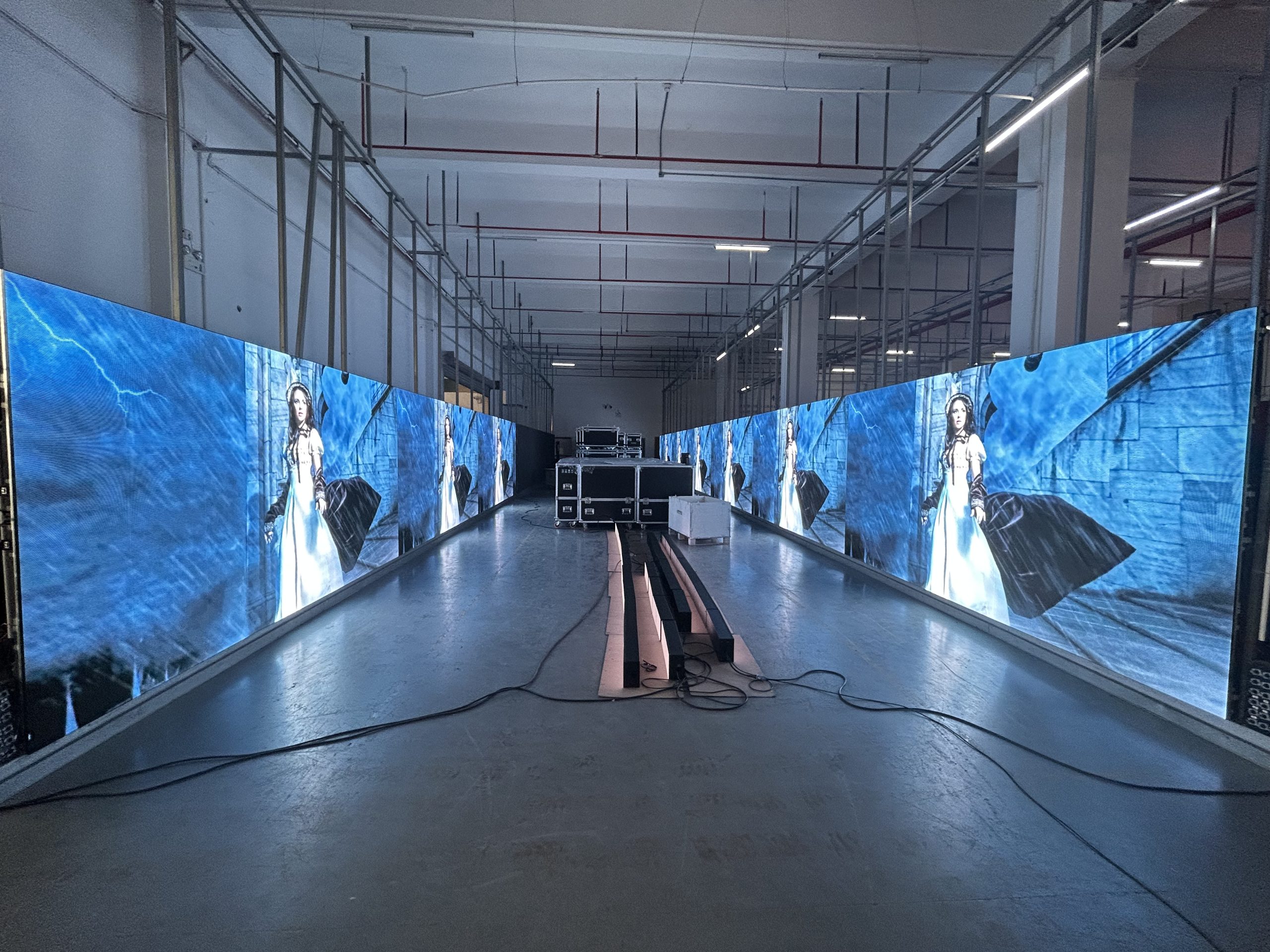
Retail and Shopping Environments
In retail settings, flip-chip COB poster LED displays excel at capturing customer attention and driving purchasing decisions. Their high brightness and vivid color reproduction immediately draw shoppers’ eyes, while dynamic content capabilities enable frequent promotional updates without printing costs.
Retail applications include:
- Window displays showcasing new merchandise
- In-store promotional signage
- Product launch announcements
- Real-time pricing and inventory displays
- Seasonal and holiday promotions
- Customer information and wayfinding
Leading retail chains have reported 3-5x increases in customer engagement when deploying LED poster displays compared to traditional static signage.
Hospitality and Dining
Hotels, restaurants, and entertainment venues leverage flip-chip COB poster LED displays to enhance guest experiences and communicate real-time information. Applications include:
- Hotel lobby displays showcasing special events
- Restaurant menu boards with real-time updates
- Bar and lounge specials displays
- Event scheduling and announcements
- Digital concierge and wayfinding
- Brand experience enhancement
The ability to update content instantly enables hospitality businesses to respond to occupancy, staff availability, and market opportunities in real-time.
Corporate and Event Environments
Trade shows, conferences, corporate offices, and event spaces benefit from LED poster displays’ portable, modular design and stunning visual impact. Applications include:
- Trade show and exhibition booths
- Conference room displays
- Corporate campus signage
- Event stage backdrops
- Meeting room information displays
- Corporate communication walls
The ability to quickly reconfigure displays enables event professionals to adapt presentations and messaging without technical complications.
Advertising and Public Spaces
Flip-chip COB poster LED displays revolutionize advertising in public spaces, from transit hubs to urban centers. Their weather-resistant designs and brilliant visibility in outdoor conditions make them ideal for:
- Airport and transit hub advertising
- Urban streetscape installations
- Shopping mall common area displays
- Public information displays
- Emergency alert systems
- Real-time traffic and transit information
Entertainment and Museums
Cultural institutions leverage LED poster displays for storytelling, interactive experiences, and visitor engagement:
- Museum exhibit descriptions and historical context
- Gallery information and artist biographies
- Interactive displays and wayfinding
- Event promotion and scheduling
- Artistic installations and creative displays
The high resolution and color accuracy of flip-chip COB technology ensures faithful reproduction of artistic content and cultural materials.
Why Choose Flip-Chip COB Over Alternative Solutions?
Advantages Over Traditional Paper Posters
Traditional printed posters require constant reprinting, new frame installations, and labor-intensive updates. Flip-chip COB poster LED displays eliminate these recurring costs while providing:
- Dynamic content capabilities enabling video, animation, and real-time information
- Instant updates without printing delays or installation labor
- Superior visual impact capturing attention in crowded environments
- Long-term cost savings despite higher initial investment
- Environmental benefits eliminating paper and ink waste
- Measurable performance data tracking customer engagement and effectiveness
Advantages Over Traditional LCD Displays
While LCD displays serve certain purposes, flip-chip COB LED poster displays offer distinct advantages:
- Higher brightness enabling visibility in direct sunlight and bright environments
- Better color vibrancy delivering more saturated, engaging colors
- Superior refresh rates ensuring flicker-free, smooth video playback
- Longer operational lifespan and lower maintenance requirements
- More flexible installation options enabling creative configurations
- Better thermal performance in continuous-operation applications
Advantages Over Standard SMD LED Displays
As previously discussed, flip-chip COB technology outperforms standard SMD LED displays in brightness, efficiency, thermal management, and long-term reliability, while typically providing comparable or better pricing on a total-cost-of-ownership basis.
Implementation and Best Practices
Site Selection and Planning
Successful LED poster display deployment begins with careful site selection. Consider:
- Viewing distance to select appropriate pixel pitch
- Ambient lighting conditions determining required brightness
- Audience demographics and engagement goals
- Content requirements and update frequency
- Environmental factors (temperature, humidity, weather exposure)
- Power availability and electrical infrastructure
- Network connectivity for remote content management
Content Strategy Development
Effective LED poster displays require thoughtful content strategy:
- Brand consistency maintaining visual and messaging alignment
- Content rotation maximizing engagement through variety
- Audience relevance tailoring messages to viewer demographics
- Seasonal updates capitalizing on timely opportunities
- Performance metrics tracking engagement and conversion
- A/B testing optimizing content effectiveness
Installation and Setup
Professional installation ensures optimal display performance:
- Structural integrity assessing mounting surfaces and weight capacity
- Electrical requirements ensuring adequate power and circuit protection
- Network connectivity establishing secure data connections for remote management
- Calibration and testing verifying color accuracy and brightness uniformity
- Staff training ensuring operators can manage content and troubleshoot issues
Ongoing Maintenance
- Regular cleaning maintaining optical clarity and aesthetic appearance
- Thermal monitoring ensuring adequate cooling and heat dissipation
- Software updates maintaining security and performance
- Periodic inspection identifying potential issues before they become critical
- Professional servicing handling repairs and component replacements
The Market Evolution and Future Outlook
The LED poster display market is experiencing explosive growth, valued at USD 1.2 billion in 2024 and projected to reach USD 3.5 billion by 2034, representing an 11.5% compound annual growth rate. This growth reflects increasing business recognition of LED displays’ effectiveness, declining per-unit costs enabling broader adoption, and advancing technology delivering superior performance.
Several trends are shaping the LED poster display market’s evolution:
Integration of Smart Technologies: IoT and AI integration enable real-time content optimization, audience analytics, and personalized messaging. Displays increasingly connect to business intelligence systems, automatically updating content based on foot traffic, weather, inventory, or customer behavior.
Sustainability Focus: Businesses increasingly prioritize sustainable solutions. LED displays’ long operational lifespan, energy efficiency, and elimination of paper waste position them as environmentally responsible choices compared to traditional signage.
Miniaturization: Advancing flip-chip COB technology enables increasingly finer pixel pitches, bringing ultra-high-definition visuals to applications previously served by standard displays.
Wireless and Cloud Integration: Modern LED poster displays integrate seamlessly with cloud-based content management systems, enabling centralized control across multiple locations without complex IT infrastructure.
Choosing Your LED Poster Display Partner

When investing in flip-chip COB poster LED displays, selecting the right supplier is essential. Leading manufacturers, such as USER, combine decades of LED display manufacturing expertise with commitment to quality, innovation, and customer support.
Quality suppliers provide:
- Professional-grade manufacturing with rigorous quality control
- Comprehensive product selection offering multiple configurations and specifications
- Responsive technical support assisting with selection, installation, and ongoing operation
- Reliable warranty and after-sales service protecting your investment
- Customization capabilities adapting displays to specific requirements
- Industry certifications ensuring compliance with international standards
Conclusion
Flip-chip COB poster LED displays represent a watershed moment in visual communication technology. By combining cutting-edge engineering with practical business benefits, this technology delivers superior brightness, efficiency, reliability, and flexibility compared to traditional and alternative solutions.
Whether you operate a retail business seeking to capture customer attention, manage hospitality properties enhancing guest experiences, promote events and exhibitions, or coordinate advertising campaigns, flip-chip COB poster LED displays provide the visual impact, operational efficiency, and long-term value that modern businesses require.
As markets continue evolving and competition intensifies across industries, the businesses that invest in superior visual communication solutions gain distinct competitive advantages. Flip-chip COB poster LED displays enable these advantages while delivering measurable return on investment through enhanced customer engagement, operational efficiency, and brand impact.
The future of advertising and visual communication is dynamic, sustainable, and visually stunning. Flip-chip COB poster LED displays deliver all three.