
The LED display industry is evolving rapidly. While flat screens still dominate, a new wave of architectural and creative projects demands something different: flexibility. From cylindrical columns wrapped in seamless video to curved walls that follow a building’s organic shape, flexible LED displays are redefining what’s possible in visual communication.
For distributors, this represents a significant business opportunity. As brands, architects, and integrators seek more immersive and customized solutions, the demand for reliable flexible LED products is surging. Becoming a flexible LED display distributor means offering clients a product category that solves real design limitations—while positioning your business at the forefront of innovation.
In this article, we explore the flexible LED market, what to look for in a manufacturing partner, and how a distributor can build a profitable portfolio with the right technology.
What Is a Flexible LED Display?
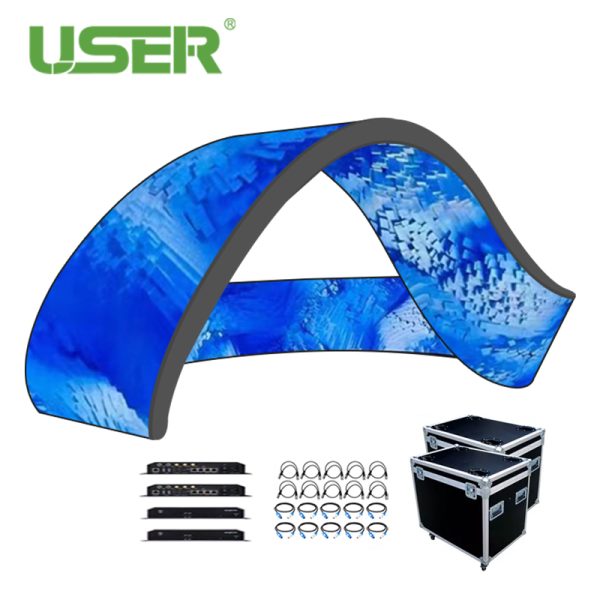
A flexible LED display uses a soft, bendable PCB (printed circuit board) that allows the screen to curve, wrap, or twist without damaging the components. Unlike traditional rigid LED panels, flexible modules can be shaped to fit columns, concave or convex walls, and even custom-built structures.
Key characteristics include:
- Bend radius: Typically 45° to 90° or more, depending on the design
- Magnetic or adhesive installation: Many flexible screens use magnetic attachments for quick mounting on metal surfaces
- Lightweight construction: Often 3–8 kg per square meter, reducing structural load
- Seamless visuals: When multiple flexible modules are combined, they form a continuous image without visible gaps
These displays are widely used in:
- Retail flagship stores (curved walls, fitting rooms)
- Shopping mall atriums (cylindrical columns)
- Museums and galleries (custom-shaped exhibits)
- Corporate lobbies (brand feature walls)
- Event stages (curved backdrops, immersive sets)
Why the Demand for Flexible LED Displays Is Growing
Distributors are increasingly turning to flexible LED products because traditional screens cannot meet the design requirements of modern commercial spaces. Here are the market forces driving growth:
- Architectural Integration Architects and interior designers want displays that blend seamlessly into their structures. A cylindrical LED column or a curved wall display is no longer a “screen” but a design element.
- Rise of Experiential Retail Luxury brands like Chanel, Louis Vuitton, and others are using custom-shaped LED installations to create memorable in-store experiences. These projects often require flexible modules to match the store’s unique geometry.
- Digital Art & Installations Museums, airports, and public spaces are commissioning large-scale digital art pieces that demand non‑standard shapes. Flexible displays allow artists to realize their vision without being limited by rigid panels.
- Space Optimization In tight spaces, flexible displays can wrap around pillars or follow curved walls, utilizing areas where flat screens could not fit.
Key Considerations When Choosing a Flexible LED Display Manufacturer
For a flexible LED display distributor, the manufacturer’s capabilities directly impact your reputation and profitability. Here are the essential factors to evaluate:
| Factor | What to Look For |
| Product Range | Variety of pixel pitches (P1.86, P2.5, P3, etc.), bendable types (curve only, full cylinder, magnetic), and indoor/outdoor options |
| Quality Assurance | ISO9001, CE, RoHS, UL certifications; in‑house testing (drop test, high/low temperature, salt spray) |
| Customization Ability | Capability to tailor size, shape, curvature degree, and even LED film for specific projects |
| Manufacturing Scale | Automated SMT lines, adequate production capacity to handle large orders without delay |
| Global Shipping & Support | Experience exporting to 80+ countries, with responsive technical support and warranty policies |
A manufacturer like USER LED Screen (https://www.userledscreen.com/) exemplifies these traits, with over 17 years of experience and a 10,000㎡ facility equipped with advanced automation.
Flexible vs. Rigid LED Displays: A Distributor’s Perspective
To help you position flexible LED products, here is a comparison from a business standpoint:
| Aspect | Flexible LED Display | Rigid LED Display |
| Target Applications | Curved walls, columns, custom shapes | Standard flat walls, billboards |
| Installation Complexity | Simple (often magnetic) | Requires steel structure, more labor |
| Customization | High – can be curved to almost any radius | Low – limited to flat, sometimes angled |
| Project Margins | Typically higher due to specialized demand | Competitive, price‑sensitive |
| Stocking Strategy | Keep modular panels; assemble per project | Stock common sizes; less customization |
| Lead Time | Usually 2–4 weeks for custom projects | Faster for standard sizes |
For distributors, flexible LED displays often yield better margins because they solve unique design problems and are less commoditized than standard billboard screens.
How a Reliable Manufacturer Supports Distributors
When you partner with a manufacturer that understands the distribution business, you gain more than just products. Below are the support pillars that can make or break your success as a flexible LED display distributor.
Consistent Quality & Certification
Clients in high-end retail, museums, and government sectors demand certified products. A manufacturer with ISO9001, ISO14001, ISO45001, CE, RoHS, and UL certifications gives you instant credibility. USER’s final defect rate below 1.7% reflects the kind of reliability distributors need to build trust.
Custom Engineering Support
Not every flexible LED project is the same. Whether it’s a 360° cylindrical screen for a Bosnian shopping mall (as seen in USER’s case files) or a magnetic‑mount curved display for a Japanese retail space, having engineering assistance ensures your customer’s vision becomes a reality. Manufacturers should provide CAD drawings, installation guidance, and even on‑site commissioning.
Marketing & Sales Enablement
Distributors need high‑quality marketing materials: product catalogs, case study galleries, demo videos, and spec sheets. A manufacturer that provides these assets reduces your internal workload. USER’s case study PDF shows dozens of real installations across America, Europe, Asia, and the Middle East—powerful evidence for your own sales conversations.
After‑Sales & Warranty
Long‑term success relies on responsive after‑sales service. Look for a partner that offers:
- 24‑hour technical support
- Spare parts availability
- Clear warranty terms (e.g., 3‑year warranty for indoor screens)
Flexible Commercial Terms
Distributors often need tiered pricing, stock rotation programs, or even financing for large rental projects. A manufacturer willing to tailor commercial terms demonstrates a true partnership mindset.
Case Study: Real‑World Flexible LED Distributor Success
Consider a distributor in Southeast Asia who partnered with USER to supply a high‑end mall renovation. The project required cylindrical screens wrapped around three main pillars and a curved wall at the central atrium. The distributor’s client (a luxury brand) had previously been told by other suppliers that the curved columns were impossible.
USER provided:
- P1.86 flexible modules with magnetic backing for quick installation
- Custom curvature software to ensure image continuity
- Remote engineering support during installation
- Unified single‑point power supply to simplify electrical work
The distributor secured the project, earned a premium margin, and now references this installation to win similar contracts. This is the power of aligning with a manufacturer that treats distributors as true partners.
Frequently Asked Questions (FAQs) for Distributors
Q1: What pixel pitches are typically available for flexible LED displays?
Common indoor pitches range from P1.86, P2.5, P3, to P4. For very close viewing distances (e.g., high‑end retail), smaller pitches like P1.86 are preferred. Outdoor flexible screens use larger pitches with protective coating.
Q2: Can flexible LED displays be used outdoors?
Yes, but outdoor flexible models require IP65 or higher protection, as well as UV‑resistant materials. Most flexible displays are designed for indoor use; always confirm outdoor specifications with the manufacturer.
Q3: How do distributors handle installation training?
Good manufacturers provide detailed manuals, video tutorials, and sometimes on‑site training for the distributor’s technical team. Some also offer “train the trainer” programs to build local expertise.
Q4: What is the typical lead time for a flexible LED display order?
For standard modular flexible panels, lead times are usually 15–25 days. Custom projects (e.g., specific curvature or cylinder diameter) may take 25–35 days, depending on complexity and quantity.
Q5: What is the minimum order quantity (MOQ) for distributors?
This varies by manufacturer. Some set MOQs per product line, while others work with distributors to create starter kits. USER offers flexible terms to match the distributor’s market entry strategy.
Q6: How can I verify the quality of flexible LED modules before ordering?
Reputable manufacturers offer sample modules for testing. Request a sample to check brightness uniformity, bend flexibility, magnetic strength, and ease of assembly before committing to large orders.
Q7: Does USER offer white‑label or OEM services for distributors?
Yes. Many distributors benefit from custom branding on the product or packaging, especially when serving regional markets. Contact the sales team at USER to discuss OEM options.
Becoming a Flexible LED Display Distributor: Next Steps
The market for creative LED displays is expanding as more architects, retail designers, and event producers seek unique visual solutions. By adding flexible LED products to your portfolio, you position yourself as a high‑value partner capable of handling projects that competitors with rigid‑only offerings cannot.
To succeed, choose a manufacturer that:
- Has proven experience in flexible LED manufacturing
- Provides strong quality certifications and after‑sales support
- Offers marketing resources to help you sell
- Views distributors as long‑term partners, not just order takers
USER LED Screen (https://www.userledscreen.com/) combines 17 years of LED manufacturing expertise with a global distribution network spanning 80+ countries. Their flexible LED product line includes curved panels, cylindrical screens, magnetic‑mount modules, and custom solutions—all backed by ISO‑certified production and a dedicated support team.
If you are ready to grow your business with one of the fastest‑growing segments in the LED display industry, explore the distributor partnership opportunities at USER. Let your next project be the one that bends boundaries—literally.
For distributor inquiries, product specifications, and partnership details, visit USER LED Screen official website: https://www.userledscreen.com/