
The demand for curved LED displays has exploded across architecture, retail, events, and broadcast environments. Curved screens create immersive experiences, guide viewer attention, and transform ordinary spaces into extraordinary visual environments. However, for project planners and specifiers, a fundamental question arises: What is the best way to create a curved LED display?
Two primary technologies dominate the market today: curve lock LED display systems—rigid cabinets with precision angle-locking mechanisms—and flexible LED modules that physically bend to form curves. Each approach has passionate advocates, and each offers distinct advantages depending on the application.
This comprehensive guide compares these technologies across every relevant factor: precision, durability, image quality, installation complexity, cost, and creative possibilities. By understanding their differences, you can make an informed decision that ensures your curved display delivers exactly what your project requires.
Understanding the Two Technologies
Before comparing performance, it is essential to understand how each technology achieves curvature and what engineering principles underlie their design.
What Is a Curve Lock LED Display?
A curve lock LED display system consists of rigid LED cabinets engineered with specialized locking mechanisms that allow cabinets to connect at precise angles. Rather than the cabinets themselves bending, the connections between them create the curved surface.
How it works:
Each cabinet features precision-machined locking components on its edges. These components—typically made of hardened steel or aluminum—allow installers to join cabinets at specific, factory-determined angles such as 2.5°, 5°, or 10°. When multiple cabinets are connected at these angles, the overall display forms a smooth concave or convex curve.
Key characteristics:
- Rigid cabinet construction: Each cabinet remains perfectly flat and structurally robust
- Precision angle control: Angles are engineered into the locking mechanism, not dependent on installation technique
- Seamless face design: Cabinet faces are designed to maintain consistent pixel spacing across angled connections
- Proven durability: Based on traditional rigid display technology with decades of field performance
What Are Flexible LED Modules?
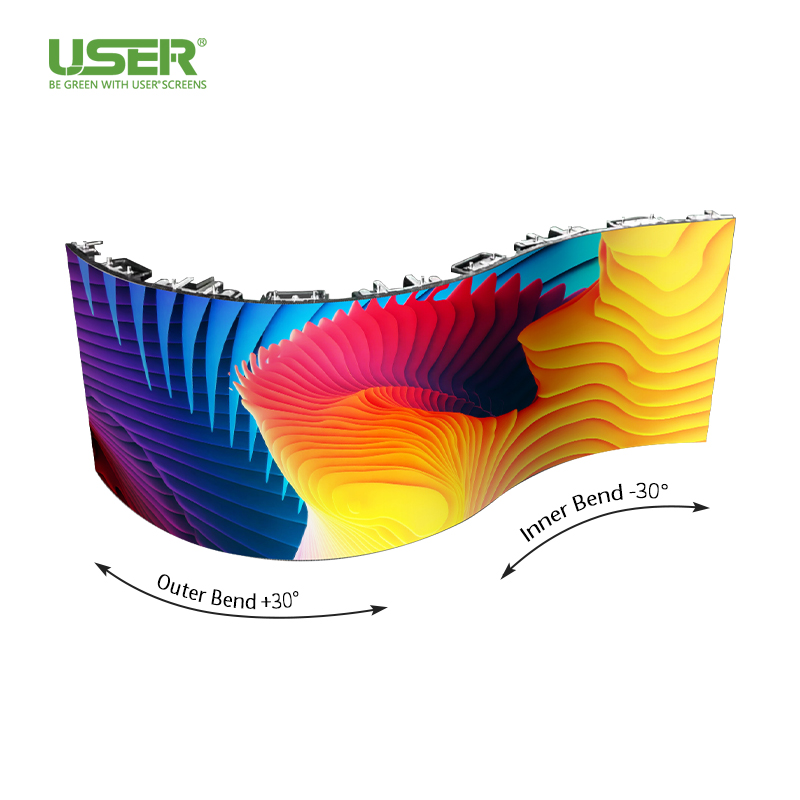
Flexible LED modules take a fundamentally different approach. Instead of rigid cabinets, these displays use modules built on flexible printed circuit boards (PCBs) that can physically bend. Advanced HOB (High-Quality Output Board) technology enables these modules to curve without damaging circuits or solder joints.
How it works:
Modules attach magnetically to a pre-fabricated curved substructure. The substructure determines the curve radius, and the modules conform to its shape. Magnetic attachment allows each module to be positioned individually while maintaining overall curvature.
Key characteristics:
- Flexible PCB substrate: The circuit board itself bends, enabling the display surface to curve
- Magnetic attachment: Modules attach to substructures without tools
- Lightweight construction: Without heavy aluminum cabinets, weight is dramatically reduced
- Tight radius capability: Can achieve curves as tight as 500mm radius
Introducing USER LED’s Approach
With 17 years of display manufacturing experience and over 10,000 customers served across 80 countries, USER LED offers both curve lock and flexible solutions. This dual capability means our engineering team provides objective guidance based on project requirements rather than pushing a single technology. Our curve lock systems deliver precision for large-scale installations, while our HOB flexible modules enable creative freedom for complex shapes.
Head-to-Head Comparison: 7 Critical Factors
To determine which technology delivers better results for your project, we must examine how they perform across the factors that matter most.
Factor 1: Curve Precision & Angle Accuracy
The precision of a curved display determines whether it appears smooth and intentional or faceted and amateurish.
Curve lock LED displays excel in this category because angles are engineered at the factory level. When cabinets lock together at a specified 5° angle, every connection across the entire wall is identical. This repeatability ensures that the curve is mathematically perfect, with no variations that might create visible “flat spots” or inconsistent curvature. For applications requiring exact specifications—such as broadcast studios where cameras will track across the wall—this precision is invaluable.
Flexible modules rely on the accuracy of the substructure to determine curvature. If the substructure is perfectly fabricated, the modules will conform to create a smooth curve. However, installation variables can introduce minor inconsistencies. The quality of the result depends heavily on the skill of the fabricator and installer.
Winner: Curve Lock LED Display – Factory-engineered angles ensure perfect consistency across the entire installation, eliminating variables introduced during on-site fabrication.
Factor 2: Minimum Radius Capability
Some projects require gentle, sweeping curves that span entire walls. Others demand tight radii that wrap around columns or create dramatic architectural features.
Curve lock systems have inherent limitations based on cabinet size and maximum lock angle. A typical cabinet measuring 500mm wide with 5° lock angles can achieve a minimum radius of approximately 5-7 meters. Larger cabinets or shallower angles result in even larger minimum radii. For gentle curves in lobbies or auditoriums, this is perfectly adequate.
Flexible modules can achieve dramatically tighter radii. Quality HOB flexible displays can curve to radii as small as 500mm—tight enough to wrap around standard building columns or create dramatic wave forms. Some specialized products can achieve even tighter curves, though this often involves trade-offs in other specifications.
Winner: Flexible Modules – When projects demand tight radii, flexible technology is the only practical solution.
Factor 3: Image Quality & Pixel Consistency
The fundamental purpose of any display is to deliver excellent image quality. Both technologies can achieve this, but the path to quality differs.
Curve lock displays maintain perfect pixel pitch across the entire surface because each cabinet is flat and the connections between cabinets are precisely engineered. There is no stretching or compression of pixels at any point. The image appears exactly as designed, with consistent brightness and color across the curved surface.
Flexible modules depend on HOB engineering quality. Premium flexible displays maintain consistent pixel pitch even when curved because the PCB design accounts for the bending. However, lower-quality flexible modules may show minor distortion at the bend points—pixels may compress slightly on the inner curve or stretch on the outer curve. This is why selecting a quality manufacturer with proven HOB technology is essential.
Winner: Tie – Both technologies deliver excellent image quality when properly engineered. Curve lock offers inherent consistency; quality flexible matches it with advanced design.
Factor 4: Durability & Long-Term Reliability
Commercial displays represent significant capital investments. Longevity directly impacts return on investment.
Curve lock displays inherit the proven durability of rigid LED technology. The aluminum cabinets protect internal components from physical damage, dust, and environmental factors. There is no ongoing stress on PCBs or solder joints because nothing bends. Lifespans of 10+ years are well-documented across thousands of installations worldwide.
Flexible modules have improved dramatically with HOB engineering. Modern flexible displays use stress-relieved trace routing and reinforced solder joints that withstand permanent bending without cracking. For indoor permanent installations where the display is curved once and remains static, durability now approaches that of rigid displays. However, applications requiring repeated flexing (frequent reconfiguration) demand careful engineering and may have different longevity characteristics.
Winner: Curve Lock LED Display – For permanent installations where maximum proven longevity is the priority, curve lock systems maintain an edge. The rigid construction simply has fewer potential failure modes.
Factor 5: Installation Complexity
The ease or difficulty of installation affects project timelines, labor costs, and the pool of qualified installers.
Curve lock installation requires precision at every step. The structural framework must accommodate the planned curve with exacting accuracy. Cabinets must be installed in sequence, with angle verification at each connection. While the locking mechanisms simplify the actual cabinet connections, the overall process demands experienced installers and careful attention to detail.
Flexible module installation is generally faster and more forgiving. Modules attach magnetically to the curved substructure, requiring no tools. If a module is slightly misaligned, it can be repositioned in seconds. The lighter weight (3-8 kg per square meter versus 15-25 kg for rigid cabinets) reduces handling requirements and allows installation in locations where heavy equipment cannot access.
Winner: Flexible Modules – Magnetic, tool-less attachment and lighter weight make flexible displays significantly faster and easier to install.
Factor 6: Cost Considerations
Budget inevitably influences technology selection, but the comparison is not as simple as “flexible costs less” or “curve lock costs more.”
Curve lock systems involve precision-machined components and robust cabinet construction, which commands a premium in the market. For large-radius curves where flexible modules could also be used flat, curve lock typically has a higher initial cost. However, for applications requiring the precision and durability of rigid construction, this premium is justified.
Flexible modules have lower material costs for the modules themselves. More importantly, for projects requiring tight curves, flexible technology often results in lower total project cost because it eliminates the need for expensive custom-fabricated curved rigid cabinets. When comparing the all-in cost including installation, flexible can be significantly more economical for complex curved applications.
Winner: Context-Dependent – For large-radius curves, curve lock is competitive. For tight or complex curves, flexible offers better economics.
Factor 7: Application Versatility
The range of projects each technology can address determines its usefulness across different requirements.
Curve lock systems excel at consistent-radius curves in both concave and convex orientations. They are ideal for large-scale architectural features, broadcast studio backgrounds, and corporate lobby statements where the curve is gentle and the installation is permanent. However, they cannot achieve tight radii or organic, freeform shapes.
Flexible modules can serve virtually any curved application. They can be installed flat (simply mounted on a flat surface), curved gently, or formed into tight radii. They can wrap columns, create waves, form spheres, and follow organic architectural forms. This versatility makes them suitable for a much broader range of creative applications.
Winner: Flexible Modules – The ability to address everything from flat to tight curves to organic shapes makes flexible technology fundamentally more versatile.
Comparison Summary Table
| Factor | Curve Lock LED Display | Flexible LED Modules |
| Curve Precision | Factory-engineered, repeatable angles | Depends on substructure accuracy |
| Minimum Radius | 5-10 meters typical | As tight as 500mm |
| Image Quality | Perfect pixel pitch consistency | Excellent with quality HOB design |
| Durability | 10+ years proven track record | Very good for permanent indoor |
| Installation | Precise structural alignment required | Magnetic, tool-less, adjustable |
| Cost | Higher for precision engineering | Lower for tight/complex curves |
| Best Applications | Large-radius curves, broadcast, lobbies | Tight curves, columns, organic shapes |
| Weight | 15-25 kg per square meter | 3-8 kg per square meter |
| Creative Freedom | Limited to consistent radii | Unlimited organic possibilities |
When to Choose Curve Lock LED Display
Curve lock technology represents the pinnacle of precision engineering for curved displays. It is the right choice when certain project characteristics align.
Ideal Applications for Curve Lock
Large-Radius Concave or Convex Walls
When a corporate lobby calls for a sweeping concave wall with an 8-meter radius, curve lock delivers the precision and consistency that the space demands. The gentle curve will be mathematically perfect, with no visible flat spots or inconsistencies.
Broadcast Studios
Television studios require absolute precision. Cameras move across curved backgrounds, and any inconsistency would be immediately visible to viewers. Curve lock’s factory-engineered angles ensure that every camera angle reveals a perfectly smooth curve.
High-End Retail Environments
Luxury brands invest in displays that reflect their attention to detail. A curve lock installation signals quality and precision that aligns with brand values.
Permanent Installations with Long Lifecycles
When the display is expected to remain in place for a decade or more, the proven durability of rigid construction provides peace of mind.
Advantages Summary
- Precision-engineered consistency across the entire wall
- Proven long-term reliability with 10+ year track record
- No stress on components over time
- Predictable installation outcomes
- Ideal for applications requiring exact angle specifications
When to Choose Flexible LED Modules
Flexible modules unlock creative possibilities that rigid systems cannot match. They are the right choice when design freedom is paramount.
Ideal Applications for Flexible Modules
Column Wraps
Building columns are ubiquitous in commercial spaces. Wrapping a column with a seamless LED display transforms a structural necessity into a dynamic brand asset. Flexible modules can achieve the tight radii required for column diameters as small as one meter.
Organic, Freeform Shapes
When the design calls for waves, ripples, or flowing organic forms, flexible technology is the only practical solution. The modules conform to virtually any curved substructure.
Exhibit designers increasingly use curved displays to create immersive narrative environments. Flexible modules allow displays to follow the natural flow of exhibition spaces.
Portable or Temporary Installations
For trade shows, events, and touring exhibits, the lightweight nature of flexible modules simplifies transport and setup. The same inventory can create different shapes for different events.
Weight-Sensitive Locations
Historic buildings, suspended installations, and locations with load limitations benefit from the dramatically lower weight of flexible displays.
Advantages Summary
- Tight radius capability for column wraps and dramatic curves
- Creative freedom for organic, freeform designs
- Lightweight construction reduces structural requirements
- Faster, tool-less installation
- Lower total cost for complex curved applications
- Future reconfiguration possible
Technical Deep Dive: How Curve Lock Works
Understanding the engineering behind curve lock technology helps explain its precision advantages.
Precision Locking Mechanisms
Curve lock systems use machined metal components—typically hardened steel or aluminum—with exact angle increments. When two cabinets are brought together, these components engage positively, locking the cabinets at the specified angle. The mechanism ensures consistent tension across all connections, preventing shifting over time.
Cabinet Design Considerations
Curve lock cabinets feature reinforced corners to handle the angled loads created by curved installations. The face design maintains consistent pixel spacing across the angled connection, with bezels or seams designed to be visually invisible at normal viewing distances.
Installation Best Practices
Successful curve lock installation requires:
- Structural framework engineered to accommodate the planned curve
- Verification of plumb and level at each stage of installation
- Angle confirmation before proceeding with full assembly
- Sequential installation following manufacturer guidelines
Technical Deep Dive: How Flexible Modules Work
Flexible module technology relies on advanced materials and engineering to achieve reliable bending.
HOB PCB Technology
Quality flexible displays use HOB (High-Quality Output Board) engineering featuring:
- Stress-relieved trace routing that accommodates bending without cracking
- Reinforced solder joints that withstand mechanical forces
- Multi-layer construction maintaining signal integrity during flexing
- Thermal management effective even in curved configurations
Magnetic Attachment Systems
Modules attach to curved substructures via magnets. Critical considerations include:
- Substructure fabrication accuracy determines final curvature
- Magnet strength must ensure secure attachment while allowing removal
- Tool-less serviceability enables rapid module replacement
Installation Best Practices
- Substructure must be accurately fabricated to the desired curve
- Curvature should be applied gradually, not forced
- Module overlap and alignment verified during installation
- Quality verification after full assembly
Real-World Application Examples
Curve Lock in Action
Corporate Lobby Concave Wall: A Fortune 500 company installed a 12-meter wide concave curve lock display in their headquarters lobby. The 8-meter radius creates an immersive welcome experience while maintaining perfect image quality across the entire surface. Five years after installation, the display continues performing flawlessly.
Broadcast Studio Curved Background: A major television network uses curve lock technology for their news studio background. The precise 45° curve at each end of the wall creates depth on camera while ensuring talent appears correctly framed from all camera angles.
Flexible Modules in Action
Airport Column Wrap: An international airport transformed twenty structural columns into dynamic advertising platforms using flexible LED modules. Each 1.5-meter diameter column displays rotating content visible from all directions, creating a new revenue stream from previously unused space.
Museum Organic Timeline: A history museum created a wave-form timeline exhibit using flexible modules. The display flows through the exhibition space, with content changing as visitors move along the curve. The organic form reinforces the narrative of historical progression.
Cost Analysis: Total Project Economics
Curve Lock Cost Factors
- Precision-machined cabinets command higher unit pricing
- Structural framework must be engineered for the curve
- Installation requires specialized labor
- Long-term durability provides value over decades
Flexible Module Cost Factors
- Quality HOB modules carry premium over standard flexible
- Substructure fabrication cost varies with complexity
- Faster installation reduces labor costs
- Lighter weight reduces logistics and structural costs
- Greater creative freedom may reduce overall design compromises
Break-Even Analysis
For large-radius curves (over 5 meters), curve lock systems are cost-competitive with flexible when all factors are considered. For tight or complex curves, flexible technology typically delivers lower total project cost because it eliminates expensive custom fabrication.
Some projects benefit from hybrid approaches—using curve lock for large curved sections and flexible for tight radius elements—though this requires careful engineering to ensure visual consistency.
Decision Framework: 7 Questions to Ask
Before selecting between curve lock and flexible technology, work through these questions with your project team:
- What is the minimum radius required for my project?
- Under 5 meters → Flexible required
- Over 5 meters → Both possible
- Is the curve a consistent radius or an organic shape?
- Consistent radius → Both possible
- Organic/freeform → Flexible required
- What are my weight constraints?
- Weight-sensitive location → Flexible advantages
- Unlimited capacity → Both possible
- Is this a permanent or temporary installation?
- Permanent (10+ years) → Curve lock advantages for large radius
- Temporary/portable → Flexible advantages
- What is my budget for curved elements?
- Compare custom rigid vs. flexible all-in cost
- Who is installing the display?
- Experienced rigid installers → Either works
- Value simplicity → Flexible reduces installation risk
- How important is future reconfiguration?
- Potential to reuse/reshape → Flexible provides optionality
Quality Considerations for Both Technologies
Regardless of which technology you choose, quality varies dramatically between manufacturers.
What to Look for in Curve Lock Systems
- Precision-machined components with verified tolerances
- Documented angle accuracy from factory testing
- Seamless face design that hides connections
- Manufacturer experience with similar curved installations
- Reference projects with long-term performance data
What to Look for in Flexible Modules
- HOB engineering certification and test data
- Bend cycle test results (minimum 10,000 cycles for quality verification)
- Magnetic attachment reliability
- Pixel pitch consistency verification when curved
- Thermal performance data in curved configurations
How USER LED Ensures Quality
With 17 years of display manufacturing experience and over 10,000 customers served across 80 countries, USER LED has developed rigorous quality protocols applicable to both curve lock and flexible technologies:
- Automated production lines with SMT machines ensure consistent module quality
- Comprehensive testing including temperature cycling, humidity testing, and mechanical shock
- Quality control systems maintaining final defect rates below 1.7%
- Engineering support for complex curved installations
- Both curve lock and flexible solutions available, ensuring objective project guidance
- Reference projects across multiple industries and applications
Conclusion: Making the Right Choice
The question of whether a curve lock LED display or flexible modules deliver better curved results has no universal answer—because “better” depends entirely on your project’s specific requirements.
Curve lock technology excels at large-radius applications where precision, consistency, and long-term durability are paramount. It delivers mathematically perfect curves with proven 10+ year reliability, making it the preferred choice for broadcast studios, corporate lobbies, and permanent architectural installations.
Flexible modules unlock creative possibilities that rigid systems cannot match. They achieve tight radii, wrap columns, form organic shapes, and adapt to virtually any curved requirement. Their lighter weight and faster installation make them ideal for complex curved applications and projects where creative freedom is the priority.
The best approach is to work with a manufacturer who offers both technologies and can provide objective guidance based on your specific needs. With quality engineering and proper installation, either technology will deliver years of reliable, visually stunning performance.
For your next curved LED project, define your requirements clearly, evaluate both options against those requirements, and partner with a manufacturer who brings experience, quality, and honest guidance to the table.
Next Steps for Project Planners
- Define your curve requirements precisely – Document minimum radius, curve type (consistent vs. organic), viewing distances, and environmental conditions.
- Request both solutions for comparison – Ask manufacturers to propose both curve lock and flexible options with complete specifications.
- Verify quality credentials – Review testing protocols, quality control processes, and warranty terms for whichever technology you consider.
- See technology demonstrations – Request live demonstrations or factory visits to evaluate image quality and build standards firsthand.
- Discuss total project costs – Work with engineering support to understand all cost factors, not just module pricing.